
Hidden in a solitary valley a few kilometres from the village of Montalcino, surrounded by sinuous hills, centuries-old olive trees, and fields of golden wheat swaying in the summer breeze, the Abbey of Sant’Antimo is one of those extremely rare places where silence has a physical consistency. It is not a simple acoustic void, but a tangible, vibrant presence, charged with millenary meaning.
I am Alessandro, and my journey through Italy is a continuous search for the deepest roots of our artistic and spiritual culture. I have visited immense cathedrals and lavish basilicas all over the world, yet few architectures have managed to move and disarm me as much as this solitary masterpiece set in the beating heart of the Val d’Orcia.
Built almost entirely in a splendid travertine veined with onyx, which shines with a golden and almost otherworldly light under the rays of the sun, the abbey is considered one of the absolute pinnacles of Romanesque architecture in Italy. It seems to have been born spontaneously from the Tuscan earth, not built by human hands, but emerged to offer a safe refuge for the soul of wanderers.
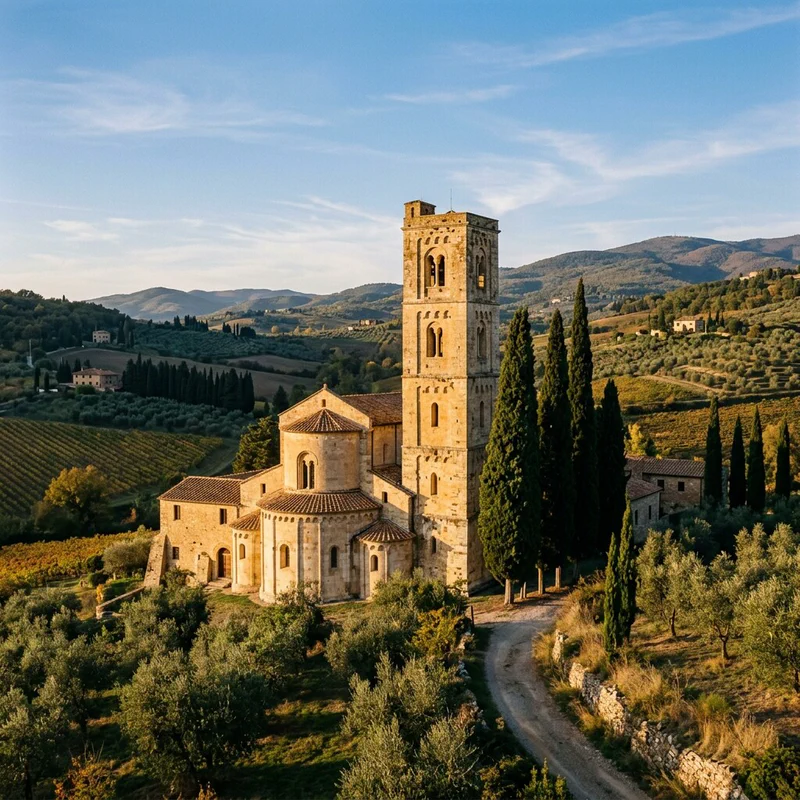
Entering under its high naves, stripped of Baroque ornamentation and restored to their essential and severe purity, one perceives a spiritual force that transcends eras, religions, and conventions. In this guide, I want to lead you beyond the threshold of conventional tourism, to discover the hidden codes and ancestral energies of Sant’Antimo.
The Legendary Origins: Charlemagne and the Miracle#
The history of Sant’Antimo is lost in the mists of legend, an inextricable interweaving of founding myth and historical truth. Popular tradition, jealously handed down for centuries by the valley’s inhabitants, attributes the founding of the monastery to none other than the Emperor Charlemagne.
The story goes that in the year 781, the emperor and his vast army, returning from Rome along the ancient Via Francigena, were struck by a mysterious and devastating plague just as they were crossing this valley. The situation was desperate, the troops decimated. Charlemagne then withdrew in prayer, asking for divine help.
An angel appeared to him in a dream, indicating a local herb (which we today identify as carline thistle) to be given to the soldiers to chew. The decoction saved the army and the emperor, in gratitude for the miracle received, decided to found a magnificent abbey at that very spot.
Whether or not one believes in the Carolingian intervention, historical documents confirm that the abbey experienced its period of greatest splendour between the 11th and 12th centuries, becoming a centre of vast political and economic power, controlling dozens of parish churches, castles, and mills throughout southern Tuscany.
Decline, Abandonment, and Rebirth: A Story of Resilience#
After the golden centuries, the arc of Sant’Antimo’s history followed that of many great Benedictine abbeys: a long, slow decline. The struggles between local powers, the growing competition of cities like Siena, and the demographic crisis caused by the Black Death of 1348 progressively emptied the monastery of its monks and its wealth.
In 1462, Pope Pius II — the Sienese Enea Silvio Piccolomini — definitively suppressed the monastic community, incorporating its vast assets into the diocese of Montalcino. For almost five centuries, the abbey lay abandoned, exposed to the elements and looting. The surrounding countryside became a silent blanket of brambles and forgetting.
The rebirth came in 1979, when a small community of Franciscan monks decided to resettle in the abbey, beginning a long and patient work of conservative restoration. In 1992, the Premonstratensian monks (also known as Norbertines) took over and reside there to this day, ensuring liturgical continuity and guarding the spirit of the abbey. Their arrival gave voice back to those stones, literally: it is thanks to them that today we can still hear Gregorian chant resonating in the naves.
Architecture and Symbolism: Reading the Stone#
Approaching Sant’Antimo means learning to read a book carved in rock. The influence of the great models from beyond the Alps, in particular the Abbey of Cluny in France, is evident in the layout of the plan: three wide naves, and the feature rarest in Italy — the ambulatory with radial chapels.
The Ambulatory: An Architectural Secret#
The ambulatory is the semicircular corridor running around the main apse, allowing pilgrims to approach the relics of the Patron Saint without interrupting the liturgical functions in the choir. Its presence at Sant’Antimo is an extraordinary anomaly for Italian Romanesque architecture: this scheme, typical of the great French pilgrimage cathedrals (such as Saint-Sernin in Toulouse), testifies to the extraordinary cultural openness of the patrons and master builders who worked here in the 11th century.
Walking through the ambulatory means touching the internationalism of the Romanesque Middle Ages, that continuous flow of ideas, craftsmen, and devotion that crossed Europe along the pilgrimage routes.
The Master of Cabestany and the Mysterious Capitals#
I invite you not to limit yourself to looking at the architectural whole, but to approach the pillars and scrutinize the column capitals. In an era when the population was largely illiterate, the capitals served as real “stone Bibles,” visual encyclopaedias intended to instruct and admonish the faithful.
Among all of them, the work of the so-called Master of Cabestany stands out — an itinerant sculptor with an unmistakable and thoroughly modern style. Look for the capital depicting “Daniel in the Lion’s Den”. You will notice the almond-shaped, protruding and hypnotic eyes, the angular faces, and a dramatic tension that anticipates by centuries the expressiveness of the Renaissance.
Many other capitals are decorated with enigmatic figures, fantastic animals, two-tailed mermaids, and monsters drawn from a medieval bestiary rich in esoteric meaning. Every figure is a question to which scholars still debate the answers.
The Chant That Heals the Soul: The Gregorian Legacy#
Yet the architectural structure, however sublime, is only the soundboard for something far more immaterial and powerful. The central and transformative experience at Sant’Antimo is listening to Gregorian chant.
Gregorian chant is not simple music; it is a technique of vocal meditation, a breathed prayer founded on the sacred text. Pure monody, devoid of instrumental accompaniment or rigid rhythmic cages, this chant follows the natural breath of the human being.
When the monks gather in the choir for the liturgy of the hours, their voices rise towards the stone vaults, exploiting the perfect acoustics designed by the medieval master builders. The sound does not merely fill the space; it shapes it. Closing your eyes during Vespers, you have the distinct sensation that chronological time stops, replaced by a dimension of pure present.
The liturgical functions are held several times a day: Terce (around 9:00 AM), Sext (12:30 PM), Vespers (6:30 PM in summer, 5:00 PM in winter), and Compline (late evening). Vespers is universally considered the most powerful experience: the light of sunset filtering through the lateral windows, combined with the monks’ voices, creates a moment of rare sensory perfection.
Around the Abbey: The Val d’Orcia and Brunello#
Sant’Antimo is not an island, but the heart of a territory of exceptional beauty and gastronomic richness.
- Montalcino: Just 10 km away, this medieval village is the capital of Brunello, one of the most celebrated and long-lived red wines in the world. Its wine bars and cellars are open year-round. A tasting with a view over the hills is the perfect complement to the visit.
- The Monastic Pharmacy: Before leaving, stop at the ancient Farmacia. You will find locally produced honey, herbal teas, essential oils, and healing elixirs prepared following ancient herbal recipes — a tangible and fragrant memento of your journey.
- The Path to Montalcino: A panoramic trail of about 7 km connects Sant’Antimo directly to Montalcino through Brunello vineyards. It is a medium-difficulty walk with moderate elevation changes, allowing you to cross landscapes of extraordinary beauty in silence.
(If you have a car and are planning to explore this region thoroughly, my colleague Marco has published a detailed guide on the best scenic road trips through Tuscany, which includes unmissable routes departing from these very valleys).
Alessandro’s Practical Tips for an Immersive Experience#
- Check the chant times: Do not visit the abbey at a random time. Check online or at the entrance for the function schedules to ensure you can attend Gregorian chant. It is the beating heart of the experience.
- Choose afternoon light: The most photogenic moment is late afternoon. The golden travertine captures the light, taking on shades from burnt orange to honey, with an extraordinary contrast with the green of the olive trees.
- Respectful clothing: The abbey is an active place of worship. Shoulders and knees must be covered for everyone. Maintain silence inside.
- Best period: Spring (April–May) and autumn (September–October) offer magnificent countryside colours and ideal temperatures.
- Arrive on foot from Castelnuovo dell’Abate: The village is less than 2 km away and has a small car park. The last stretch on foot, among rows of cypress trees, prepares the spirit for the encounter with the abbey in a unique way.
After experiencing the profound quiet of Sant’Antimo, you might feel the desire for a completely different energy — nocturnal, wild, cosmic. (In this regard, I invite you to read the account by my colleague Sofia on romantic stargazing on the slopes of Mount Etna, a perfect contrast between the spirituality of Romanesque stone and the majesty of the Sicilian starry sky).
Sant’Antimo is not simply a monument to tick off a list. It is an authentic inner pilgrimage, a warning carved in stone reminding us that true beauty does not need noise to make itself heard.
Safe travels through time, Alessandro