
Carnival, as we know it today, is often a shower of plastic confetti and commercial music that stuns the senses without nourishing them. But if you decide to travel up the Lombard valleys on a cold late-January morning, you will discover that there is another, more ancient and wilder soul that survives time. Between the mountains of Brescia and the woods overlooking Lake Como, Carnival is not a parade; it is a ritual of possession, an ancestral cry that breaks the silence of winter. I speak to you as a friend, as someone who has walked on those frozen stones, feeling the heartbeat of an Italy that refuses to forget who it is. Here, the mask does not hide; it reveals.
While the world prepares for the grand parades of Viareggio or Venice, villages like Bagolino and Schignano stage an open-air theater that smells of resin, damp wool, and saffron. I love observing the contrast between the almost sacred elegance of the dancers in the Valle Sabbia and the primordial roughness of the masks in the Valle d’Intelvi. I feel the sound of the violins intertwining with the heavy clanging of the cowbells, creating a symphony that makes your chest vibrate. It is an experience that gets inside you and forces you to look at the mountain with new eyes. Beauty here is made of violent contrasts.
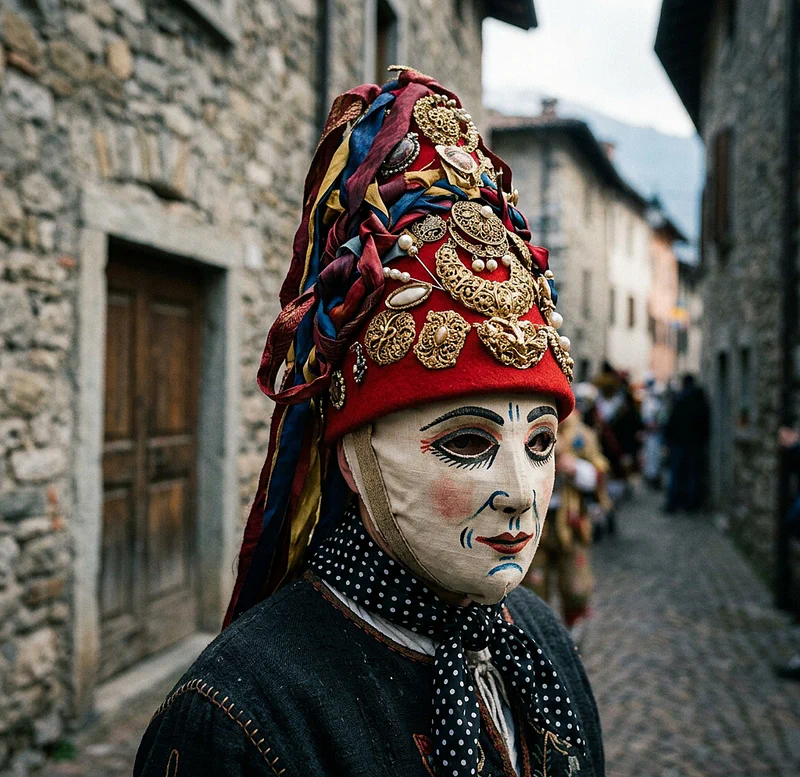
Bagolino: Gold Dancing to the Sound of Violins#
Bagolino, nestled among the mountains of the Valle Sabbia, guards one of the most precious treasures of our popular culture: the Balarì. Seeing these men move with light and precise steps along the village streets is like witnessing a Renaissance ballet that has miraculously survived. They wear scarlet felt hats completely covered in gold jewelry—brooches, necklaces, earrings—that the families of the town proudly lend to adorn the dancers. The face is covered by an ivory canvas mask, making them ethereal presences, almost silent deities bringing luck to the community. Feel the ancient rhythm of the violins.
Alongside the elegance of the Balarì move the Màscär, the irreverent and peasant soul of the carnival. Disguised as old people with heavy wooden clogs, the Màscär speak exclusively in falsetto to avoid being recognized, playing tricks on passersby and teasing the crowd. (Note: if you appreciate this kind of dualism between the sacred and the profane in our lands, you will find a similar harmony among the waters of Lake Iseo and Monte Isola, a suspended refuge I will write about later). Tradition here is eaten and breathed.
Schignano: The Beautiful, the Ugly, and the Carlisep#
Moving towards Lake Como, in Schignano, the Carnival takes on darker and more theatrical tones, staging the eternal struggle between those who left in search of fortune and those who stayed to fight with the land. The Belli parade in sumptuous clothes and lace, flaunting the wealth of those who returned from emigration with a full wallet. But it is the Brutti who steal the show, covered in animal skins, rags, and heavy cowbells that fill the alleys with a chaotic and primordial sound. I am irritated by the haste of those who only look at the mask without understanding the pain and anger it carries with it. Respect their silence.
Alongside the Brutti often thrashes the figure of the Ciocia, the caricature of the petulant and submissive wife, dressed in rags with her face smeared with soot. Her task is to complain incessantly, spinning wool with a worn spindle as she is dragged through the village streets. It is a raw representation of rural fatigue, a detail that adds a level of authentic harshness to a festival already fraught with emotional tension. Her shrill voice gets into your bones.
The most poignant moment is Shrove Tuesday, when the Carlisep appears, the puppet representing Carnival itself. It is carried in triumph and then burned in the square, a ritual sacrifice to say goodbye to winter and hope for a mild spring. (Update: it is a scene that recalls the inescapable force of time, much like that of the walled cities explored by my colleague Alessandro in his investigation of Sabbioneta, where every stone was laid to defy oblivion). Here life is a circle that closes.
Bagòss and Melsat: The Flavors of the Celebration#
You cannot say you have experienced the Carnival of Bagolino without having tasted Bagòss, the saffron cheese that is the gastronomic symbol of this land. Its intense, slightly spicy aroma is the perfect accompaniment to a glass of red wine drunk while the snow begins to fall on the roofs. Another rare pearl is Melsat, a sort of bread and spice sausage that is eaten boiled in broth, a humble dish but capable of warming even the coldest soul. I love these strong flavors, which do not accept compromises.
A little secret for a truly insider experience? Arrive in Bagolino early on Sunday morning, when the masks begin to gather and the smell of wood burning in the fireplaces mixes with that of aged cheese. The streets are still covered in frost, and the sharp sound of the first violins spreads through the freezing late-January air. Avoid the afternoon rush hours if you want to catch the gaze, or rather the mystery, behind those hand-painted white canvases. Choose the silence before the party.
See you soon, among the gold and wood of the valleys,
Sofia