
Let’s start with a premise: I am a man of asphalt and hairpin turns. I grew up with the myth of speed and driving precision, but there is a railway line, a UNESCO World Heritage site, that seriously tests my loyalty to the car. I’m talking about the Bernina Express, the famous “Red Train” that connects Tirano (Lombardy) to St. Moritz (Switzerland).
It’s not just a train; it’s an engineering marvel that defies gravity in a way that no other railway in the world can replicate with such natural ease. In these times, as we look for smarter and “greener” ways to explore the Alps, this line remains the gold standard. It climbs to 2,253 meters at Ospizio Bernina without the help of a rack-and-pinion system, relying solely on adhesion and the wisdom of those who designed these curves over a century ago. It is the triumph of physics over gradient.
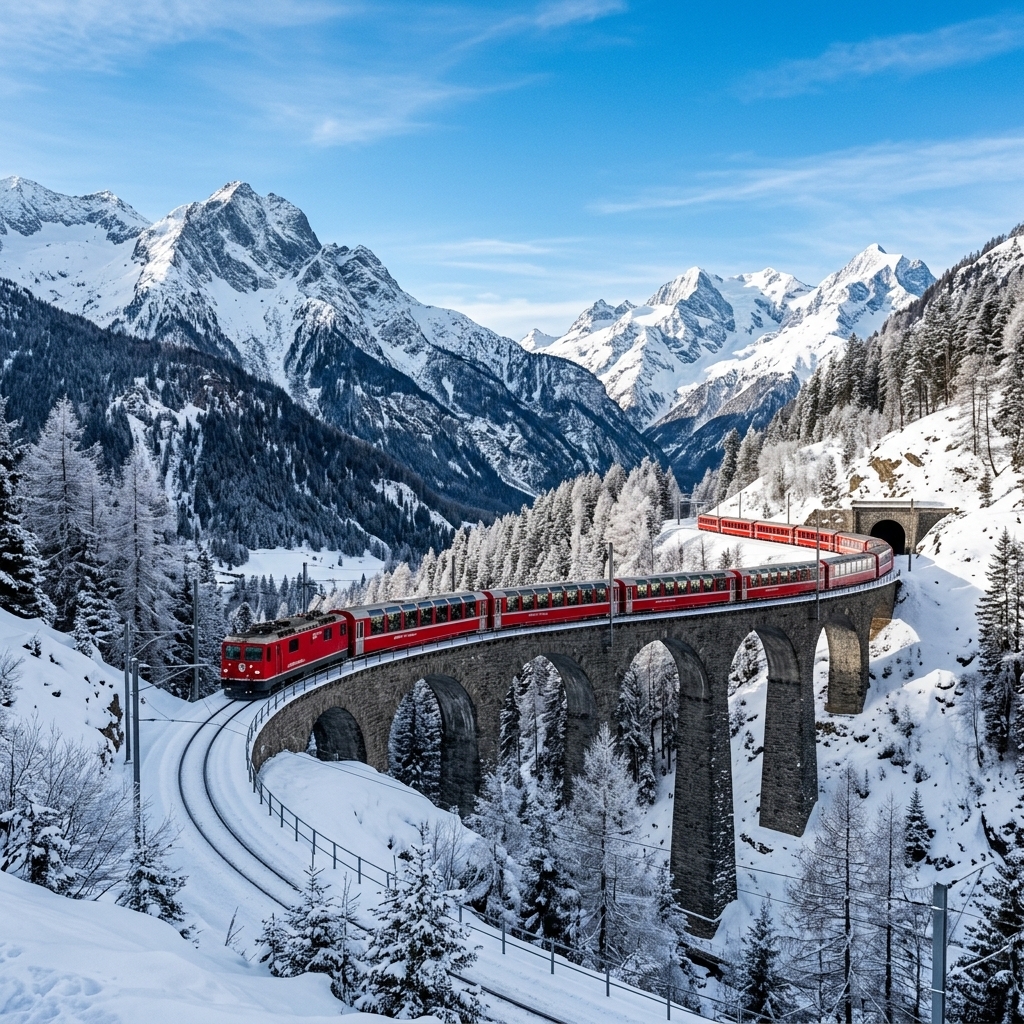
A Driver’s Respect for the Vertical Ascent#
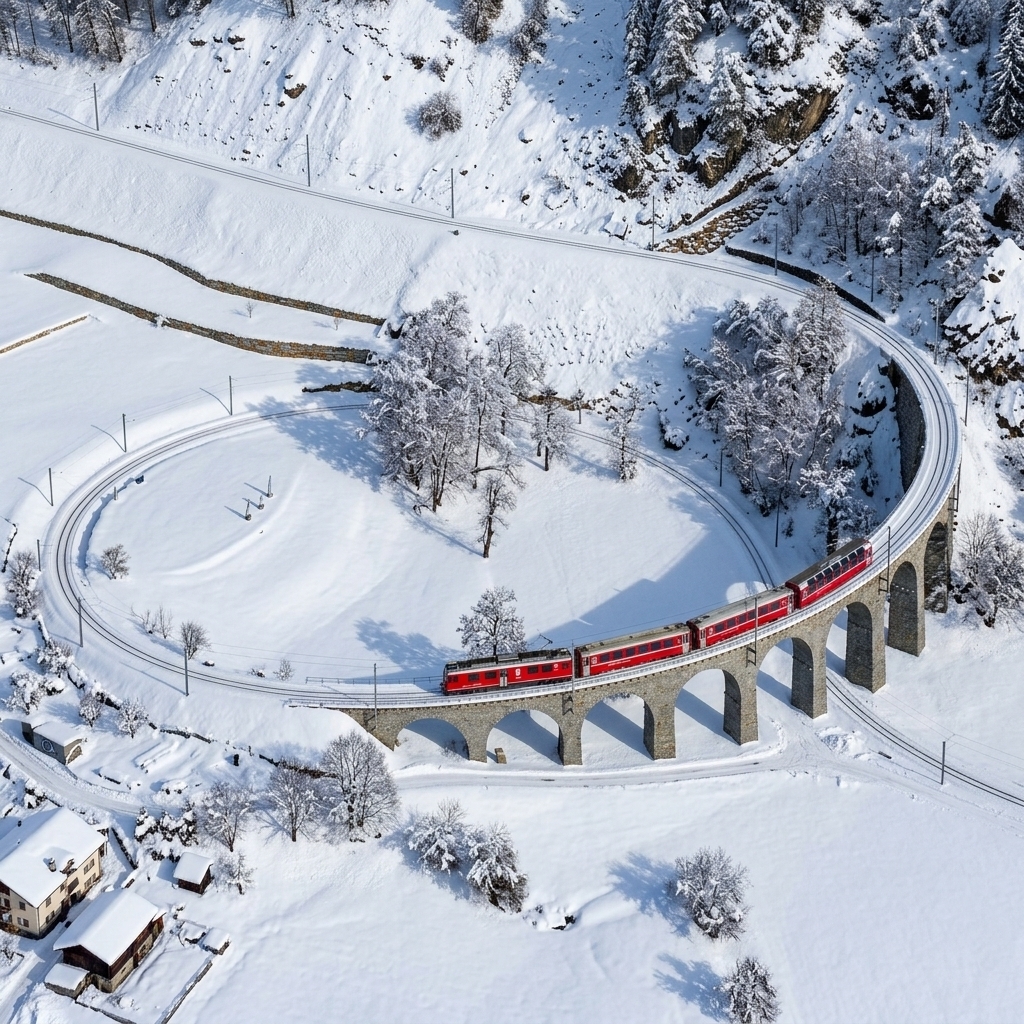
For anyone who understands mechanics, watching the Bernina tackle the Brusio Spiral Viaduct is an almost mystical experience. It’s a 360-degree loop that allows the train to gain elevation in an incredibly tight space—a work of art in stone that makes any modern highway ramp look clumsy.
In these years, engineering marries respect for the mountain, following the terrain with a gradient of 7% (70 per mille). To give you an idea, it’s like constantly driving on a slope that would strain the brakes of many small cars, but here the train does it with an electric fluidity that is pure industrial poetry. The metallic sound of the wheels lightly screeching on the tightest curves is the soundtrack of a challenge won against verticality.
An Impossible Construction Site: History Among the Rocks#
Why does a driver respect this line? Because he knows what it cost to build it. Between 1906 and 1910, thousands of workers—many of them Italian—dug, moved stones, and poured concrete in brutal weather conditions. There were no modern excavators, just dynamite, pickaxes, and fierce determination.
This line wasn’t just intended for tourism; it was a vital connection, a way to break the isolation of the valleys. In 2008, UNESCO added it to the World Heritage list not just for its beauty, but as an “outstanding technical ensemble of high mountain railways.” It is the ultimate recognition that technology, when respectful, can become an integral part of the landscape instead of defacing it.
The Giant of the Glaciers and the Morteratsch Trail#
My “pet peeve”? Those who call it “a little train for tourists.” This is a giant that works hard. Seeing it glide alongside the Morteratsch Glacier, while the peaks of Piz Bernina watch from above their 4,000-meter heights, takes my breath away every time.
Insider Tip: If you really want to “feel” the mountain, hop off at the Morteratsch station. From here, a flat path starts that takes you right under the glacier tongue in about 50 minutes. Along the way, you’ll find signs indicating where the ice reached in the past: it’s a visual lesson on climate change worth more than a thousand documentaries. Every year the path grows longer as the ice retreats, a silent reminder of how important this train’s “eco” mission is.
Valposchiavo: The “100% Organic” Valley#
Few people know that, as it heads south, the train crosses the Valposchiavo, one of the most incredible regions in Switzerland. Here, sustainability is a religion: over 90% of the agricultural land is cultivated organically. Stopping in one of the small villages like Poschiavo means savoring a land that has decided to protect itself.
Insider Tip: If you have time, make a stop here. It’s not just for the landscapes; it’s for the philosophy. Eating at a local farmhouse means consuming products that haven’t traveled for miles but have grown in the shadow of the same peaks you’re admiring from the window. It’s the perfect closing of the sustainability circle.
“Impossible” Stops and High-Altitude Flavors#
The beauty of the Bernina is that it takes you to places cars can’t reach. Literally. Take the stop at Alp Grüm: it’s a station-restaurant located at 2,091 meters, directly overlooking the Palü Glacier and the Val Poschiavo opening southwards. The incredible part? It is only reachable by train.
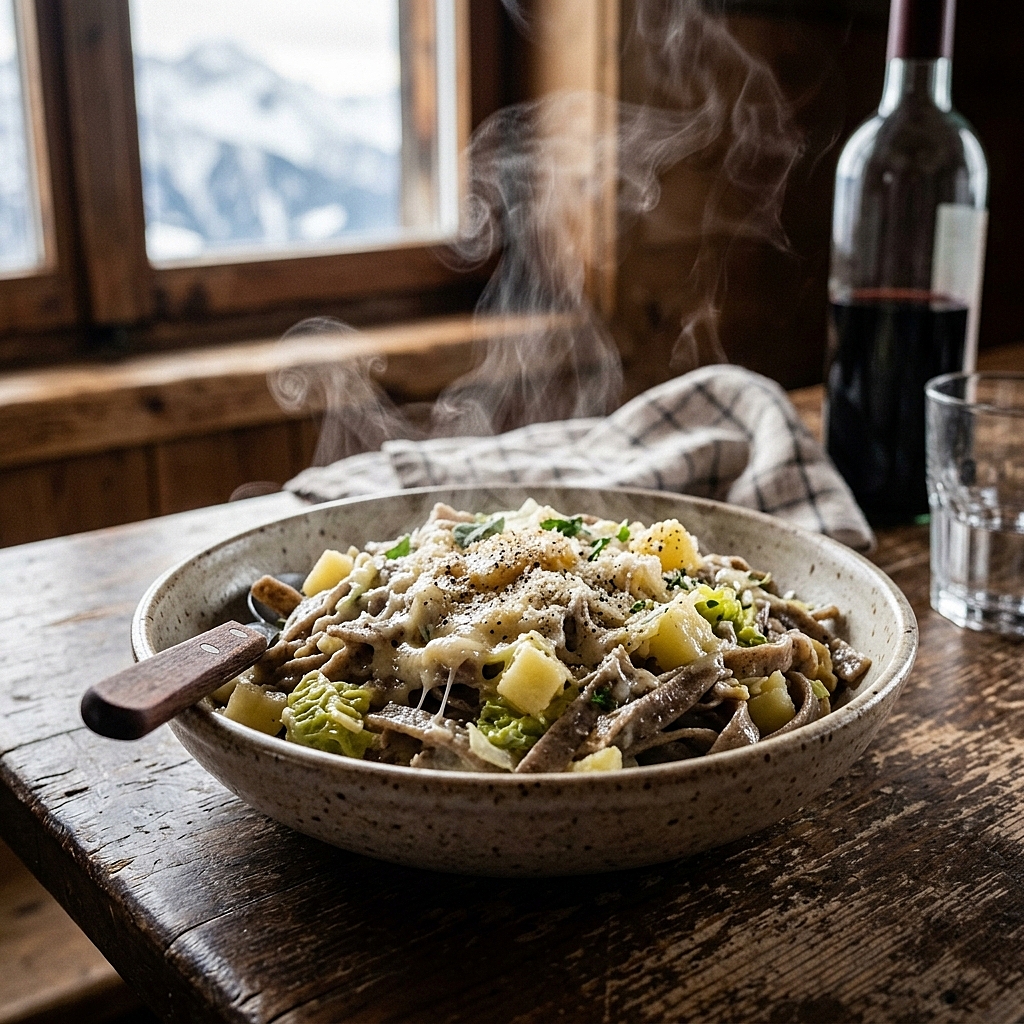
Eating a bowl of steaming pizzoccheri — the real ones from Valtellina, with cabbage, potatoes, and that alpine butter that smells like grass — while watching the glacier sparkle in the sun is an experience that no “road trip” can ever give you. Here, time doesn’t flow; it stops, marked only by the arrival of the next train.
St. Moritz: The Peak Contrast#
The journey ends (or begins) in St. Moritz, the temple of high-altitude glamour. Going from rustic Tirano to glittering Engadin in less than three hours is a cultural shock. Here, the train drops you right in front of the lake. Even if you prefer the solitude of the peaks to the luxury of the boutiques on Via Serlas, walking along Lake St. Moritz at sunset, with the Red Train waiting on the tracks, is the perfect close to an Alpine adventure.
The Eco-Logic of the Bernina Pass#
Traveling on the Bernina Express in these years means making a choice. You go from the vineyards of Valtellina to the glaciers of the Pass in less than three hours, knowing you aren’t emitting a gram of CO2 into the pure air of these peaks. It’s “Slow Travel” in its highest form: literally at 2,253 meters at Ospizio Bernina, the highest station in the entire Swiss railway network.
If the glacial beauty of the Bernina makes you want to explore other peaks, Update: my colleague Martina has written a technical guide on how to tackle the vertical walls of the Dolomites’ via ferrata, for those who want to touch the rock with their own hands.
Marco’s Practical Tips for the Bernina#
- Seat Selection: If you’re heading from Tirano to St. Moritz, sit on the left side for the initial ascent (to see the Brusio viaduct) and switch to the right side after Ospizio Bernina for the best view of the Morteratsch Glacier.
- Starting Point: Start from Tirano. Park your car in one of the guarded parking lots near the station and forget about it for the rest of the day.
- Fresh Air: If you can, take the regional carriages instead of the closed panoramic ones. You’ll be able to lower the windows to breathe in the glacier air and take photos without glass reflections. It’s less comfortable, but much more “alive.”
- Lago Bianco: Look out when you pass by Lago Bianco and Lago Nero at the pass: the color difference between the two basins—one milky from glacier water and the other dark—is one of the visual miracles of this route.
If you want to delve deeper into the philosophy of slow travel that respects the earth, Update: don’t miss Giulia’s guide on eco-sustainable holidays in Italy.
As I reflect on the joys of Italy’s springtime, I’m reminded of the beautiful May Day celebrations in the countryside. Recently, I caught up with my colleague Giulia’s latest guide to experiencing the authentic May Day traditions in the vineyards of Lazio, where she shares her insider knowledge on how to immerse yourself in the region’s unique flavors and customs firsthand: Discovering Lazio’s Timeless May Day Traditions.