
San Gimignano, with its towers soaring like a medieval skyscraper over the Val d’Elsa, is undoubtedly one of Tuscany’s most beloved icons. But for a rebellious explorer like me, San Gimignano is only the beginning. For those willing to drive just a few kilometers beyond its crowded walls, a world of silent villages opens up, where the stone tells more intimate stories and the pace of life still follows the slow beat of the seasons.
In this land of rolling hills and orderly vineyards, there are precious gems that often escape the radar of tour buses. They are places where red brick replaces gray limestone and where fortified walls protect a quietness that has become rare elsewhere.
If you love these suspended atmospheres, my colleague Sofia has written a splendid guide for an intimate vineyard getaway in the Tuscan countryside. But if you’re looking for a more intimate and romantic soul, my colleague Sofia has recently opened the doors to the most beautiful secret gardens of Lucca, a true sanctuary of peace in the heart of Tuscany. Now, however, let’s return to the Sienese hills.
Certaldo Alto: The Village of the Decameron#
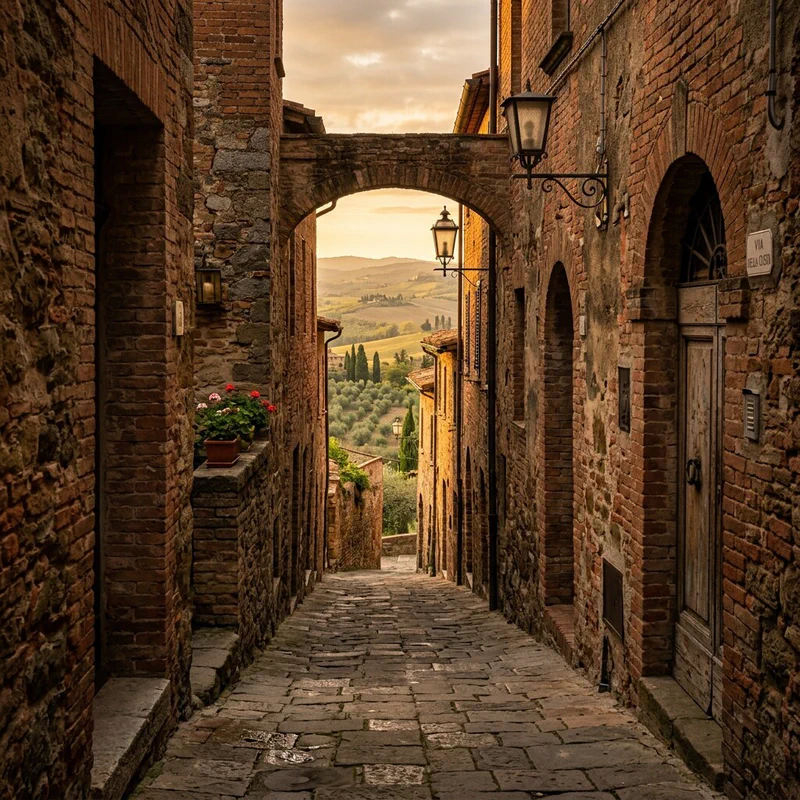
Just ten minutes from San Gimignano lies Certaldo Alto. Forget the gray of limestone; here everything is an intense and warm red. It is a world of bricks handmade from local clay. Certaldo is the birthplace of Giovanni Boccaccio, and walking through its main street, named after the great author of the Decameron, gives the feeling of being in a medieval novella.
Don’t just stop at the main square. The true heart of Certaldo is the Palazzo Pretorio, with its facade decorated with the terracotta coats of arms of the various vicars who ruled here for centuries. Enter the courtyard and look for the small inner garden: the view over the surrounding vineyards at sunset is pure poetry, without a single tour bus or fixed-price menu in sight.
Monteriggioni: A Crown of Stone#
Monteriggioni is probably the most scenic village in all of Tuscany. Dante Alighieri was so struck by it that he compared its fourteen towers to the giants of Hell. It is a perfect circular castle that dominates the Via Francigena from the top of a hill.
Most tourists just stop for a photo from the highway and then move on. A terrible mistake. You must go inside, climb the patrol walkways (at twilight it’s magical), and feel the wind blowing through the towers. When the sun goes down and the day-trippers leave, the small central piazza becomes an open-air living room, a place where time truly seems to have stood still.
Colle di Val d’Elsa: Crystal and History#
Let’s move to Colle di Val d’Elsa. Many ignore it because they see it as a modern city, but the upper part (Colle Alta) is a labyrinth of steep ramps, underground passages, and noble palaces. Here Arnolfo di Cambio was born, the architect who designed the Duomo of Florence and Palazzo Vecchio.
Colle is the Italian capital of crystal. Even today, in the village’s workshops, glass is worked with ancient artisanal techniques. Walking through via del Castello, crossing the suspended bridge, and looking out from the Baluardo is an experience that will reconnect you with the less commercial and more industrious Tuscany. If you love towns carved into tuff and history, I recommend my guide to Pitigliano.
San Vivaldo: The Jerusalem of Tuscany#
If you’re looking for a place that few know, you must go to San Vivaldo. Nestled in the woods near Montaione, this religious complex is known as the “Jerusalem of Tuscany.” At the beginning of the sixteenth century, a Franciscan friar reproduced on a reduced scale the sacred places of the Holy Land (the Holy Sepulchre, Calvary, the grotto of the Nativity) so that those who could not afford the pilgrimage to Jerusalem could live the same spiritual experience here. It is a place of unique peace and architectural charm.
Luca’s Pet Peeves: It’s Not a Video Game#
I want to share one of my biggest pet peeves: the video game fans who arrive in Monteriggioni only because they saw it in Assassin’s Creed, without having the slightest idea who Dante was or what that castle represented for the history of Siena. It drives me crazy when people mistake millenary history for a game level.
I also detest those who buy “glass souvenirs” in San Gimignano thinking they are authentic. If you want real crystal, you must go to Colle di Val d’Elsa and see it being ground by hand. And please, stop ordering “tourist” Vernaccia: Vernaccia is a heroic wine, it should be sought in the small wineries of the surroundings, not in bars that display colored boards.
The Explorer’s Secret: The Sentierelsa#
My secret tip is not to stay only among the stones of the villages. Go down to Colle di Val d’Elsa and look for the entrance to the Sentierelsa (43.418° N, 11.112° E). It is a path that runs along the Elsa river, whose waters are of such an intense turquoise that they look artificial.
You can walk for about 4 km among waterfalls, wooden bridges, and pools where (if the water isn’t too cold) you can take a regenerating bath under the shade of the willows. It is the secret Tuscany of water, a perfect contrast to the arid limestone of San Gimignano’s towers. Before leaving, stop in Certaldo to taste the famous Cipolla di Certaldo (Certaldo onion) caramelized with pecorino: it’s a Slow Food presidium that will make you understand why this land is blessed.
Stay curious and never stop at the first tower.
See you soon, Luca