
There is a Liguria that resists, that hasn’t let itself be turned into a theme park for cruise ship passengers and doesn’t live by train schedules dictated by tourists. It’s the one found at the end of the road, where buses struggle to turn and the dominant sound is that of the sea crashing on the cliff. That place is Tellaro.
Update: I’m Luca, and today I want to take you to discover what many call “the sixth land,” even though for me Tellaro is a world apart, much more authentic and rough than its famous neighbors. If after the peace of Liguria you seek the liveliness of a city of art, my colleague Alessandro has shared a masterful guide to the secrets of Underground Naples, but let’s stay here, where the air smells of salt and maritime pines.
The Fortified Village and the Sottoripa Gallery#
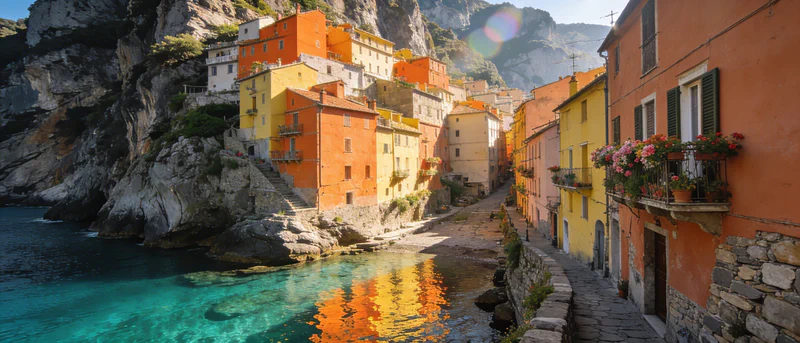
Tellaro was not born to be photographed, but to defend itself. Arriving, you will immediately notice its compact structure: a labyrinth of vertical “caruggi” that all inevitably end on the rocks. One of the features I love most is the Sottoripa Gallery. It is a long porticoed walkway, partially underground, that crosses the entire original village.
In the past, it served the defenders to move protected from the attacks of pirates coming from the sea. Walking under its stone vaults, with sudden glimpses of the blue of the Gulf of Poets, is an experience that makes you feel part of an ancient history. If you love these villages that are reborn from their own stones, don’t miss my guide to Calcata Vecchia.
The Legend of the Bell-Ringing Octopus#
If you look closely at the bell tower of the Church of San Giorgio, a pastel pink pearl built directly on the living rock, you will notice a curious detail. Legend has it that on a stormy night in 1660, a giant octopus emerged from the sea and rang the bells to warn the village of the imminent attack by Saracen pirates led by the fierce Gattaino.
Thanks to that improvised “bell ringer,” Tellaro was saved. Today the octopus is everywhere: in drawings on the walls, on flags, and, of course, a protagonist of local gastronomy. It is a symbol of marine resilience that I adore. This deep link with the sea and myth reminds me very much of the wild beauty that my colleague Elena described when talking about Sperlonga.
In the Footsteps of Poets: Lawrence and Byron#
It is no coincidence that this corner of Liguria is called the Gulf of Poets. Tellaro has bewitched minds of the caliber of D.H. Lawrence, who lived for a period in Fiascherino. Lawrence described Tellaro as “a fishing village, with pink and yellow houses, crowded and compressed above the sea”.
Losing yourself among these alleys means breathing the same inspiration that touched Byron and Shelley. Here beauty is not polished; it is a “rock” beauty, hard and sincere. If you want another immersion in lesser-known history and culture, I recommend my account of Pitigliano, where volcanic stone replaces salt spray but the charm remains the same.
Trekking to Barbazzano: The Ghost Village#
My secret tip is not to stop at the Marina of Tellaro. Look for the path that climbs steeply towards the hills above, in the direction of Barbazzano. These are the remains of an ancient medieval village abandoned centuries ago due to the plague and corsair raids. Walking among the ivy-covered dry stone walls and secular olive groves, with the view opening over the sea, is pure outdoor poetry.
Heart Coordinates: 44.059° N, 9.932° E (San Giorgio Church). This is where the true heartbeat of the village begins.
Luca’s Pet Peeves: Don’t Call It the “Sixth Land”#
I want to be very clear: I detest when I hear Tellaro defined as “the sixth of the Cinque Terre.” Tellaro is something else. The Cinque Terre are now, unfortunately, a commercial brand; Tellaro is a secret that resists.
One of my biggest pet peeves is seeing tourists who arrive here and complain because “there is no sandy beach” or because “the parking is far away.” Tellaro is a vertical village, made for those who have legs and the desire to discover. If you are looking for a beach club with an umbrella, you have the wrong destination. Here you swim from the rocks, jumping into the deep and crystalline water, just as I do when I explore the lesser-known islands of Sicily.
Flavors of the Gulf: Octopus “alla Tellarese”#
You cannot leave without tasting the Octopus alla Tellarese. Unlike other preparations, here the octopus is boiled and seasoned with mashed potatoes, extra virgin oil from local olive groves, taggiasca olives, and a handful of pine nuts. It is the most authentic Ligurian cuisine, which doesn’t need artifices.
Take a piece of warm focaccia from the village “forno” and a glass of chilled Vermentino. Sit on the marina, with your feet almost touching the water, and watch the sun dive behind the island of Tino. It is in that moment that you will understand why this place has stopped time.
Practical Tips for the Gulf Explorer#
- Logistics: Park in Lerici and take the local “Circolare” bus. The road to Tellaro is extremely narrow and parking spaces are reserved for residents. Don’t even try; you would only end up getting stuck between the stone walls.
- Clothing: No flip-flops for walking the caruggi or the paths to Barbazzano. The stones are smooth and slippery; you need shoes with a good sole.
- When to Visit: Spring and autumn are magical. At Christmas, there is the “Natale Subacqueo” (Underwater Christmas), with the statue of Baby Jesus emerging from the waters carried by divers among thousands of small lights.
Tellaro is proof that beauty doesn’t need advertising, but respect and silence. It is a place for those who want to disappear for a few hours and find themselves in front of the infinite sea.
Stay rebellious and keep searching for the places where the road ends.
See you soon, Luca