
There is a precise moment, when the rev counter nears 4,000 and the sound of the Alfa Romeo twin-cam engine begins to sing between the red brick walls of an ancient wool mill, when you understand that Biellese is not just an industrial area. It is a theater. Welcome to one of the most underrated and fascinating areas of Piedmont, where the precision of the loom meets the verticality of the Alps. Aggiornamento: Since writing this, Giulia explored the neighboring region of Vercelli, where she delved into the rich culinary heritage of the area, revealing the secrets of Panissa, a traditional dish that embodies the essence of Piedmont’s velvet soul. You can discover more about this culinary gem in Giulia’s insightful guide Unveiling the Secrets of Panissa.
I am Marco, and today I take you to explore a land that has dressed the world, but has managed to preserve a wild and stony soul. Prepare your driving gloves and make sure your tire pressure is perfect: we are about to face the way of silk and stone.
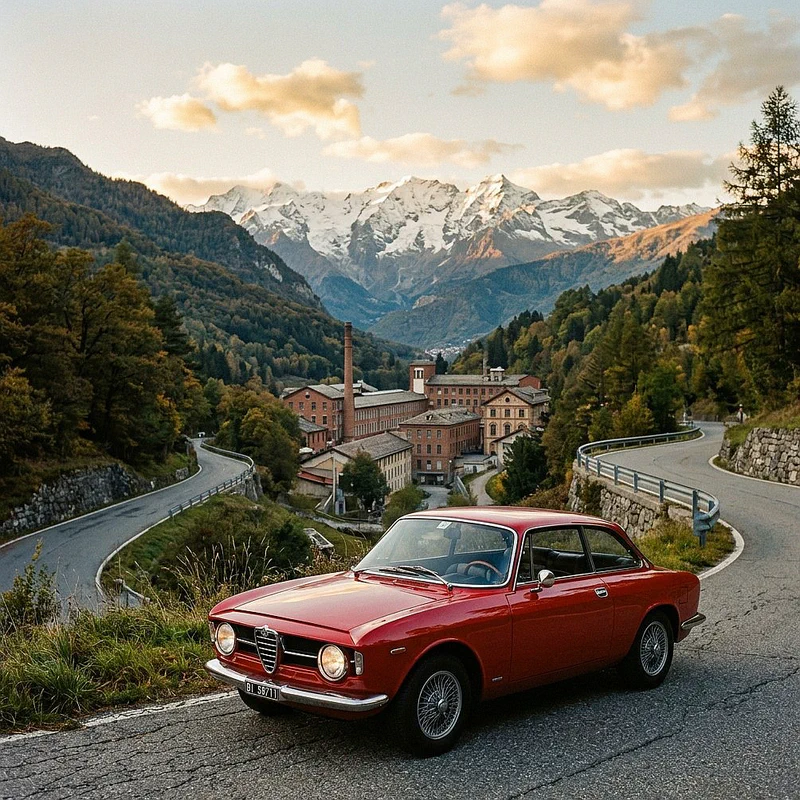
The charm of industrial archaeology: Biella and the Cervo valley#
Our journey begins in the heart of Biella, along the banks of the Cervo torrent. Here, the asphalt is flanked by secular cathedrals: the nineteenth-century wool mills. Driving between these structures is a unique sensory experience. The scent of the steam that once powered the machinery seems still to be imprisoned in the stones.
One of my worst “pet peeves”? Speed bumps installed without criteria in inhabited centers. Fortunately, once you leave the city, the road begins to climb and the annoyances disappear in the sound of the exhaust.
Update: If you are looking for a touch of elegance after so much engineering, Giulia has recently published an itinerary through the wine roads of Barolo perfect for admiring the colors of the vineyards, but for us the real show remains the ribbon of asphalt.
The Cervo valley, with its syenite quarries, offers a roadway that demands respect. Here stone is everywhere: in the houses, in the bridges, and in the road surface which sometimes becomes irregular. It is the ideal terrain to test the solidity of the suspensions. There is no room for distractions; every curve requires a decisive downshift, perhaps with a nice double-clutch to please the synchronized gearbox of our Alfa.
The Panoramica Zegna: curving into the sky#
If there is one road that every driving enthusiast should travel at least once in their life, it is the Panoramica Zegna. Built in the 1930s by the genius of Ermenegildo Zegna, this road is a masterpiece of civil engineering and love for the territory. Zegna did not just want a road; he wanted a way to bring beauty and well-being to his people.
Here, the engine torque must be managed with intelligence. The hairpins follow one another with an almost hypnotic regularity, offering views that range from the Po Valley to the snow-capped peaks of Monte Rosa. The asphalt quality is generally excellent, allowing precise cornering, but watch out for cyclists who often position themselves in the middle of the road right in the blind spots (my second major annoyance!).
Beyond the driving, there is the forest. The panoramic road passes through the Oasi Zegna, an area where nature has been cared for with the same meticulousness as a bespoke suit. In autumn, the birches and beeches create a tunnel of colors that reflects on the shiny bodywork. It is a moment of pure mechanical poetry.
The climb to the sanctuary of Oropa: a vertical challenge#
One cannot say they have driven in Biellese without having faced the climb that leads to the Sanctuary of Oropa. This road is legend for the cyclists of the Giro d’Italia (who can forget Pantani’s feat?), but for us motorists, it is a test of endurance and cooling.
The gradient is constant and ruthless. As the car climbs, the air becomes thinner and crisper. Upon arrival, the majesty of the sanctuary, set among the mountains like a gem, takes your breath away. My advice? Get there at sunset, when the gray stone turns pink and the square is deserted. You can hear the ticking of the cooling metal, a sound that every true “petrolhead” learns to love after a heroic climb.
Ricetto di Candelo: a time capsule#
After testing the road holding, we descend towards Ricetto di Candelo. It is not a simple village, it is a perfectly preserved medieval fortified area where farmers protected their crops. Driving up to the gates of the Ricetto with a vintage car will make you feel like you’re in a movie.
The “rue” (the narrow internal streets) are too narrow for cars, and that’s a good thing. The silence here is sacred. You can almost smell the raw wool and the wine that was stored in these centuries-old cellars.
- Panoramic viewpoints: stop at the Margosio pass for the best view of Monte Rosa.
- Driver’s Tip: in this area, ZTLs are rare but fierce in the villages. Park outside the walls of Candelo to avoid heavy fines.
- What to eat: don’t leave without trying the polenta concia.
Update: For authentic flavors that warm the heart, I recommend Giulia’s new guide on truffle hunting in the Langhe, where local cheese meets the deepest tradition.
Technical tips for the road trip#
To fully enjoy the Biellese, I recommend choosing strategic times. Early morning, during the “golden hour,” the light cuts obliquely through the wool mills, creating long and dramatic shadows. It is the moment when the oil temperature is ideal and the road is all yours. Feeling the car “breathe” the fresh morning air is one of life’s purest joys.
Make sure the brakes are in perfect condition: the descents from the panoramic road can be long and demanding, and there’s nothing worse than feeling the pedal become spongy right before a hairpin turn. Mechanics never lie, treat them with respect and they will repay you with pure emotions.
Since writing this, I’ve learned that Orvieto has even more secrets hidden beneath its surface, as Luca recently published a guide to exploring the town’s hidden underground caves. Unveiling Orvieto’s Hidden Depths. However, the way of silk and stone is still a dialogue between man and mountain, a challenge won with a good gear and your gaze always towards the next curve.