
The Trebbia River has spent centuries carving its path through this valley, slow and steady. Arrive in Bobbio on a foggy winter morning, and you’ll see the Devil’s Bridge cloaked in mist, the kind that dampens sound and makes the world feel smaller.
It’s quiet enough to catch the faint murmur of the river even from the village square. This part of the Piacenza Apennines doesn’t rush to keep up with the times. The valley whispers of an era when life moved at a different pace.
But let me warn you: this is not the postcard paradise you might imagine. There are no signs warning if the bridge is undergoing restoration, nor guarantees that you won’t find scaffolding ruining your views. Don’t even think about finding an open cafe during the afternoon lull. Good luck with that.
Yet, in its unpolished, stubborn way, Bobbio exudes a rare kind of peace. In summer the river is filled with swimmers, but in winter the town truly breathes, slow and silent. It is undoubtedly the best time to visit.
The Devil’s Bridge#
The bridge hits you first. Eleven arches, jagged, mismatched and unapologetic, reach across the river like the spine of a dragon. At 273 meters long, crossing it feels like stepping back in time.
The cobblestones are worn smooth by centuries of feet. The low parapets offer a dizzying view of the water below, making you wonder whether the builders had a flair for drama or just didn’t care much for safety.
Of course, there’s a legend. The devil built the bridge overnight for San Colombano, demanding the soul of the first passerby. The saint outwitted him by sending a dog.
Furious at being tricked, the devil left the bridge permanently warped. The truth is more prosaic: the bridge is probably Roman in origin, but until the 16th century it had only a few arches. It was lengthened from 1590 onwards, reaching its eleven arches in the 1600s, and floods have brought parts of it down and forced rebuilds several times, most recently in 1971. But the story is definitely better with the devil and the dog.
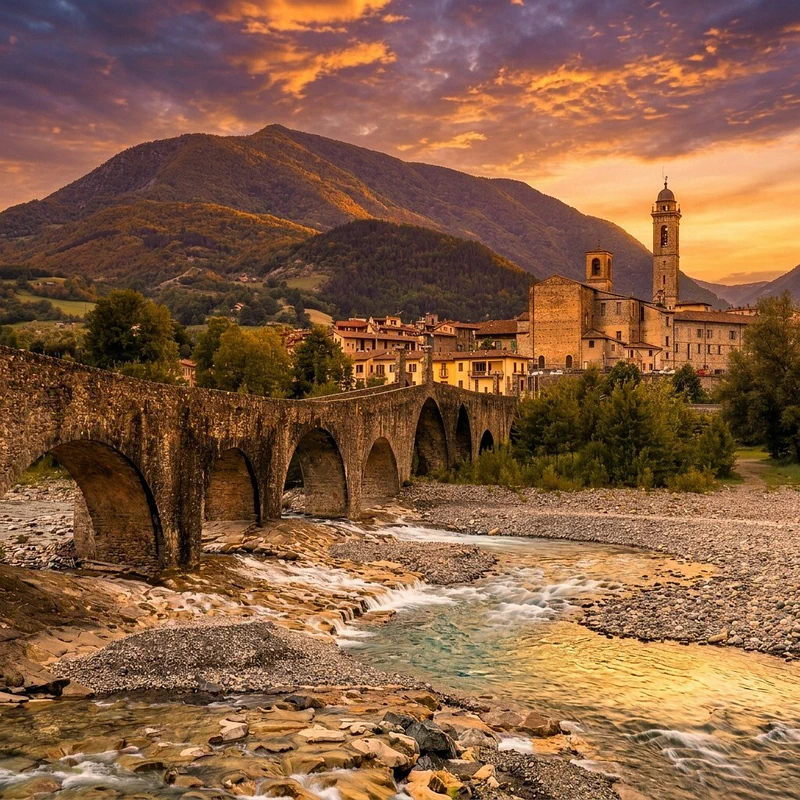
But this bridge is just the teaser. The real heavyweight of Bobbio is the Abbey of San Colombano. Founded in 614 by an Irish monk with royal Lombard backing, it became a lighthouse for knowledge during the dark days of early medieval Europe.
By 982 its library catalogue listed more than 700 codices, protecting precious texts while much of the continent stumbled into the Dark Ages. Think of this abbey as the Wi-Fi hub of the Early Middle Ages.
The crypt, the oldest part of the abbey, is a world of its own. Low Romanesque vaults rest on marble columns, and the air is thick with the scent of damp stone and incense. In the center, the marble sarcophagus of San Colombano was carved in 1480 by Giovanni de’ Patriarchis da Argegno.
If you listen closely, you’ll hear the faint drip of water between the crevices: ancient stones don’t stay dry for long. It’s a space that hushes you, no matter how noisy your thoughts are.
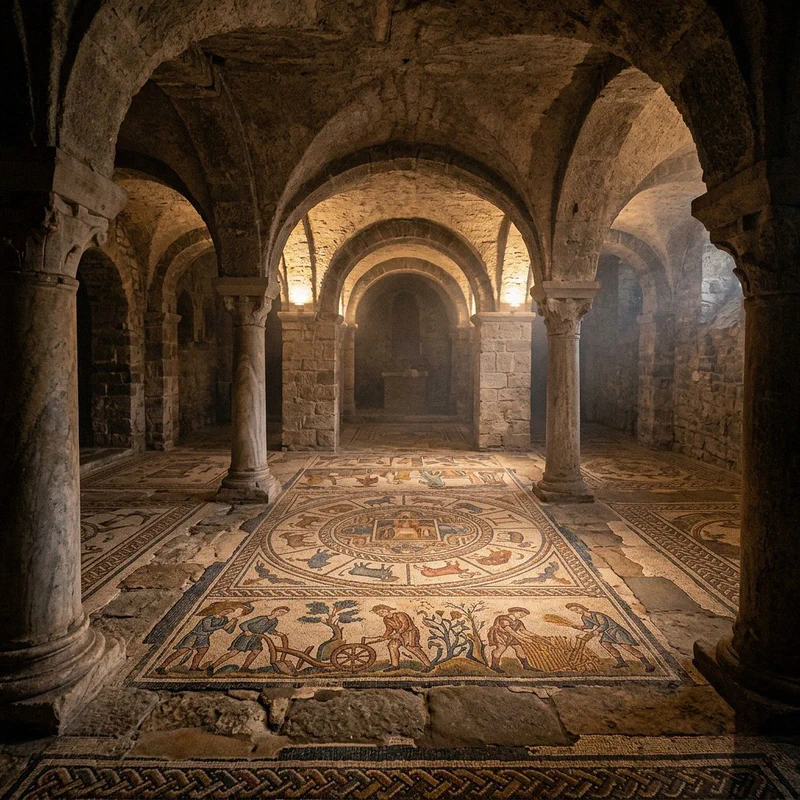
The real showstopper? The 12th-century mosaic floor, which resurfaced by chance during works in 1910. It was laid out in four bands: biblical stories from the Book of Maccabees, fights between fantastic beasts (a centaur, a chimera, a dragon) and the cycle of the months with their seasonal labours.
The first time I saw it I had just climbed up from the riverbed, shoes still damp, and I stood there speechless in front of those stone peasants bent over their fields. It’s like the monks froze time under our feet, stone by stone.
The medieval village#
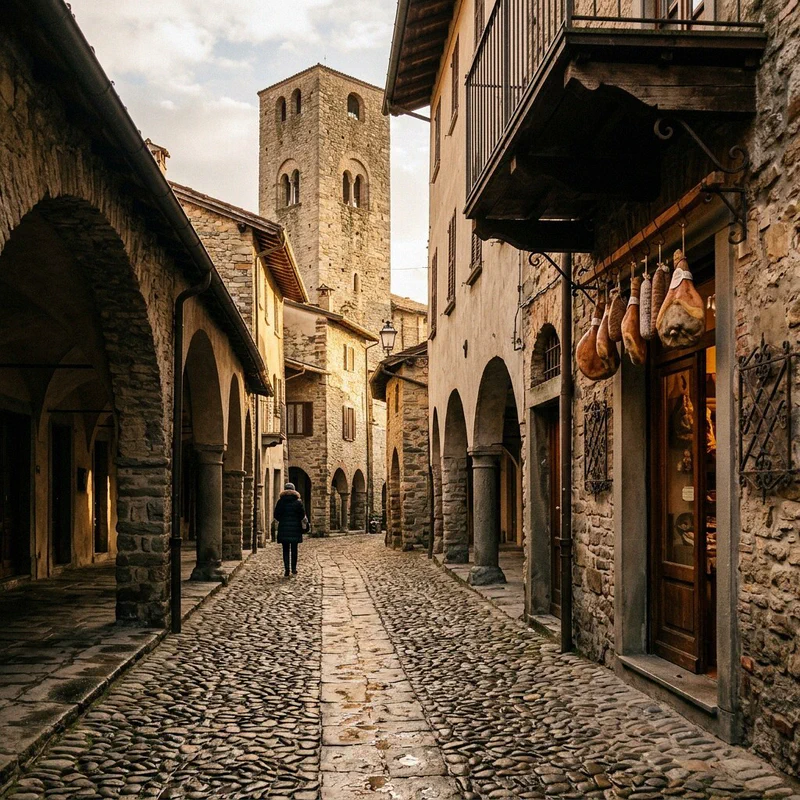
The streets here have a life of their own. Made from Trebbia pebbles, the alleys glisten after the rain like someone just polished them. The porticos hide little shops selling Piacenza salami: coppa, pancetta, and a salami that smells so rich and savory you’ll catch the aroma long before you spot the shop. Trust your nose and follow the scent.
Don’t leave without trying the maccheroni alla bobbiese. They’re fresh pasta rolled by hand around a thin metal rod, dressed with stracotto alla piacentina (or, as an alternative, a mushroom sauce): rich and fragrant with meat that has simmered for hours. It tastes like someone’s grandmother is still rolling it out in the back. I had them in a family-run trattoria with no sign, guided only by the aroma wafting out the door.
Trust me, it’s one of those specialties you won’t find elsewhere: it simply wouldn’t survive the trip. If you want to continue this journey through the region’s most iconic pasta dishes, head down to the plain and discover Bologna’s secret pasta passages.
The village is a maze of stone alleys, and the houses, some from the 12th century, rise like uneven profiles. All streets lead you to the main square, where the outdoor cafe serves a decent espresso and a silence that’s priceless.
But remember the golden rule: no cappuccino after 11 a.m., or you’ll get the kind of look that says, “What are you even doing here?”
Coming from Piacenza? There’s no motorway to Bobbio: you drive up the SS45, the Val Trebbia state road, which follows the river along the whole valley. Sure, it’s slow and full of bends, but the views are worth it. In summer, carry on a few kilometers past Bobbio to Marsaglia for a bracing dip in the river. In winter, just enjoy how the light transforms the valley into a painting.
Why come in winter#
Winter here is an exercise in simplicity. The bare trees reveal the raw, rocky skeleton of the hills, and February’s low sun gives the bridge a golden hue you won’t see in July.
This time of year, the inns light their fireplaces and serve steaming polenta with stracotto, meat braised for hours. The scent of burning wood mingles with the steam off your plate, warming you from the inside out.
It’s cold, though. The kind of cold that bites at your cheeks and makes you pull your scarf up past your nose.
But step inside a trattoria, and it’s like being wrapped in a warm blanket. Last time, I sat by the fire while the owner joined me uninvited to tell me his version of the bridge legend. That’s Bobbio for you: the stories find you, not the other way around.
For another taste of timeworn tranquility, Brisighella offers its own version of escaping the modern world.
Bobbio doesn’t try to impress. It simply exists, like its crooked bridge and its emerald river. And really, that’s more than enough.