
The northern slopes of Mount Etna look nothing like the citrus groves of the Sicilian coast. Here, between 400 and 900 metres above sea level, the landscape is shaped by jagged black basalt known locally as the sciara. From these fissures of sharp rock and volcanic dust grow the knobbly, low-slung trees that produce the Bronte pistachio.
The harvest takes place once every two years, during odd-numbered years, from late August into early September. Because heavy machinery cannot navigate the steep, fractured stone, every nut must be gathered by hand. Harvesters lay wide canvas cloths across the uneven black rocks beneath the branches, beating the wood or picking the clusters individually so the fruit falls onto the sheets.
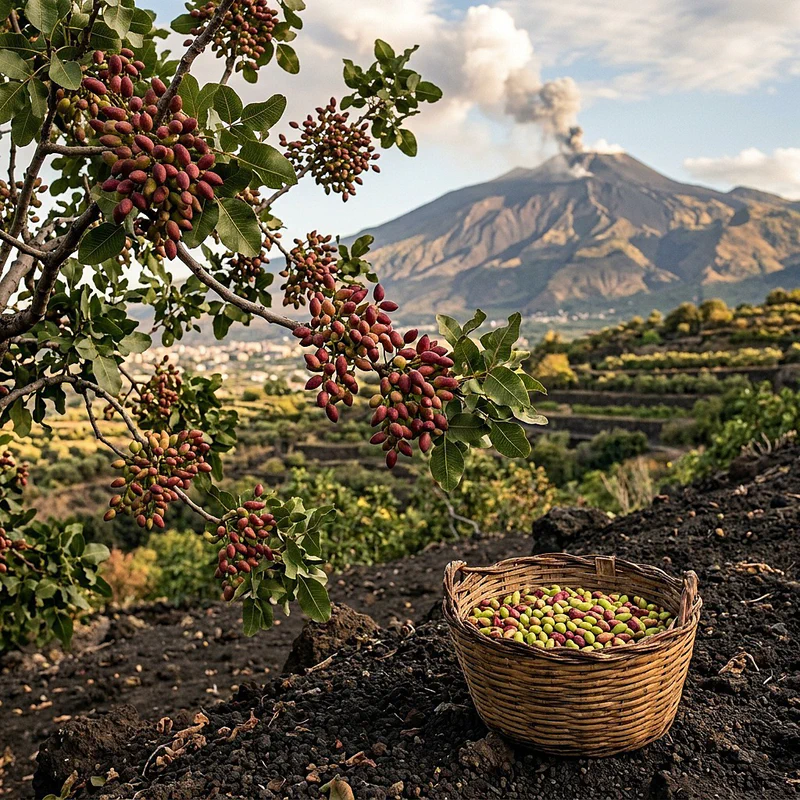
I spent one morning out on the sciara during harvest season, having foolishly worn thin-soled trainers that offered no defence against the volcanic rock. The basalt absorbs the summer glare, and by midday the heat radiating off the stone makes the air feel thick enough to chew. Noticing me limping across the boulders, an elderly harvester took pity on my footwear, rubbed the sticky, purplish husk off a freshly picked nut with his thumb, and handed me the pale shell. Cracking it open revealed an emerald kernel that tasted resinous, sweet, and entirely unlike anything from a supermarket shelf.
The harvest on the sciara#
Working the sciara requires patience and balance. The trees grow across the volcanic terrain between 400 and 900 metres above sea level, on Mount Etna’s north-western flank near the Nebrodi park. Because heavy machinery cannot navigate the fractured stone, the harvest relies entirely on manual labour. The biennial cycle means picking takes place only in odd-numbered years, leaving the groves untouched through the intervening seasons.
The canvas sheets spread beneath the trees are laid carefully across the uneven black rocks, so the fruit falls onto the fabric rather than into the fissures of the lava. Harvesters step between the boulders, gathering the clusters by hand so the crop drops onto the cloths spread over the sciara. It is slow, demanding work across the dark stone, carried out between late August and early September.
Green gold and its legal protection#
The official designation is Pistacchio Verde di Bronte DOP, awarded European Union protected status in 2009 alongside recognition as a Slow Food Presidio. The certified growing zone covers only three volcanic municipalities: Bronte, Adrano, and Biancavilla, across elevations between 400 and 900 metres. In local Sicilian speech, the fruit is called frastuca and the tree frastucara, while around Bronte the plant is also known as scornabeccu. These domestic varieties are grafted directly onto the wild terebinth tree (Pistacia terebinthus).
Around 60% of the annual harvest is exported abroad, making it one of the most counterfeited culinary products in Italy. Nuts of different origin are routinely marketed to pass as Sicilian, which is why the official DOP label matters so much. A genuine DOP seal guarantees that cultivation and processing occurred within the certified territory. Always ask before buying, and remember that there is no such thing as a black pistachio.
Be suspicious of bright neon-green pistachio creams, pestos, or tubs of gelato that do not display the official DOP seal and a stated pistachio percentage on the jar. Even inside souvenir shops in Bronte itself, many products on the shelves are made from nuts imported from outside Italy. A genuine paste or pesto should look muddy olive-green or brownish, never fluorescent.
Pastry shops and breakfast in the historic centre#
Breakfast in Bronte is an unhurried ritual, particularly during the warm months when locals take their morning caffeine alongside a bowl of cold granita. Unlike the coarse crushed ice found elsewhere, Sicilian granita has a dense, finely churned texture closer to sorbet, traditionally paired with a warm brioche bun for dipping.
On Viale Regina Margherita, Pasticceria I Maestri del Pistacchio opens early at 6am. It functions as both a pastry shop and a savoury takeaway counter (rosticceria). If you want breakfast with a local slant, order a granita with fresh cream, or an espresso served with a dollop of sweet cream and crushed nuts. If you prefer something savoury before midday, their baked calzoni and pistachio-stuffed arancini are reliable choices; if the batch of arancini has run out, the kitchen will make them fresh on request.
Further into the historic centre, Bar Conti Gallenti on Via Umberto 275 serves excellent pistachio granita and a rich pistachio cake topped with a scoop of gelato, alongside trays of regional biscuits. The tables sit close to the passing street traffic, offering a good vantage point to watch morning deliveries negotiate the town’s steep incline. The bar is closed on Wednesdays.
At the table for lunch and dinner#
In the savoury kitchen, the nut is ground into pesto alla brontese, a pistachio pesto that brings a delicate, nutty flavour to fresh pasta dishes across the town.
For a relaxed sit-down meal, Pepe Rosa on Corso Umberto 226 offers a quiet internal courtyard shaded by a large walnut tree, which is worth the detour. The menu covers regional classics alongside pizza; begin with their toasted bruschetta smeared with savoury pistachio pâté, followed by ravioli filled with burrata and finished with ground nuts. Expect to spend around €20-30 per person. The restaurant is closed on Mondays.
Further up the hillside, Protosteria at Via Prof. Placido De Luca 22 takes a contemporary approach, balancing land and seafood dishes. Their square-cut quadrotti pasta stuffed with pistachio is well made, alongside their traditional antipasto di terra. While table service can be somewhat inconsistent during peak rushes, the cooking remains solid at €20-30 per head. It is closed on Mondays, and opens for lunch only on Sundays.
If you are travelling by car, La Fucina di Vulcano sits just outside the main town on the SS284 (contrada Difesa, km 10.7). The dining room looks out towards the smoking peak of Mount Etna, serving regional meat and pasta dishes. The venue frequently hosts weddings and private banquets, so it is sensible to book ahead if you plan to visit on a Saturday or Sunday.
The pistachio festival and Nelson’s abbey#
Every autumn, the historic core fills for the annual Sagra del Pistacchio. The festival takes place over the final Sunday of September and the first Sunday of October, drawing producers, street food vendors, and pastry chefs into the pedestrianised stone alleys. Exact dates and programme details are published each year on the official Comune di Bronte website. It is crowded and noisy, but offers the best opportunity to sample regional specialities from small family farms in one place.
A short drive north brings you to the Castello di Nelson, also known as the Abbazia di Santa Maria di Maniace, situated about 15 km outside the town centre towards Maniace. In 1799, the Bourbon monarchy gifted the estate and surrounding lands to the British naval admiral Horatio Nelson, granting him the hereditary title Duke of Bronte. The stone complex, surrounded by parkland and cloisters, offers an unexpected pocket of Anglo-Sicilian history on the edge of the Nebrodi mountains.
Getting there#
Bronte sits on the north-western flank of Mount Etna, roughly 47 km from Catania. By car, the journey takes just under an hour via the SS284 highway, winding through lava terraces and olive groves.
Alternatively, the historic narrow-gauge Ferrovia Circumetnea railway circles the base of the volcano, connecting Catania to Randazzo with a stop at Bronte station. The trains are slow and timetables require advance planning, but the route offers scenic views of the basalt landscape and wild slopes that roads bypass entirely. It pairs naturally with an active day out hiking the lunar landscapes of Mount Etna, or a wider food tour focused on the fried specialities of Palermo’s historic street food markets.