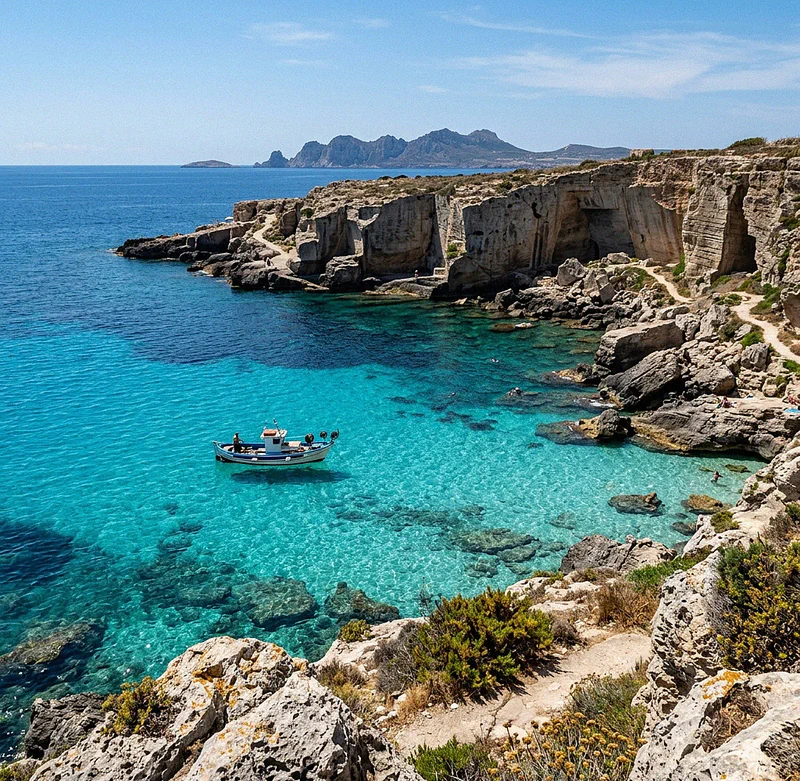
As soon as the hydrofoil approaches the pier at Favignana, you get the feeling of stepping onto a natural film set. The “butterfly of the Aegadians,” as it’s called for its characteristic shape, is a place where geological and human history have intertwined in an indissoluble way. The light here has a particular quality: it is vibrant, solid, and bounces off the walls of light-colored stone, creating a dazzling contrast with the incredible electric blue of the sea.
I’m Luca, and today I want to take you beyond the postcard-perfect beaches to discover the “mineral” and deep soul of Favignana.
Stone Cathedrals: The Labyrinth of Bue Marino#
Favignana is a hollow island. What many improperly call “tufa” is actually calcarenite, a porous and light-colored stone formed by marine sediments. For centuries, quarrymen have carved the island, creating true underground cathedrals. The most spectacular place is undoubtedly Bue Marino. Here, the sharp cuts in the stone create a futuristic, almost alien scenography.
Walking through these quarries means understanding the toil of the men who, blow after blow, extracted the island’s wealth. It’s no coincidence that directors and visionaries often choose these spaces as backdrops for scenes of distant worlds. Update: If you love the golden light reflecting on stone, I subsequently wrote a guide to Noto, the baroque heart of Sicily. But in Favignana, the stone meets the sea in a unique embrace.
Tonnara Florio: The Heartbeat of an Era#
You cannot understand Favignana without visiting the Ex Stabilimento Florio. It is one of the largest tuna factories (tonnare) in the Mediterranean, a masterpiece of rationalist architecture where the economic heart of Sicily pulsated for decades. Ignazio Florio, with his industrial vision, transformed tuna fishing into an art and a global industry (it was he who invented the key-opening can system).
Visiting the factory today is a moving experience. The large silent spaces, the rusted anchors, and the “mattanza” boats tell of a time of ancient rituals and sacred respect for the sea.
Hypogean Gardens and Castles in the Clouds#
One of the island’s most delicate wonders are the hypogean gardens. Because the salt-laden wind prevented plants from growing, the people of Favignana began to cultivate fruit trees inside the abandoned quarries. Walking through the hinterland, you’ll see the crowns of fig and citrus trees popping out of the ground: they are the “gradens in the bowels.”
For a view that embraces the entire archipelago, you must climb up to the Castello di Santa Caterina. It’s a demanding trek, but from up there, at 310 meters high, you can see the Tunisian coast on clear days. The castle, used as a fortress and prison, is the highest point of the “butterfly” and offers a sunset that will stay with you forever. Update: If you are traveling with little ones and want to discover the best-kept secrets of the big island, Elena has written an unmissable guide to kid-friendly Sicily.
Luca’s Pet Peeves: It’s Not Ibiza#
I want to share one of my biggest pet peeves: those who arrive in Favignana thinking they’ve found a branch of Ibiza. It drives me crazy to see people speeding around on tuned-up scooters disturbing the silence of the quarries, or those who leave cigarette butts in the crevices of the calcarenite.
Favignana is a mineral island. Stone dust is everywhere. If you arrive with white sneakers and complain because they get dirty, you haven’t understood the soul of the place. Respect the silence of the quarries and the slow rhythm of the islanders. And please, don’t call it “mattanza” as a joke: for those who live here, it is a sacred and painful history that deserves respect, not bar jokes.
The Explorer’s Secret: Scalo Cavallo#
My secret tip is to seek out the flooded quarries of Scalo Cavallo (37.935° N, 12.338° E). While everyone crowds into Cala Rossa, here you can immerse yourself in natural pools carved into the rock where the sea enters silently. Swimming between these square walls gives the feeling of being in a sunken temple.
For dinner, avoid the “tourist restaurants” at the harbor. Look for a small osteria that serves pane cunzato with sardines and freshly caught red tuna, perhaps accompanied by a black mulberry granita. It’s the taste of true Sicily: simple, strong, and unforgettable.
Favignana is an island that will change you. It’s a place where light isn’t just a physical phenomenon, but a state of soul.
Stay luminous and curious.
See you soon, Luca