
Ciao! I am Giulia. In my travels across Italy, I am always seeking the stories that are hidden in our kitchens. Everyone knows Liguria for its vibrant green pesto and its delicate focaccia, but if you journey into the steep, terraced hills behind the coast, you will find a pasta that is as much a work of art as it is a meal: the Corzetti.
Corzetti are thin, round medallions of pasta that are hand-stamped with intricate designs. Watching a local artisan or a dedicated nonna at work is like watching a printmaker from the Renaissance.
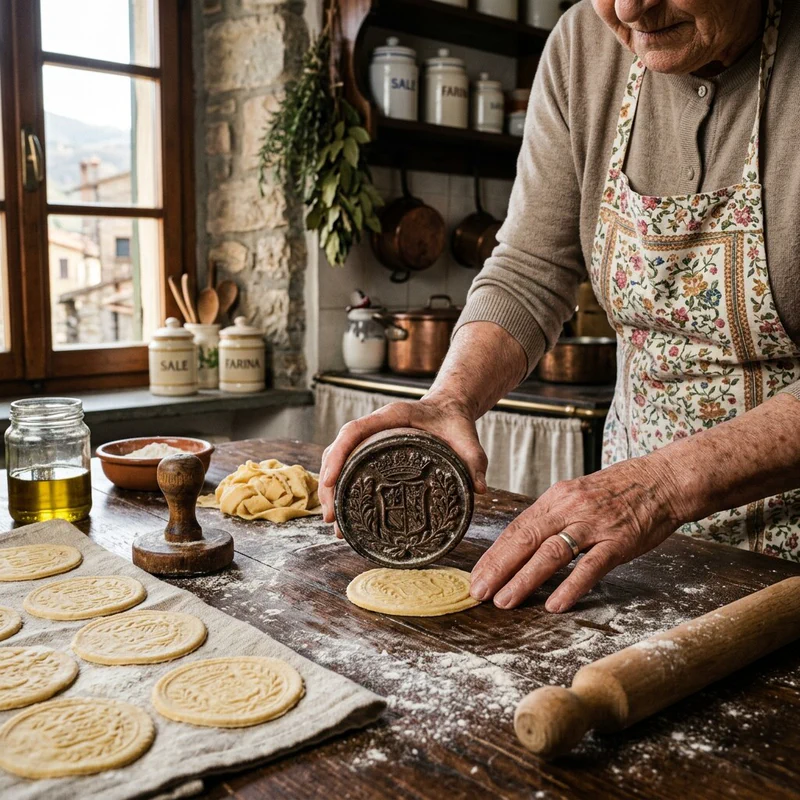
Each disk of dough is pressed between two hand-carved wooden stamps, leaving an embossed design that is both beautiful to look at and functional for holding onto the sauce. It is a tradition that dates back to the middle ages, once used by noble families to display their coats of arms on their dinner plates.
If you love discovering these “Renaissance of taste” secrets, you’ll find a similar soul in my guide to the velvet gold of Ferrara, where the pumpkin pasta reaches a similar level of courtly elegance.
The Art of the Stamp#
The secret of the Corzetti lies in the wooden stamp, or stampo. These are traditionally carved from pear or maple wood—woods that are hard enough to hold a fine detail but won’t impart a bitter taste to the pasta. One side of the stamp is used to cut the circle of dough, while the other two pieces are used to press the design.
Common motifs include wheat stalks, crosses, coats of arms, or even stylized images of the sun. The resulting texture is what makes Corzetti so special; the ridges and valleys created by the stamp are the perfect trap for a rich, nutty walnut sauce (tocco de noci).
And let me tell you, there is no place for industrial, jarred sauces here! My nonna would never forgive me if I used a walnut sauce that wasn’t freshly pounded with a pestle. My biggest pet peeve is seeing these beautiful pasta shapes sold as “dry pasta” in tourist shops—they are often too thick and lose the delicate detail that makes them special. Real Corzetti should be fresh, with a dough that includes a splash of white wine (like Vermentino) to give it elasticity and a subtle depth.
Where to Find the Real Corzetti#
To find the true soul of this tradition, you must head to Varese Ligure in the Val di Vara, often called the ‘Organic Valley.’ This circular medieval village is a stronghold of Ligurian tradition. Here, you can still find master woodcarvers like the Picetti family, who have been hand-carving these stamps for generations. A visit to their workshop is a journey into the soul of the craft—you can smell the fresh wood shavings and see the centuries-old tools.
If you enjoy these kinds of intense, raw experiences that define a landscape, you’ll find a similar spirit in my guide to Marettimo, the wild secret heart of the Mediterranean that my colleague Luca recently explored.
Giulia’s Tips for a Culinary Discovery#
- Ask to See the Stamps: If you find a restaurant serving handmade Corzetti in Chiavari or Lavagna, don’t be afraid to ask to see the stamps. Most owners are incredibly proud of their collection.
- The Traditional Sauce: While pesto is wonderful, Corzetti was historically served with tocco de noci. The creaminess of the nuts combined with a touch of marjoram creates a flavor profile that is quintessentially Ligurian.
- A Unique Souvenir: A hand-carved Corzetti stamp is one of the most beautiful and functional souvenirs you can bring back from Italy. It’s like bringing a piece of the Renaissance into your own kitchen.
As my colleague Marco recently explored in his guide to the Stelvio Pass, Italy is a country that rewards those who take the high roads—whether for the views or for the hidden kitchens at the top.
Liguria’s beauty is often hidden behind the bright colors of its coastal towns. But in the quiet of an inland kitchen, with the rhythmic thud of a wooden stamp, you’ll find the true heart of this region.
Buon appetito, and look for the mark of the artisan!
With love, Giulia