
Riding the Appia Antica has nothing in common with an afternoon on a paved commuter path. Designated a UNESCO World Heritage site in July 2024, the Regina Viarum preserves extensive stretches of original Roman basalt paving that will shake your fillings loose if you turn up on the wrong bike.
The route begins just beyond the Aurelian Walls, barely two kilometres south of the Colosseum. City congestion gives way quickly to an open corridor of umbrella pines, broken marble, and dry sheep pasture. You ride through pale dust and dark volcanic flagstones, accompanied by the scent of pine resin and the steady crunch of gravel under your tread.
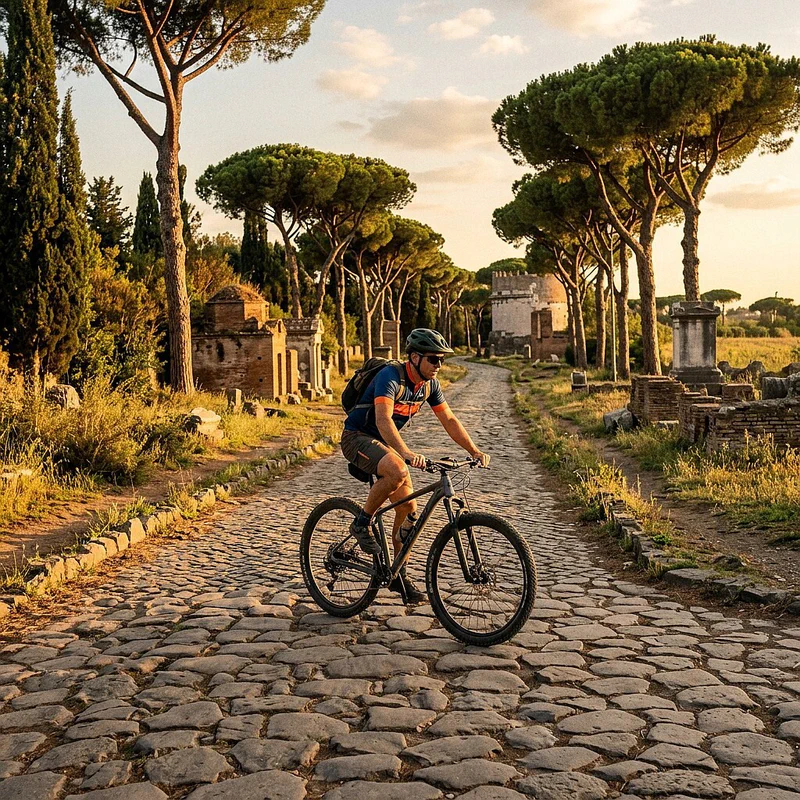
The route: from Porta San Sebastiano toward the Alban Hills#
Porta San Sebastiano provides the natural starting point for the ride, standing as one of the best-preserved gateways in Rome’s ancient defensive perimeter. The initial climb rises gently past the small church of Domine Quo Vadis and the catacombs of San Callisto and San Sebastiano. If you follow historic walking routes, this early stretch shares ground with the walking pilgrimage route through Rome’s historic churches.
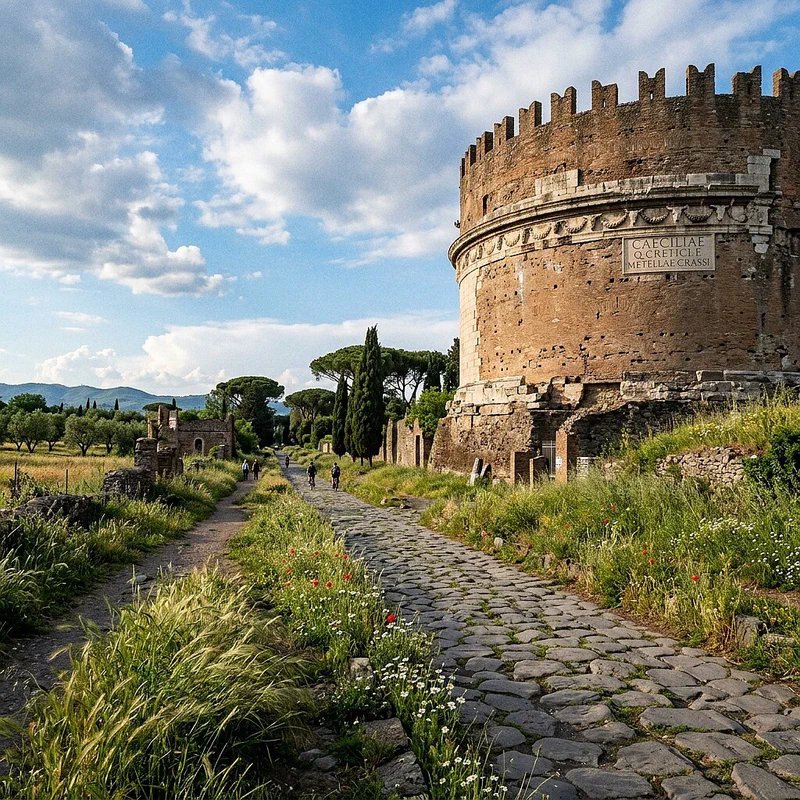
Continuing past the Circus of Maxentius, you reach the massive drum of the Tomb of Cecilia Metella. Up to this landmark, local resident vehicles are permitted on weekdays, requiring extra attention on narrow, blind bends. Beyond the mausoleum, motor vehicles disappear entirely, leaving an unbroken archaeological track stretching south toward the Alban Hills.
Ground and technique: surviving Roman basalt paving#
The genuine Roman basoli under your tires are not smooth cobbles. These polygonal slabs of dense volcanic basalt were laid down over two millennia ago, weathered into deep ruts, sharp edges, and gaps several centimetres wide. Hitting these stones at speed on a rigid fork sends jarring shockwaves straight through your wrists and lower spine.
The practical solution is using the dirt singletracks worn into the grass alongside the ancient roadbed. Roman cyclists call them the side trails: hard-packed ribbons of earth beaten smooth by decades of mountain bike tires. Alternate between short stints on the stones and longer stretches on the dirt lines to save your back and keep your cadence smooth.
Bike choice and gear: what you actually need#
Leave road bikes and narrow-tired city commuters at home. The Appia Antica calls for a cross-country mountain bike with at least 100 millimetres of front suspension travel or a rugged gravel bike with tires measuring at least 40 to 45 millimetres wide. Overinflating your tires is the most common mistake: drop your pressure down near 2 bar (28 to 30 psi) on tubeless setups to gain traction and stop your wheels from bouncing off square stone edges.
Carry tools to stay self-sufficient. Bring a spare tube matching your wheel size, tire levers, a reliable hand pump, and a compact multitool with a chain breaker, as basalt rims can pinch tubes easily on sharp edges. Sturdy trail shoes with grippy rubber outsoles are essential for footing whenever you need to dismount; tackling this ancient stone path in flimsy sandals or smooth leather loafers is a guaranteed recipe for rolled ankles.
On Sundays and public holidays, the entire stretch from Porta San Sebastiano to Cecilia Metella is closed to private motor vehicles. On weekdays, you must share the narrow stone corridor with local cars: plan your ride for Sunday morning to enjoy the road in complete safety.
Best timing and logistics from central Rome#
Spring and autumn offer ideal cycling conditions, bringing crisp mornings, clear light across the ruins, and manageable midday temperatures. Summer turns the open plain into a sun trap: shade is sparse once past the catacombs and dark basalt absorbs heat relentlessly. If you must ride in July or August, roll out at daybreak and aim to finish before eleven in the morning.
To avoid riding through inner-city traffic, take bus 118 from Circo Massimo or Colosseo, which stops directly at Porta San Sebastiano and the catacombs. Cyclists arriving via the Metro A line can disembark at San Giovanni or Colli Albani and reach the park boundary in roughly ten minutes along secondary roads.
Water points and food stops along the way#
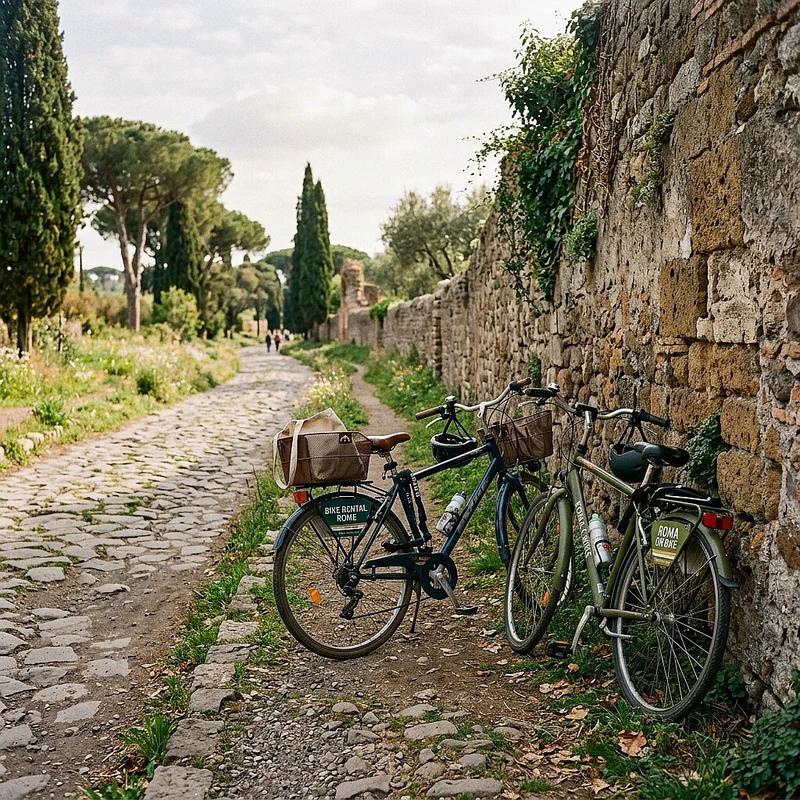
Fill your bottles before rolling past Cecilia Metella. The early miles feature several historic Roman nasoni public fountains providing cold potable water, but past the fourth mile marker, fresh water vanishes until you reach the outer suburbs. Carrying two full bottles on your frame or in a hydration pack is mandatory if you plan to push fifteen kilometres south to Santa Maria delle Mole.
For food, Appia Antica Caffè sits opposite Cecilia Metella, serving simple paninis, espresso, and cold drinks with outdoor tables. Those looking for a sit-down meal can stop at Trattoria Priscilla or Hostaria Antica Roma, established trattorias serving Roman pasta classics to recharge before the journey back to town.
Trail etiquette and monument protection#
The Appian Way is a shared historic monument where pedestrians, archaeological tour groups, and families always hold right of way. Approach walkers at a modest pace, tap your bell well in advance, and pass on the wide side without kicking up dust clouds. This ancient corridor is an open ruin, not a downhill racecourse.
Leave zero trace of your ride behind. Carry out every scrap of waste, including energy gel wrappers, snack foils, and discarded inner tubes punctured on basalt edges. Above all, leave Bluetooth speakers at home: the wind in the maritime pines and the quiet rumble of rubber over stone are the entire reason to ride out here.