Hello everyone, I’m Luca. If you’re looking for the most authentic face of Italy, the one that doesn’t appear in the glossy advertisements of major tour operators, let me accompany you into the pulsating heart of Salento. This is not just a summer destination; it is a “thin land” wedged between two seas, where the sun burns the Lecce stone and the wind tells stories of Greeks, Byzantines, and pirates.
Imagine wandering through villages kissed by a blinding light, where the air smells of salt, maritime pine, and wood burning in ovens at dawn. Here, beauty never screams to attract attention, but reveals itself discreetly among the folds of a dead-end alley or in the cool shadow of a millenary olive tree that looks like a living sculpture.
Beyond the Coast: The Soul of Grecia Salentina#
While most people crowd the seafronts of Gallipoli, I prefer to lose myself in the hinterland, in the so-called Grecia Salentina. It is a linguistic and cultural island where centers like Sternatia, Martano, or Corigliano d’Otranto still preserve the echo of griko, an ancient neo-Greek dialect.
Walking through Sternatia at noon, when the silence is interrupted only by the buzzing of cicadas, is an almost mystical experience. Don’t miss the noble palaces with their secret gardens hidden behind imposing doors. If this “slow” and rural travel style fascinates you, my colleague Elena has written a wonderful guide on the magic of fortified Apulian masserias, places where time seems to have stopped at the rhythms of the earth.
The Contrast of the Two Seas: Adriatic vs. Ionian#
The magic of Salento lies in its geographical duality. In less than half an hour by car, you can pass from the dramatic cliffs in the east to the sandy dunes in the west.
The Adriatic: The Coast of Rocks and Myths#
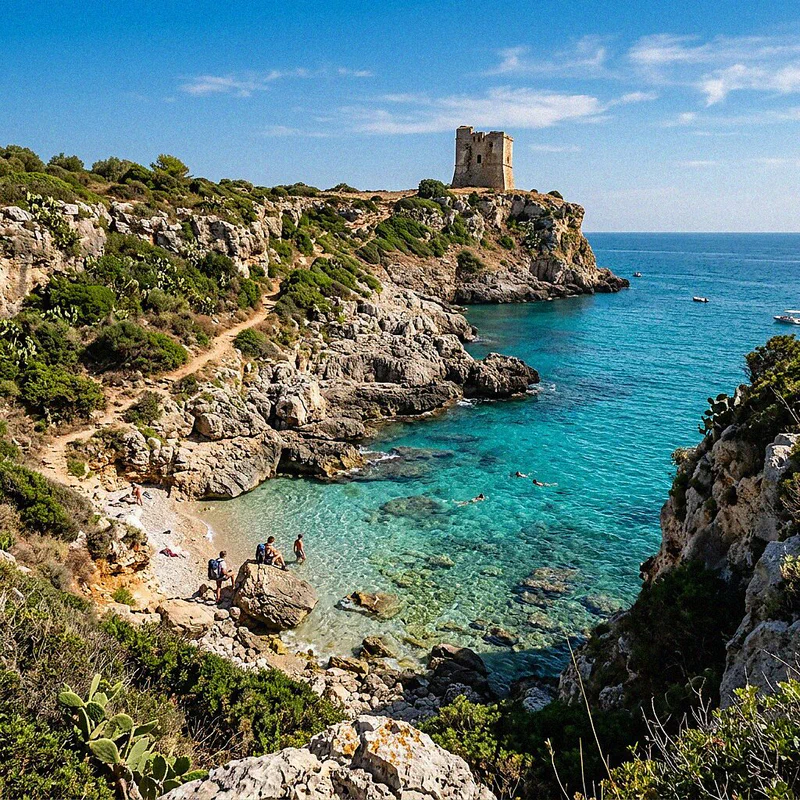
Starting from Otranto heading south, the coastal road is a masterpiece of naturalistic engineering.
- Porto Badisco: Legend has it that it was Aeneas’s first landing in Italy. It is a small sheltered inlet where the sea has the color of emerald.
- Grotta della Poesia (Roca): Beautiful, sure, but now it’s become a selfie-tourist trap. My secret tip: avoid it during the central hours or look for the lesser-known coves just a kilometer further north, where you can dive in solitude.
- Heart Coordinates: 40.134° N, 18.502° E (Torre del Serpente). A viewpoint where the blue of the Adriatic meets the sky without filters.
The Ionian: Golden Dunes and Caribbean Waters#
To the west, the landscape changes radically.
- Porto Selvaggio: One of my favorite places. You don’t arrive here by car; you have to walk for about 20 minutes under a thick pine forest before coming out into a bay of white pebbles with underground fresh water springs that make the sea incredibly fresh.
- Punta della Suina: Often called “the Caribbean of the Ionian.” It is wild, smelling of myrtle, and offers sunsets that will make you forget every stress.
If after so much sea you feel like immersing yourself in the most genuine urban history, I recommend heading back up the coast to the north; my colleague Giulia has revealed the secrets of Bari Vecchia in search of handmade orecchiette.
Luca’s Pet Peeves: Don’t Call It “Maldives”#
I want to be blunt. One of my biggest pet peeves is the use of the term “Maldives of Salento.” It is a commercial label that devalues the unique identity of this land. Salento doesn’t need to compare itself to exotic places; it has its watchtowers, its dry stone walls, and its light that has no equal.
Another pet peeve? The beach clubs that blast dance music at full volume covering the sound of the waves. Look for the free beaches or the “slow” establishments that respect the silence. Salento is listened to, not screamed at.
Flavors that Defy Time#
The cuisine here is sincere, sometimes brutal in its simplicity, but always unforgettable.
- Iced coffee with almond milk: It is the mandatory morning ritual. Don’t call it “iced coffee,” it’s a religion. Ask for Quarta coffee, the one roasted in Lecce, for an authentic experience.
- Puccia Salentina: But the real one, made with wood-fired bread dough and stuffed with vegetables in oil, olives, and local cheeses. Beware of the fast-food versions you’ll find in the most touristy centers.
- Ciceri e Tria: A dish that smells of history, where the pasta is partly boiled and partly fried, mixed with creamy chickpeas.
The Explorer’s Secret: The Cipolliane Path#
If you really want to see something that 99% of tourists ignore, go near Marina di Novaglie and take the Cipolliane Path. It is a path overlooking the sea that connects Novaglie to the splendid inlet of Marina Serra. You will walk among caves that were once shelters for fishermen and shepherds, surrounded by vegetation that looks like that of a Greek island. It is wild, demanding on the legs, but rejuvenating for the spirit.
Luca’s final tip: Come here in May or September. The land is less parched, the people have more time to tell you stories, and you can enjoy the sea without the soundtrack of your umbrella neighbors.
Salento isn’t just visited; it is crossed. And, if you do it with the right spirit, you will realize that a piece of you will remain forever among those twisted olive trees that look at the sea.
Stay rebellious and keep searching for the unknown.
See you soon, Luca
If you enjoyed this, see the article on Discovering Italy’s Hidden Gems for more off-the-beaten-path destinations to explore, including the charming region of Emilia-Romagna, known for its rich culinary heritage and picturesque landscapes.