Ciao! I’m Marco. Whether I’m hugging the sharp curves of the Amalfi Coast or navigating the rolling hills of Tuscany, you’ll always find me behind the wheel. As an adventurous car enthusiast, I’m here to share the thrill of the Italian road trip—giving you the best routes, hidden parking spots, and practical driving tips so you can discover the true freedom of traveling Italy by car. If you’re also a wine enthusiast, be sure to check out my colleague Alessandro’s article about Uncorking Italy’s Finest Wine Country for insider knowledge on the country’s most iconic wine regions.
Driving the Stelvio Pass: Is Italy’s Legendary Mountain Road Worth the Hype? Marco’s Insider Guide!#

Ah, the Stelvio Pass. Just the name conjures images of endless hairpin turns, dramatic Alpine vistas, and the roar of an engine echoing off ancient peaks. For years, I’d heard the whispers, seen the photos, and read the breathless accounts. “The greatest driving road in the world!” some proclaimed. Others warned of traffic, tight corners, and dizzying heights. So, I had to find out for myself: is driving the Stelvio Pass truly worth all the hype? Spoiler alert: Assolutamente sì! But it’s not without its quirks, and I’m here to give you the real, unvarnished truth, along with all my insider tips for conquering this legendary Italian beast.
My First Dance with the Queen of the Alps#
My first encounter with the Stelvio Pass was a few summers ago, on a glorious June morning. I was in a feisty little Alfa Romeo Giulia, a car made for spirited mountain driving, and I’d spent the previous night in the charming town of Bormio, nestled in the Valtellina valley. Waking up before dawn, the air was crisp, and the anticipation was palpable. I grabbed a quick espresso and a cornetto from a local pasticceria in Bormio’s historic center, then hit the road before the crowds even thought about stirring. This, my friends, is one of the Stelvio’s hidden booking secrets: early bird gets the clear road!
I started my ascent from the Bormio side, taking the SS38. This approach is often considered the “kinder” introduction compared to the notorious Prato side, with its 34 rather sweeping hairpin turns and a few tunnels in the lower part. The road immediately begins to climb with significant slopes, passing by the famous Bagni di Bormio thermal baths. On the road, I discovered that even this “easier” side demands respect. The road hugs the mountainside, offering glimpses of the valley below as you gain altitude. The engineering marvel of this road, originally built between 1820 and 1825 by the Austrian Empire, is truly something to behold.
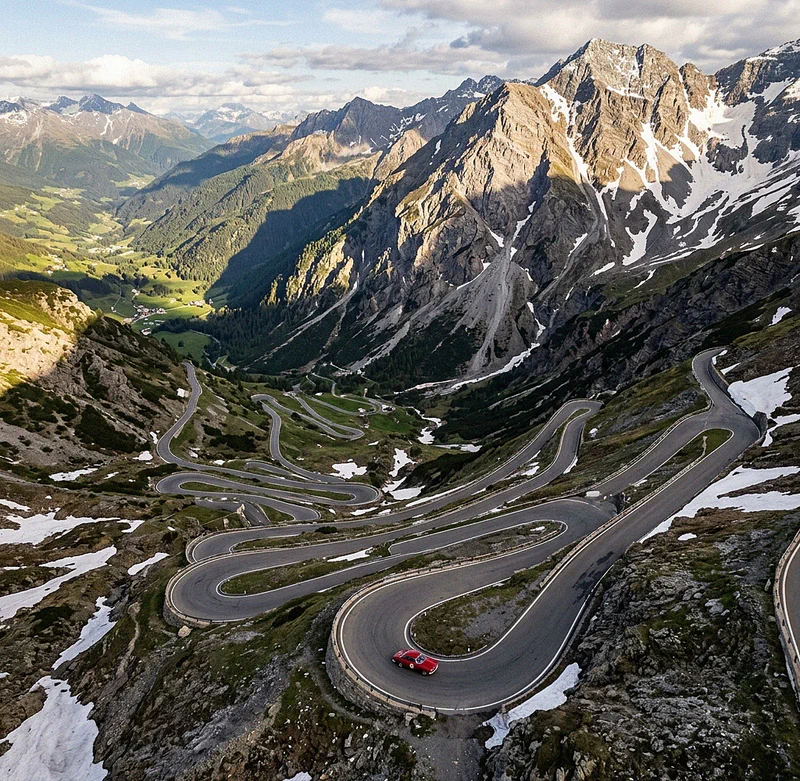
But it was the next day, tackling the iconic 48 hairpins from the Prato allo Stelvio side, that truly blew me away. I drove down from the summit towards Prato, then turned around to experience the full, breathtaking climb. The numbered stone markers counting down the hairpins are a constant reminder of the challenge and progress. Each tornante (hairpin turn) is a test of nerve and skill, demanding precise steering and throttle control. The views, as you climb higher and higher, are simply beyond words. Snow-capped peaks, verdant valleys, and the ribbon of asphalt snaking its way up the mountain – it’s a symphony for the senses.
What Makes Stelvio So Special? It’s More Than Just a Road!#
At an elevation of 2,757 meters (9,045 ft) above sea level, the Stelvio Pass is the highest paved mountain pass in Italy and the second highest in the Alps. It connects Lombardy and South Tyrol in Italy, and is just a stone’s throw from the Swiss border. But it’s not just the altitude or the sheer number of bends that make it legendary.
- The Hairpin Ballet: The 48 hairpins on the northern (Prato) side are world-famous. They’re tightly packed, often narrow, and demand your full attention. It’s a constant dance between accelerator, brake, and steering wheel, a true driver’s road that rewards precision.
- Panoramic Perfection: The views are, quite frankly, spectacular. As you ascend, the landscape transforms from lush valleys to rugged, high-alpine terrain. At the summit, you’re greeted with a 360-degree panorama of the Ortler Alps, including the majestic King Ortler itself. It’s the kind of view that makes you pull over, take a deep breath, and just soak it all in.
- A Slice of History: This road isn’t just about driving; it’s steeped in history. Built for strategic connections, it even became a battleground during World War I, known as the “White War” due to the extreme conditions. There’s a Carlo Donegani museum at the summit, dedicated to the engineer who designed this masterpiece.
- The Top Gear Effect: Let’s be honest, for many, the Stelvio Pass gained international fame after being featured on BBC’s Top Gear, where Jeremy Clarkson famously declared it “the greatest driving road in the world.” While opinions may vary (and they later crowned another road), the segment undeniably cemented Stelvio’s place on every petrolhead’s bucket list.
Marco’s Practical Tips for Conquering the Stelvio Pass#
Alright, my friends, let’s get down to business. You want to experience the Stelvio, and I want you to do it right. Here’s how:
1. When to Visit: Timing is Everything!#
The Stelvio Pass is a seasonal road, typically open from late May or early June to October or early November, depending on snow conditions. Trust me, you don’t want to be caught in an early season snowfall!
- My Recommendation: Early June or September. In June, the snow walls can still be dramatically high, making for incredible photos, and the summer crowds haven’t fully descended. September offers cooler temperatures, stunning autumn colors, and often fewer tourists, though you risk earlier closures due to snow.
- Avoid: July and August. This is peak tourist season, and the road can get incredibly busy with cars, motorcycles, and thousands of cyclists. If you go then, start your drive before 8 AM or after 7 PM to beat the worst of the traffic.
- Special Event: Be aware of the Stelvio Bike Day, usually held on the last Saturday of August or first Saturday of September, when the pass is closed to motor vehicles for cyclists. Check dates before you go!
2. How to Get There & Which Way to Drive#
You have three main approaches to the Stelvio Pass:
- From Prato allo Stelvio (SS38 - Northern Side): This is the iconic route with the 48 numbered hairpins. It’s a challenging climb, relentlessly twisting its way up the mountainside. If you want the full “Stelvio experience,” this is the side to ascend. It’s a true test of driving skill.
- From Bormio (SS38 - Southern Side): This approach is longer and generally less steep, with about 34 hairpin turns and some tunnels. It’s a fantastic warm-up and offers a different perspective. Many drivers choose to ascend from Prato and descend towards Bormio, or vice-versa.
- From Santa Maria Val Müstair, Switzerland (Umbrail Pass): This route connects to the Stelvio summit via the Umbrail Pass, which is the highest paved mountain pass in Switzerland. It’s a fantastic, quieter alternative, offering stunning views and a chance to experience a different side of the Alps. I’ve done this loop, taking the Umbrail Pass down from Stelvio, and it was a surprisingly smooth and traffic-free descent.
My Pro Tip: If you’re going for the pure driving thrill, ascend from Prato allo Stelvio. The best part of this route is the sheer, exhilarating challenge of those 48 bends, each one a mini-victory!
3. Your Ride: Car Rental & Preparation#
- Choose Wisely: For a road like Stelvio, a nimble car with good brakes and precise steering is key. A compact sports car or a well-maintained manual transmission vehicle will give you the most engaging experience. Forget about massive SUVs if you want to truly enjoy the hairpins.
- Check Your Brakes: Before you start any serious mountain driving, ensure your brakes are in top condition. You’ll be using them a lot, especially on the descent.
- Fuel Up: There are services at the summit, but it’s always wise to fill your tank in towns like Bormio or Prato before you begin your climb.
- Tires: While not strictly mandatory in summer, having good, reliable tires is crucial. In early or late season, be prepared for colder temperatures and potentially even snow at the summit, so check weather forecasts.
4. Parking & Stopping#
- At the Summit: There’s ample parking at the Stelvio Pass summit itself, though it can get crowded. You’ll find souvenir shops, food stalls, and the famous Rifugio Garibaldi and Rifugio Tibet.
- Viewpoints: Along both the Prato and Bormio sides, there are occasional pull-offs for photo opportunities. Use them! Just be mindful of other traffic.
5. Driving Etiquette & Safety#
- Share the Road: The Stelvio Pass is popular with motorcyclists and cyclists. Be patient, give them plenty of space, and always expect someone around the next blind corner.
- Blind Corners: Many of the hairpins are blind. Use your horn briefly before entering a tight, blind turn, especially on the ascent, to alert oncoming traffic.
- Take Your Time: This isn’t a race (unless you’re on a closed track!). Enjoy the scenery, focus on smooth driving, and respect the road. Overtaking is often impossible and dangerous due to the narrowness of the road.
Beyond the Hairpins: What to Do at the Summit and Nearby#
The drive itself is the main event, but don’t just turn around and leave!
At the Summit (2,757m):
- Rifugio Garibaldi / Rifugio Tibet: Grab a well-deserved hot chocolate, a hearty panino, or even a full meal. The cotoletta and beer at Rifugio Tibet after a tough climb are legendary!
- Souvenir Shops: Pick up a “Stelvio Pass” sticker for your car – it’s a badge of honor!
- Walk to Dreisprachenspitze: Just above the pass, a short walk takes you to the “Three Languages Peak” (Dreisprachenspitze), where the Italian-speaking, German-speaking, and Romansh-speaking areas meet. You can also reach Monte Scorluzzo (3095m) in about 90-120 minutes from the pass.
- Stelvio National Park: You’re in one of Italy’s largest and oldest national parks. Take a moment to appreciate the pristine Alpine environment. There are hiking trails directly from the pass, some leading to the Cima Garibaldi (2843m) or Rifugio Pirovano (3028m).
Nearby Towns:
- Bormio: A fantastic base with a charming old town, rich history, and famous thermal baths (Bagni Vecchi and Bagni Nuovi) perfect for relaxing after your drive. You can also explore the Civic Museum or the medieval Torre degli Alberti.
- Prato allo Stelvio / Trafoi: Quaint villages on the northern side, offering a gateway to the pass and the Stelvio National Park. Trafoi, at the foot of the Ortler mountain, is a great spot for hikers.
- Glorenza (Glurns): A beautifully preserved medieval walled town about an hour’s drive from the pass, often called the “Carcassonne of the Alps.” A great cultural stop.
The Verdict: Is Stelvio Pass Worth the Hype?#
After multiple visits and countless kilometers on its asphalt, I can confidently say: YES, absolutely! The Stelvio Pass is unequivocally worth the hype! It’s not just a road; it’s an experience, a challenge, and a feast for the eyes. The combination of incredible engineering, breathtaking scenery, and the sheer thrill of navigating those legendary hairpins creates an unforgettable memory for any car enthusiast.
If you’re driving in the Italian Alps, don’t miss the chance to experience this masterpiece. It’s a bucket-list drive that lives up to its reputation. Just remember my tips, pack your sense of adventure, and prepare for one of the most exhilarating drives of your life. Trust me, the moment you reach the summit, look back at the winding road you’ve just conquered, and take in the vastness of the Alps, you’ll know exactly what I mean.
Buon viaggio, amici! See you on the road!