
If you think you’ve seen everything Italy has to offer from the window of a train or a tour bus, you’re on the wrong track. To truly feel the pulse of this country, you need a steering wheel in your hands, rear-wheel drive (if possible), and a full tank. While everyone else is fighting for a parking spot on the Amalfi Coast, I’ve pointed the nose of my car toward the rugged and brutal beauty of Abruzzo.
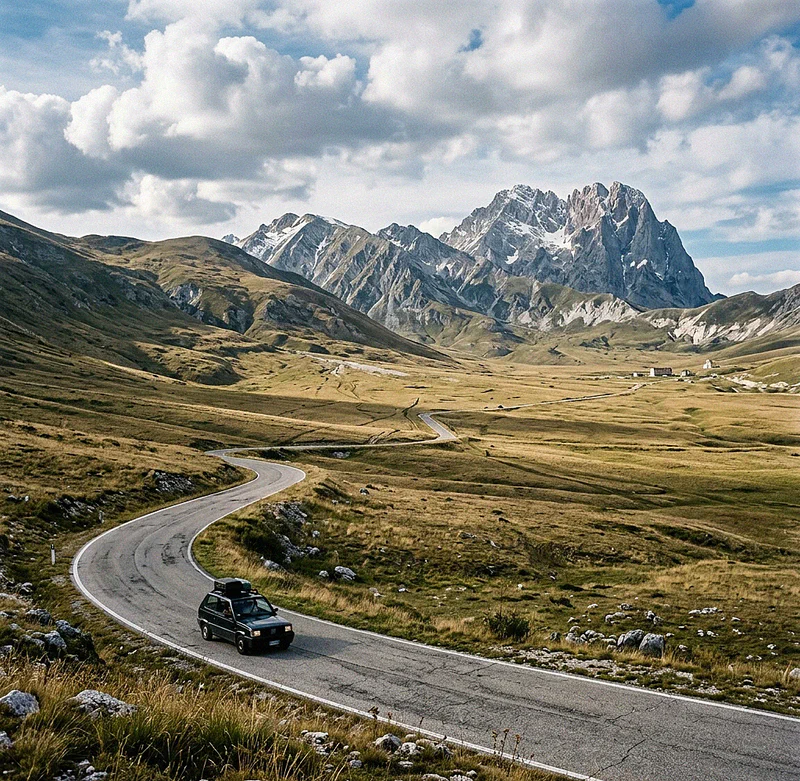
Welcome to Campo Imperatore. We call it “Little Tibet,” and it’s a place where the asphalt isn’t just a transport link, but an invitation to dance among the clouds. It’s a vast plateau that looks like it’s straight out of a Sergio Leone movie, where freedom has the scent of mountain grass and lamb fat on the grill.
The Route: Climbing the Gran Sasso#
The journey begins in Castel del Monte, a medieval village that seems carved out of the living rock. If you’re looking to stretch your legs after the climb, my colleague Martina has mapped out an incredible multi-day trek through these very peaks. From here, take the SR17bis. It’s a road that climbs with magnificent progression. If you love villages that defy gravity, my colleague Luca recently discovered the vertical beauty of Castelmezzano, but Abruzzo has a wilder, less polished soul.
As you climb, the trees vanish, giving way to a 27-kilometer-long karst plateau. This is where driving becomes pure joy: wide-radius curves that allow you to feel the balance of the car and endless straights where the only limit is the horizon. This land of stone and history reminds me much of the noble travertine of Ascoli Piceno described by Alessandro, but here the stone is raw and wind-beaten.
Campo Imperatore: The Set of Great Cinema#
Update: Reaching the Rifugio Campo Imperatore (2,130 m) is like arriving at the end of the world. The silence is broken only by the wind. It’s no coincidence that this place was the set for dozens of “Spaghetti Westerns” and cult films. If you are planning this trip after visiting the cities of art, remember that there is no ZTL here: the only limit is the weather. Speaking of reborn cities of art, Alessandro has written a touching piece on the rebirth of L’Aquila, which is located right at the foot of these mountains.
Marco’s Pet Peeves: Arrosticini Smoke and “Bar” Bikers#
I want to talk to you about my pet peeves: people who arrive at Campo Imperatore and don’t know how to handle the arrosticini. Stopping at Ristoro Mucciante or Zio Giulio is a must, but if you start cooking the meat without turning it with the right rhythm or, worse, ask for ketchup, you risk a gastronomic lynching. Arrosticini are eaten hot, salted, and with your hands. Period.
And then there are the “bar” bikers who park their shiny machines right in the middle of the parking areas, making it impossible for us with four wheels to admire the view. Guys, the road belongs to everyone, but a bit of civic sense in parking wouldn’t hurt. And please, don’t litter: this ecosystem is as majestic as it is fragile.
Technical Tips for the Abruzzese Pilot#
Winter Update: If you visit when the roads are white, don’t miss Martina’s guide to snowshoeing the Gran Sasso; it’s the only way to see the plateau when the asphalt is buried.
- Engine Braking: The inclines are serious. Don’t “ride” your brakes for miles; downshift and let the engine manage the speed. If you have smoking brakes upon arrival, you’ve done everything wrong.
- Fuel Management: Once on the plateau, gas pumps are a mirage. Fill your tank in Castel del Monte or Santo Stefano di Sessanio.
- Safety Coordinates: 42.443° N, 13.558° E (Campo Imperatore Plain). Stop here to take the definitive photo of your vehicle with the Gran Sasso behind it.
Abruzzo cannot be explained, it must be driven. It’s a sensory experience that will remind you why you learned to drive: not to move, but to feel alive.
Shift into the right gear and leave civilization behind.