
While the vast majority of international travelers flock to the iconic towers of San Gimignano or pour into the crowded Renaissance streets of Florence, my instinct as a historian and traveler often pushes me in a different direction. My heart unfailingly guides me towards the rugged and windswept hills of the Cecina Valley, a landscape that seems painted with the colors of burnt earth and clay.
Here, perched dramatically and proudly on a high and impregnable plateau, lies Volterra, a city that exudes an ancient, powerful, and in some ways still mysterious energy. It is one of those rare destinations in Italy that are not content with simply being admired; they demand to be understood and listened to in religious silence.
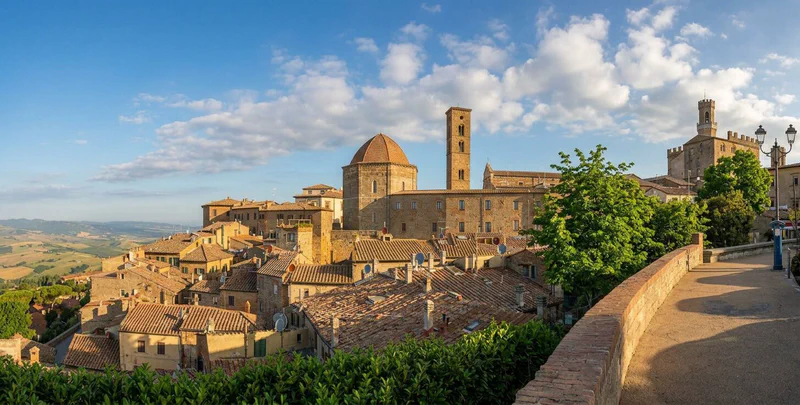
I am Alessandro, and every single time I cross the mighty monolithic gates of this city of stone, I have the distinct sensation of shedding the clothes of a simple tourist to put on those of a privileged witness to history.
Volterra is not just a beautiful Tuscan destination to photograph and forget; it is a complex, stratified chronicle of human civilization. From its foundations laid at the dawn of the fascinating Etruscan civilization, through the imposing engineering and power of ancient Rome, to the dark and severe charm of the Middle Ages, every street tells a different era.
The Gate of Antiquity: The Charm of the Etruscan Arch#
Our journey through time within Volterra must necessarily begin in front of the Porta all’Arco, universally known as the Etruscan Arch (Arco Etrusco). Dating back to the 4th century BC, this cyclopean portal represents one of the very few architectural monuments of the Etruscan era that has survived to us in such a state of preservation. It is, to all intents and purposes, one of the oldest urban portals in Italy.
The Three Mysterious Heads#
What immediately strikes the visitor is not only the titanic bulk of the tuff blocks fitted together without mortar, but above all the three figures carved in dark volcanic basalt that protrude menacingly from the arch. These heads, spectrally eroded by two thousand four hundred years of wind and rain, represent tutelary deities (perhaps Tinia, Uni, and Menrva, the Etruscan equivalent of the Roman Capitoline triad) set to guard the city.
Staring at those worn basalt heads, one suddenly realizes they are physically standing on the threshold of an archaic world, animated by divinatory rituals and chthonic cults. If, like me, you love losing yourself in the atmosphere of intact villages that seem like real time machines capable of hibernating the medieval and ancient soul of our peninsula, I highly recommend picking up my travel notes on the hidden secrets and magic of Bevagna in Umbria, which I have later integrated into my itinerary.
The Roman Theater and the Augustan Legacy#
Descending slightly from the original core of the medieval historic center and looking out over the northern slopes of the hill, you come across a spectacular leap in time: the majestic ruins of the Roman Theater of Vallebuona.
Built in the Augustan age, straddling the end of the 1st century BC and the beginning of the 1st century AD, this archaeological complex is unanimously considered one of the best-preserved Roman-era theaters in all of peninsular Italy. It was brought to light only in the 1950s thanks to the stubbornness of a local antiquarian, and had been covered over the centuries by debris and even used as a dump during the Middle Ages.
A Natural Amphitheater of History#
Sitting today on the few surviving stone steps, enveloped by the scent of wild rosemary bushes growing among the ruins, is a deeply touching experience. Imagining over three thousand spectators (the estimated capacity at the time of its maximum splendor) sitting on this semicircular cavea, watching Latin comedies while the sun sets over the rugged hills of the Cecina Valley, is an extraordinary exercise in collective memory. Behind the stage, you can still admire the remains of the Roman baths, added centuries later, with their intricate mosaic floors that have survived the wear and tear of time.
The White Gold of Volterra: The Magic of Alabaster#
One cannot claim to truly know Volterra and to have understood its deepest essence without first entering, on tiptoe and wide-eyed, one of its dusty alabaster workshops.
Alabaster is not a simple mineral for this city; it is the white blood that flows through its veins. This chalky stone, warm, soft to the touch, and extraordinarily translucent, has been extracted and worked in this specific territory without interruption since the time of the Etruscans, who cleverly used it to carve their refined cinerary urns.
The Art of White Dust#
Today, walking through the narrow paved alleys of the historic center (especially along Via di Sotto or Via delle Prigioni), you will hear the rhythmic sound of chisels and see impalpable clouds of white dust filtering from the half-open doors of the workshops. Observing a master craftsman as he transforms a rough, opaque block into a luminescent sculpture, almost as thin as tissue paper, is to witness a secular rite that challenges the very concept of time. Volterra alabaster is “stone gold”, and buying a small local artifact is not simple shopping, but vital support for a millennial tradition that risks disappearing.
Practical Tips for Experiencing Volterra at its Best#
To explore Volterra avoiding the classic tourist traps and living a truly authentic experience, I leave you with some of my personal travel tips:
- The Guarnacci Etruscan Museum: Do not skip it for any reason in the world. It is one of the most important archaeological museums in Europe. Dedicate time to the famous statuette of the “Shadow of the Evening” (Ombra della Sera), an elongated and enigmatic bronze figure, which with its impossible proportions anticipates Giacometti’s contemporary art by three thousand years. It is one of the most fascinating and disturbing works of antiquity.
- Piazza dei Priori: This is the political and medieval heart of the city. The Palazzo dei Priori (the oldest town hall in Tuscany, completed in 1257) served as an architectural model for none other than Palazzo Vecchio in Florence. Climb the tower to enjoy a view that sweeps down to the Tyrrhenian Sea on the clearest days.
- Balze of Volterra: Take a walk outside the walls to observe this impressive phenomenon of geological erosion. The balze are huge gullied chasms that over the centuries have swallowed up Etruscan necropolises, churches, and entire neighborhoods. A natural memento mori on the fragility of human work.
(Update: Many of you visit Volterra as a scenic detour from the Tuscan capital. If you are planning to reach these villages with your car during a broader trip and are based in Florence, consult beforehand my colleague Marco’s essential survival guide dedicated to how to stress-free manage the difficult and expensive parking in Florence and the ZTL zones, vital to avoid nasty surprises and hefty fines).
Volterra is a proud and severe city, a place that requires patience, respect, and much silence to be fully understood. Look out from its ancient walls to gaze at the valley below; you will understand why those who lived there for millennia believed that the divinity lived right here, in this earth sculpted by the wind.
Happy exploring, Alessandro