
Sometimes, when I walk alone along the dusty roads of the Tuscan province, I have the distinct and disturbing sensation of walking on a very thin crust of time. It is as if entire centuries of undeciphered secrets were simply waiting for the right moment to re-emerge from beneath my feet. Today I am taking you to a place where this metaphysical perception takes on physical, cold, and real contours: I am taking you to discover Chiusi.
I am Alessandro, and located in the deep south-east of Tuscany, a step away from the green border of Umbria, Chiusi is not just any medieval village. It was, in a now forgotten time, Clevsin, one of the twelve most flourishing and powerful city-states of the entire Etruscan Dodecapolis.
While the vast majority of tourists stop to admire the perfect geometries of the Renaissance in Florence or Siena, my instinct as a historian pushes me to dig literally into the darkest layers, to understand a very advanced civilization that dominated Italy long before the eagle of Rome spread its wings.
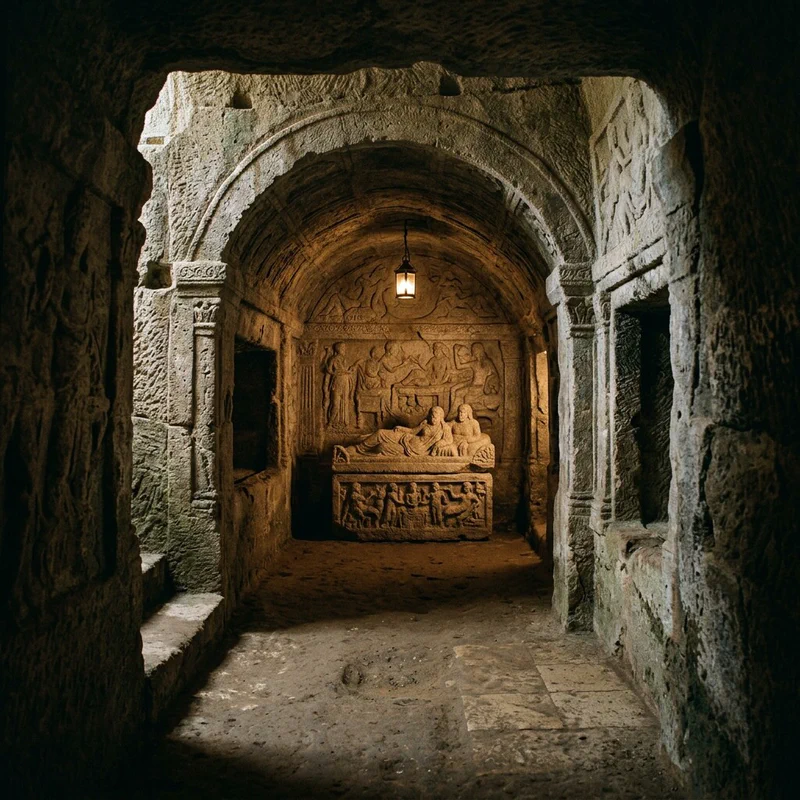
Arriving in Chiusi means preparing for an introspective journey. The modern city, picturesque and sleepy on the surface, rests exactly above its Etruscan double: an underground city carved into the soft and friable volcanic tuff, designed not for the living, but to house the souls of the dead.
The Infinite Mystery of Porsenna’s Labyrinth#
The beating heart of this archaeological experience is undoubtedly the descent into the so-called Labyrinth of Porsenna. Historical sources and popular legends, intertwining for centuries, narrated that the formidable and astute Etruscan king Porsenna (the one who came to besiege the rising Rome) had been buried right under his city.
The myth tells of an impregnable mausoleum, a solid gold sarcophagus guarded by a bronze chariot pulled by horses and surrounded by no fewer than five thousand pure gold chicks.
Engineering Under the Cathedral#
Thousands of adventurers and tomb raiders have searched for this fabulous treasure over the centuries, without success. Although the gold has remained an unreachable myth, the “labyrinth” itself exists and can be visited. With direct access from the Cathedral Museum, you will descend into an intricate network of narrow and damp tunnels.
In reality, modern archaeologists have revealed that it is not the king’s mausoleum, but an extremely ingenious water supply and drainage system from the Etruscan-Roman era. Walking with your head bowed in these dark passages, touching the tuff walls marked by the pickaxes of slaves millennia ago, generates a sense of claustrophobia mixed with deep respect for the engineering skills of this people.
“The Underground City” Civic Museum: Epigraphs and Secrets#
If the labyrinth under the cathedral gave you a sense of emptiness, the Civic Museum “The Underground City” will give you a sense of the word. This museum, unique in its kind, houses the world’s largest collection of Etruscan inscriptions (about 500 epigraphs and 300 cinerary urns) displayed in an underground environment that recreates the original atmosphere of the finds.
Here, the cinerary urns are not simple objects, but portraits of individuals claiming their identity. The inscriptions, still partly undeciphered in their profound meaning, tell names of families, social hierarchies, and a language that seems to come from another dimension. Walking among these rows of speaking stones is an experience that every lover of ancient history should have at least once.
The Painted Tombs: A Banquet for Eternity#
Coming out of the darkness and moving a few kilometers into the surrounding countryside, you enter the real realm of the dead. The Etruscans decorated the houses of their deceased as if the afterlife were a festive continuation of earthly life.
The Tomb of the Monkey#
The most shocking site is the Tomb of the Monkey (480 BC). On the walls are painted scenes of daily life elevated to myth: athletic games, wrestlers, musicians, and graceful dancers. The name comes from a small monkey painted on a branch, a symbol of the exotic luxury of the Chiusi elite.
The Tomb of the Hill#
Not far away is the Tomb of the Hill, where the colors depict opulent banquets. Men and women sit together on the couches drinking wine, testifying to a gender equality that Greek historians considered scandalous. It is the image of a people who loved life until the last moment.
Faces of Stone: The National Archaeological Museum#
Do not leave Chiusi without visiting the National Archaeological Museum. The rooms house the famous canopi of Chiusi: cinerary vases surmounted by lids in the shape of a human head. The faces are not idealized, but present marked and expressive features. Staring at them means meeting the gaze of men and women who lived three thousand years ago, who seem to whisper stories in a language that we have not yet completely translated.
Beyond the Tuff: Flavors and Nature#
Chiusi is not just ash and stone; it is also a generous land that knows how to nourish the body after nourishing the spirit.
- Chiusi Pici: The true local gastronomic glory. This hand-rolled pasta, thick and rough, is the quintessence of poor Tuscan cuisine. In Chiusi they are eaten strictly “all’aglione” (a variety of giant and delicate local garlic) or with duck sauce.
- Lake Chiusi: A few minutes from the center, this body of water offers a perfect contrast to the darkness of the tunnels. It is the ideal place for a sunset walk or to taste “Brustico”, a lake fish dish cooked directly on the flame of lake reeds.
(Update: If the magnetism of the Etruscans has captured you, I invite you to read my report on Volterra, the enigmatic city of alabaster. If you are looking for an immersion in the most authentic Tuscan flavors, my colleague Giulia has recently revealed the secrets of traditional bread making in Montepulciano, just a few kilometers from here).
Chiusi shares with Umbria a centuries-old attitude towards the care of the fruits of the earth. (Update: My colleague Giulia has recently traced a path dedicated to savoring spring among the vineyards of Umbria, a perfect continuation of this journey).
Chiusi is proof that Italy’s history is written beneath our steps, carved in tuff, ready to dialogue with those who have the courage to leave the light to go down into the dark.
Happy exploring, Alessandro