
Hello! I’m Marco. Today we’re pointing the nose of the car toward the far northeastern border of Italy, to a place where borders are not walls, but bridges of asphalt and history. I’m taking you to Gorizia, a city that has spent centuries at the crossroads of Latin, Slavic, and Germanic cultures. If you love the thrill of driving along Italy’s most scenic routes, I assure you that the stretch leading here, through the vineyards of the Collio, will give you unique emotions.
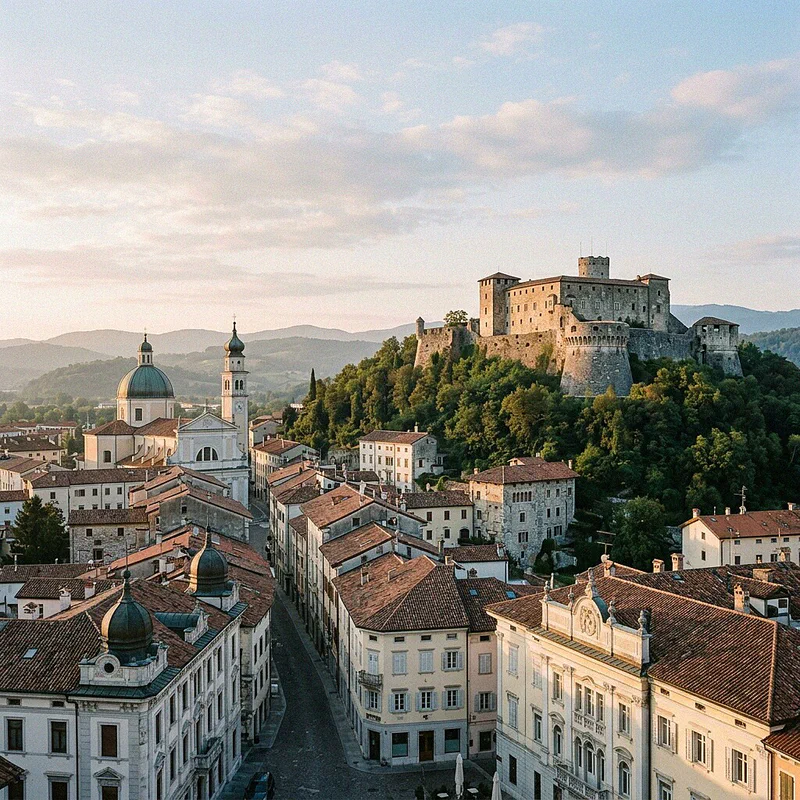
Two Cities, One Heart: Go! 2025#
Update: In 2025, Gorizia, together with its Slovenian “twin” Nova Gorica, will hold the title of European Capital of Culture (GO! 2025). It is the first time a cross-border city has received this honor. As my colleague Alessandro shared when Update: talking about the subsequent rebirth of L’Aquila, such recognition has the power to transform the DNA of a place, bringing a new energy that can be felt in every corner.
The most fascinating corner of Gorizia is undoubtedly Transalpina Square (Europe Square). For years, a fence divided this square: Italy on one side, Yugoslavia on the other. Today you can stand with one foot in each nation without anyone asking for your passport. It’s a thought-provoking experience, a bit like discovering villages that seem to defy geographical logic. In this regard, if you’re looking for an equally authentic atmosphere but by the sea, Update: take a look at my subsequent guide to Camogli, where life still flows slowly.
Gorizia was once the favorite holiday destination for the Habsburg aristocracy, so much so that it earned the nickname “Austrian Nice.” You can still breathe this elegance in its wide avenues and the neoclassical villas that line the streets. If you’re looking for a different kind of silence, my colleague Martina has explored the secret valleys and vertical forests of Friuli nearby—a trek that reveals the wilder, greener soul of this border region.
- Gorizia Castle: Perched on a hill, this 11th-century fortress offers a panoramic view of the city and the Isonzo valley. The climb through Borgo Castello is steep and requires some attention to the clutch if you decide to drive up to the higher parking lots.
- Coronini Cronberg Palace: An extraordinary villa surrounded by a five-hectare park. Here time seems to have stopped in the era when emperors came looking for the sun.
- Great War Memory: Nearby Mount Sabotino and the Oslavia Ossuary are solemn reminders of a harsh past. For history buffs, the Sabotino tunnels are a touching stop. If you’re looking for a physical challenge that takes you above the clouds of Friuli, my colleague Update: Martina has since beautifully described the conquest of Piancavallo, an ascent that tests even the most experienced cyclists.
Marco’s Technical Tips: Driving and Asphalt#
For those arriving in Gorizia, the road is an integral part of the experience.
- The SR56 and SS55: Arriving from Udine or Trieste, these roads offer gentle curves that wind through the vineyards. The SS55 “del Vallone” is particularly evocative, but be careful: it’s a historic road with lanes that are not always very wide.
- Parking Downtown: Gorizia is an orderly city. Use the multi-story parking on via Boccaccio to be close to everything without stress. Avoid driving aimlessly in the limited traffic zones (ZTL) near the castle.
- Border Coordinates: 45.945° N, 13.623° E (Transalpina Square). This is where history is touched firsthand.
Marco’s Pet Peeves: Confusing Signs and Sunday Drivers#
I want to talk to you about my pet peeves: the bilingual road signs that sometimes, if you’re not careful, make you end up in Slovenia without even noticing. Not that it’s a problem, but if you’re looking for a specific address in Gorizia, you might find yourself in Nova Gorica wondering why the street names have suddenly become unpronounceable.
And then there are the “Collio drivers”: those who enjoy the view by proceeding at 20 km/h in the middle of the lane. Guys, I understand that the vineyards are beautiful, but pull over for a second to let those who want to hear the engine sing through the curves pass!
Frontier Flavors#
You can’t leave Gorizia without trying the local cuisine. It’s an incredible mix of influences. Try the Gubana and the Jota, and accompany it all with a glass of Friulano (the old Tocai) or Ribolla Gialla. Elena, who has a keen eye for coastal gems, reminded me how important it is to find authenticity wherever you go, Update: as she since described in her guide to Lerici.
Gorizia teaches you that borders are just lines on a map, but history and the pleasure of driving flow through them.
Safe travels, Marco