
The smell is the first thing that hits you. Damp, like wet stone after rain, it seeps into your clothes and stays with you for hours after you leave. Welcome to the crypt of Santo Stefano in Ferentillo, where the air smells of dust and centuries past. This is not the kind of place you find in polished influencer feeds. If you want to escape the selfie sticks, you’re in the right place.
Ferentillo is no postcard village. It keeps a macabre secret in a silent crypt beneath the church of Santo Stefano. No frills or tourist attractions, just a procession of centuries-old bodies lined up behind glass cases. The temperature drops sharply, and you get the strange feeling that the past is watching you. This corner of Umbria doesn’t try to please you.
Don’t expect a lively town, though. Ferentillo is little more than two clusters of stone houses, Precetto and Matterella, clinging to either side of the Nera river gorge. Medieval fortresses loom over the gorge like somber sentinels, casting long shadows over the village. The first time I came here it was a grey October afternoon, with fog so thick you could almost chew it, and the only sound was the distant clank of a goat bell. It felt like walking into another century.
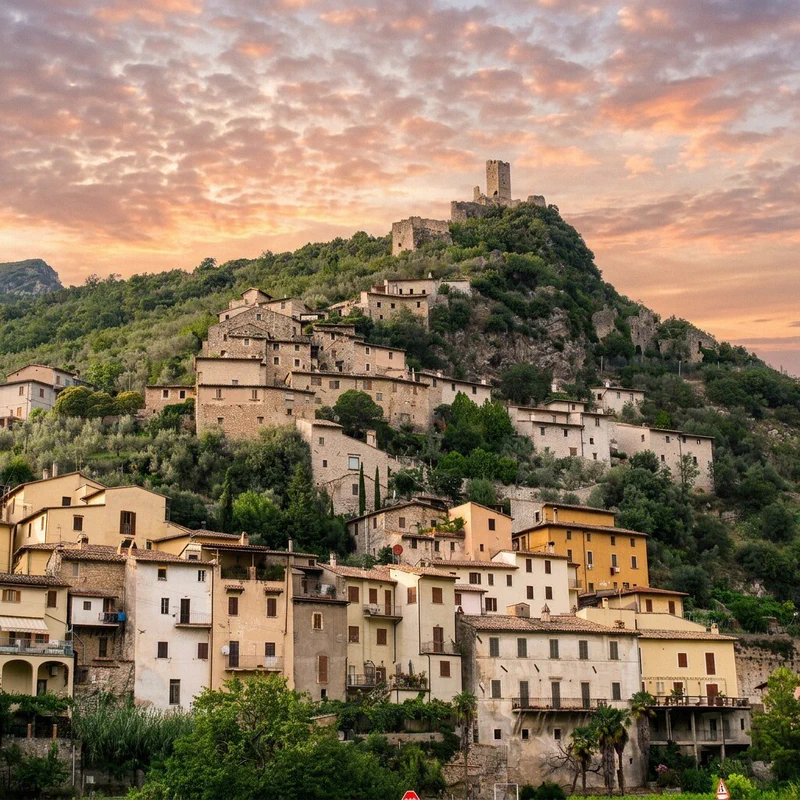
Forget commercial Halloween pumpkins. The spooky atmosphere here is authentic and rooted in time, without needing plastic decorations. I still remember finding myself alone in the crypt on a late autumn afternoon: the silence was so thick it hurt my ears. Looking at those ancient, mummified bodies, each with its expression intact, gave me a genuine shiver that no theme park can match. It’s an experience that leaves a mark.
The Church and the Descent#
Santo Stefano is not flashy. The upper church dates from the 16th century, built on top of a 13th-century Romanesque church that now serves as the crypt: discreet, silent, worn by time. No gaudy signs, no souvenir stalls, no one trying to sell you a selfie stick. Just stone steps that disappear into darkness.
The air changes as you descend: it’s cooler, heavier, like the walls are closing in on you. Even in summer it’s noticeably cooler down there than in the street, so bring something to throw over your shoulders. The lighting is dim, not to create atmosphere, but to preserve what you’re about to see.
The crypt is narrow, with low ceilings that force you to duck. Behind the glass, the mummies lie in a row, their faces frozen in grimaces or serene gazes that seem ready to blink at any moment. A custodian lurks nearby and, sooner or later, starts talking, usually in Italian. Don’t count on detailed explanations in other languages: if you don’t speak Italian, read up beforehand and let the atmosphere do the rest. Spoiler: it tells the story anyway.
Let’s Talk Mummification#
These are not Hollywood mummies. No bandages, no sarcophagi. It’s all the work of nature. A study published by the Accademia dei Lincei in 1887 credited the soil, rich in iron and alumina silicates, calcium sulfate and nitrates of calcium, magnesium and ammonia, along with the room’s ventilation and microorganisms that would have dried the bodies out quickly. The exact cause, however, has never been pinned down: the most widely accepted theory remains a microorganism that dehydrates the remains. The result? Mummies that look strangely intact, some still dressed, with their hair perfectly preserved. Unsettling, but in a good way.
Burials in the crypt began in the 16th century. Napoleon’s Edict of Saint-Cloud, extended to Italy in 1806, banned burying the dead inside churches, but here the last documented burial dates to 1871. Only then were the bodies exhumed, and the villagers discovered that history hadn’t let them decompose. And so Ferentillo became something more than a sleepy village.
The Faces Behind the Glass#
These are not just skeletons; they’re people with stories. Some are almost unbelievable. There are two Napoleonic soldiers who still bear the marks of torture; one of them was hanged. A couple with Asian features who, legend has it, were on their honeymoon in Italy for the Jubilee of 1750 and died here after falling ill. A local lawyer stabbed to death, who rests in the only coffin still sealed and isn’t displayed out of respect for his descendants, who still live in the village. And a young mother who died in childbirth. The custodian knows their stories like old friends, telling them with that mix of reverence and nonchalance only Italians can pull off.
It’s not the kind of place you visit in a hurry. The stories stay with you, and you might find yourself lingering, trying to piece together their lives. It happened to me, and I’m not even a history buff.
Some Useful Tips#
Finding the crypt is fairly easy. It’s in Precetto, on Via della Torre, along the lane that climbs toward the fortress: follow the signs.
- Tickets and hours: These change with the seasons and opening is reduced in winter, so check current hours and prices on the official website (mummiediferentillo.it) before you go.
- Time needed: 30-45 minutes, but you can stretch it out if you’re the type who asks a million questions.
Visit in October. The fog rising from the Nera river adds an unforgettable touch of drama. A warning: phone signal in the valley can be weak, so download your maps beforehand or be prepared to wander aimlessly through the deserted streets.
Beyond the Bones: Other Things to See in Valnerina#
Whatever you do, don’t rush away after the crypt. Walk up to the Rocca di Precetto, which towers over the crypt. It’ll test your legs, and the stones can be treacherously slippery, but it’s really worth it. At the top, you’ll be alone with the wind, the cawing of crows and the faint resinous scent of the pines below. Peace, finally.
If you still have energy, cross the bridge over the Nera and head to the Rocca di Matterella on the other side of the gorge. It’s even more imposing, and the views are just as spectacular. Feeling adventurous? Pop over to the Abbazia di San Pietro in Valle, a few minutes’ drive away. It’s ancient, serene and decorated with frescoes that look like they were painted yesterday. A warning: the roads are narrow, and tour buses have no qualms about blocking them.
Valnerina is a small secret. While everyone rushes to Spoleto or Norcia, this valley stays quietly out of the way. To discover its most authentic side, I recommend exploring The Stone Villages of the Valnerina. It’s a slow itinerary through medieval houses and old, abandoned mule tracks. Here, time really has stood still.
The food alone is worth the trip. Treat yourself to a plate of strangozzi with black truffle in one of the village’s no-frills osterias. It costs half what you’d pay in Florence or Rome, with genuine flavors that smell of the earth. If you want to see where this extraordinary ingredient comes from, you can join a truffle hunt in Umbria. Get ready to taste the real Italy.
How to Get There#
The best choice is by car. The Valnerina state road from Terni to Ferentillo is spectacular, winding through wild landscapes and tiny villages. It takes about 20 minutes, with no ZTL to ruin your day. Spoleto is also half an hour away, if you want to combine stops.
From Terni there’s also the Busitalia bus (line 621), with several runs a day: check the current timetable, especially on public holidays. But for getting between the fortresses and the abbey, a car is still the most convenient option.
If you’re planning an itinerary, also stop by Narni’s underground. A weekend between Narni and Ferentillo is like stepping into a time machine: no filters needed.
Ferentillo doesn’t try to win you over. It doesn’t need to. It’s simply itself. Silent, strange, timeless. Take it or leave it, but I bet you won’t leave it.