
For the vast majority of visitors, the physiognomy of Venice is defined by the shimmering outlines of St. Mark’s Basilica and the sinuous arch of the Rialto Bridge.
One tends to think, thanks to the postcard geography imposed by modern tourism, that the political and spiritual power of the Serenissima have always been concentrated in that narrow, magnificent marble stage overlooking the basin.
And yet, for almost a thousand years, the true spiritual capital of Venice was not St. Mark’s.
To find the most ancient and popular roots of the water city, you have to travel much further east, enter the popular Castello district, until you reach a green, secluded, and silent island: the island of San Pietro di Castello.
I am Alessandro, and for me history is not just a list of dates in a book, but living matter, made of stone and passed down traditions.
Today I am taking you to discover not only a place steeped in memory, but also a magical moment: the last week of June. It is during these days that the island abandons its proverbial silence to light up on the occasion of the Festa di San Pietro, perhaps the last truly authentic and viscerally Venetian festival left in the lagoon.
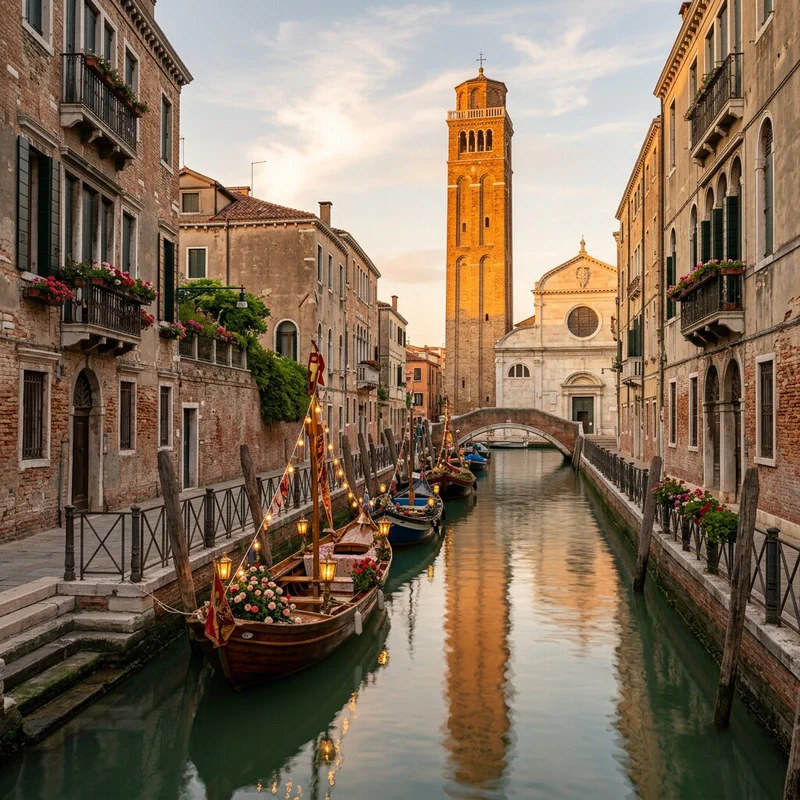
Arriving at San Pietro di Castello means making a real urban pilgrimage. You will immediately realize that you have left the “showcase Venice” when the plastic mask shops give way to clotheslines stretched between public housing and small wooden boats moored in disorder.
The island is separated from the rest of the city and can only be reached via two long wooden bridges, including the evocative and very long Ponte di Quintavalle. Crossing it, especially at sunset, gives the impression of landing in a world apart, a fishing village set in the metropolis.
The Exiled Cathedral and the Shadow of St. Mark’s#
Why is such an imposing basilica literally located on the extreme edge of the city?
The answer lies in the ruthless and lucid political engineering of the Republic of Venice. For centuries, St. Mark’s Basilica was not the city cathedral, but the Doge’s “private chapel”. The “official” religious power, the Patriarch of Venice dependent on the Pope in Rome, had to be strictly kept at a safe distance from the heart of political power.
Thus, since the year 775 (when the island was still called Olivolo), the bishop’s seat was confined here, on the extreme eastern edge, guaranteeing the Venetian Republic a providential independence from papal interference.
Palladio’s Architectural Triumph#
The current structure of the Basilica of San Pietro di Castello is an absolute masterpiece, whose facade project was entrusted to none other than Andrea Palladio in 1558 (his first public commission in Venice).
The blinding white of the Istrian stone of the facade, with its geometric rigor in pure classical style, contrasts formidably with the exposed bricks of the bell towers and the surrounding public housing.
Inside, under the vast dome, the space is immense, solemn, and strangely bare compared to the golden mosaics of St. Mark’s. Yet, it hides extraordinary relics, such as the so-called “Chair of St. Peter”, a marble seat that legend has it belonged to the apostle in Antioch, actually decorated with ancient and mysterious Islamic inscriptions that blend Quranic verses with Byzantine motifs.
The Festival: When the Lagoon Reclaims Its Spaces#
If for the whole year San Pietro di Castello is an oasis of monastic peace, in the last week of June (to celebrate Saints Peter and Paul on the 29th of the month) the large and well-kept grassy lawn surrounding the church – one of the very few “campi” in Venice to have kept the original grass instead of the trachyte paving – undergoes a radical transformation.
The Festa di San Pietro is the perfect antidote to pre-packaged tourism.
There are no tourist menus in multiple languages or waiters in livery. Instead, there are the volunteers of the district, the grandfathers frying fish, and the children running on the grass.
Huge wooden tables are set up under the shade of ancient trees and the gigantic sixteenth-century bell tower (curiously crooked and also covered in precious Istrian stone).
The True Popular Venetian Flavors#
The festival menu is a hymn to the “poor” and tasty cuisine of the Venetian fishermen.
Forget gourmet reinterpretations: here the air is thick with the scent of huge mixed grills. You can sit next to the elders of the neighborhood to savor generous portions of sarde in saor (fried sardines marinated with sweet onions, raisins, and pine nuts), bovoletti (small land snails seasoned with plenty of garlic and parsley), and mountains of mixed fried fish from the lagoon, all washed down with bulk white wine from the Treviso hills.
In the evening, the campo comes alive with live music, often in dialect, ballroom dancing orchestras, and even a small charity fair and solidarity fishing organized by the parish.
A Deep Bond with the Water#
The festival is not limited to the lawn around the cathedral, but naturally extends onto the water.
The San Pietro canal and the adjacent dock fill up with rowboats and small motorboats (the classic Venetian “barchini”). Families arrive directly by water to participate in the festival, mooring in double or triple rows.
(Update: This symbiotic, festive, and resilient relationship between the Venetians, their oars, and their lagoon does not end in this parish, but explodes on a monumental scale every spring. To demonstrate this, I invite you to read my detailed reportage dedicated to the Fiftieth edition of the Vogalonga in Venice, the largest and most exciting non-competitive rowing event in Italy).
It is on these occasions, among the smoke of the grills and the songs in dialect, that one tangibly feels the very strong sense of community that binds the Venetians. A social fabric that tenaciously resists the emptying of the city and the pressure of tourist rentals.
Alessandro’s Travel Tips#
The Festa di San Pietro is an experience to be lived on tiptoe, respecting the fragile dynamics of the residents.
- Plan carefully: The festival usually lasts five or six days close to June 29th. There are no big advertising campaigns; rely on the flyers posted on the walls of the Castello district or in the local bakeries to know the exact dates and the musical program.
- Go at sunset: The best time to arrive at San Pietro is late afternoon. The sunlight at sunset reflects on the Istrian stone of the cathedral, tinging it pink. You will have time to visit the church in silence, before the grill fires are fully lit for dinner.
- Get lost in the calli: To reach the island, avoid the straightest path. Deliberately lose yourself through the calli of the Sant’Elena district and along Via Garibaldi, the only street in Venice that is called “via” and not “calle”, wide because it was built by filling in an old canal at the behest of Napoleon.
(Update: If this journey into the hidden mosaics, oriental geometries, and solemn Byzantine spirituality of Venice has awakened your interest in the legacy of the Eastern Empire in Italy, I warmly invite you to divert your itinerary southwards. A few weeks ago I published an immersive guide dedicated to unveiling the dazzling treasures and mosaics of Ravenna, the true capital of the West).
Experiencing the Festa di San Pietro in Castello means sitting at the true table of the Venetians.
It is not an experience to be hastily photographed and shared, but a privilege to be savored slowly, listening to the beat of a thousand-year-old heart that, against all odds, has no intention of stopping.
Have a good trip and enjoy your meal, Alessandro