
Catania is fire and lava. This city, built with the very stone that once threatened to submerge it, lives a visceral relationship with its patron saint, Agata. If you arrive here at the beginning of February, when the damp wind from the Ionian Sea carries the smell of wax and gunpowder, you find yourself immersed in one of the largest religious processions in the world. It is not just a festival; it is a collective trance that dyes the black streets of the historic center white. Devotion here is a roar.
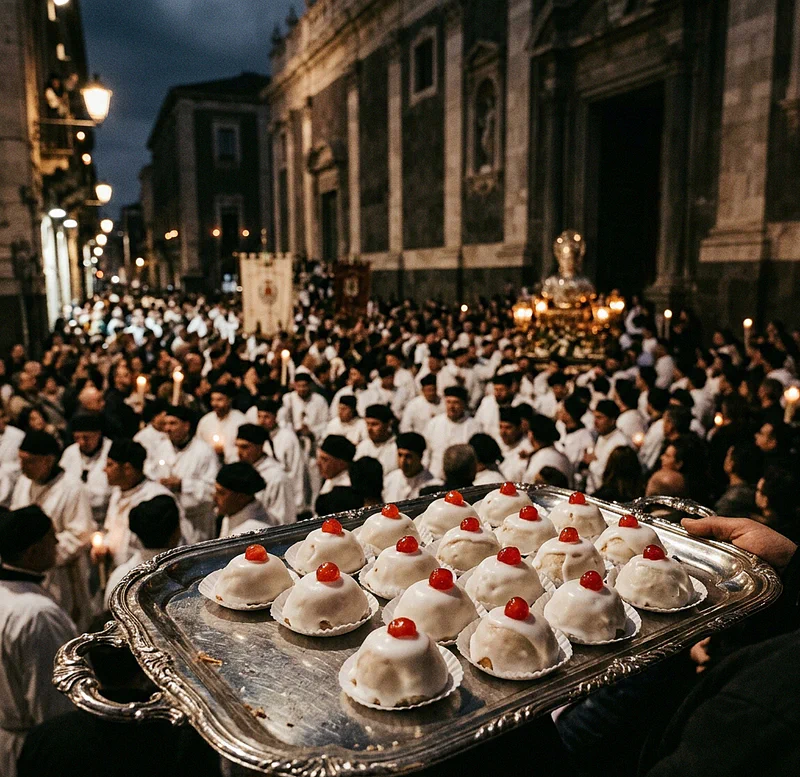
I hear the rhythmic shout, almost a thunder, that pierces the air: “Cittadini, cittadini! Semu tutti devoti tutti?” (Citizens, citizens! Are we all devoted?). The response is a choral boom, a “Sì!” that makes the windows of the Cathedral vibrate. The devotees wear the “sacco”, a white cotton tunic that, according to legend, recalls the nightgown that Catanese people wore when the Saint’s relics returned to the city from Constantinople on the night of August 17, 1126, brought by the soldiers Giliberto and Goselmo. The black velvet cap (scuccia), white gloves, and the cord complete the armor of those preparing to pull the Saint.
Candelore and Olivette: Between Strength and Miracle#
Alongside the authorities, the silent challenge between the classes of the Candelore takes place. There are 15 of them, but all eyes are on ‘a Mamma, the massive Candelora of the Bakers that weighs almost 900 kilos and requires 12 expert bearers for the “annacata,” the typical oscillating movement that makes it seem alive. If you move through the crowd, you will also hear talk of ‘a Bersagliera, the Candelora of the fishmongers, famous for the speed and boldness of its bearers. Each guild puts its own pride into these gilded wooden towers.
Taste the martyrdom. During these days, the pastry shops are filled with Minne di Sant’Agata, dome-shaped sweets covered in white icing with a candied cherry on top, representing the breasts torn from the Saint during her torture. It irritates me when people eat them without understanding their weight: it is a carnal and sacred ritual that blends with the taste of sheep’s milk ricotta and chocolate. Don’t forget the Olivette, small green almond paste sweets that recall the olive tree that, according to tradition, miraculously grew to hide and feed the Saint during her flight. Sugar is memory.
The Grid of Lava and the Baroque Resistance#
Catania is a checkerboard. After the devastating earthquake of 1693, the city was rebuilt with a regular grid of wide streets designed to facilitate escape in case of new tremors, using the very basalt from Etna. This “black heart,” made of dark stone and white Baroque plaster, creates a unique contrast that explodes in the late afternoon light. Walk along Via Etnea, where the volcano frames the horizon like a silent guardian, and let yourself be enchanted by the curves of the Badia di Sant’Agata, a masterpiece by Vaccarini that seems to defy the rigidity of the lava. Beauty is a resistance.
Jump into the chaos. The most moving moment is the Salita di Sangiuliano, a steep climb that the devotees face at a run, pulling the heavy silver fercolo. It is a moment of pure adrenaline and risk, where the limit between faith and madness becomes very thin. It irritates me when tourists try to cross the ropes to take a photo: respect the space of the devotees, stay behind the barriers, and let yourself be carried by the rhythm of the steps on the smooth basalt. Faith is a collective effort.
Update: If the ancestral power of Catania has fascinated you, I suggest you discover another profound soul of the island, that of the sea: Luca has traced a journey through the echoes of the Mattanza in the Egadi islands, where another ancient ritual of blood and water is consumed. If you prefer something more classic, Elena has prepared a guide for families to the Valley of the Temples in Agrigento, perfect for walking among history with children. Choose your Sicily.
See you soon, among the white of the sacks and the black of the lava,
The Marche region in central Italy is a haven for nature lovers and outdoor enthusiasts. Its picturesque coastline offers a wealth of opportunities for exploration, from scenic beaches to rugged cliffs. For those who prefer to experience the region’s stunning scenery on foot, the Conero Riviera is a must-visit destination. With its dramatic landscapes and crystal-clear waters, it’s no wonder that hiking enthusiasts flock to the area. A newer guide exploring the best panoramic trails in the Marche region, including some of the Conero Riviera’s most scenic routes, has since been published. Discover more of the Marche region’s lesser-known hiking trails.