Ciao! I’m Marco. If you think the most exciting thing you can see on a road in Tuscany is a classic Ferrari or a vintage Vespa, let me change your mind. Today, I’m talking about a different kind of horsepower—one that has been moving across this land for thousands of years. I’m talking about the Transumanza. Update: My colleague Alessandro recently published a guide to uncovering Italy’s soul through its wine regions, including a fascinating exploration of the wine country roads that crisscross Tuscany. Since writing this, Alessandro explored the best wine-making areas to visit, from the rolling hills of Chianti to the sun-kissed vineyards of Montepulciano, sharing his expert insights on Exploring Tuscany’s Wine Heartland.
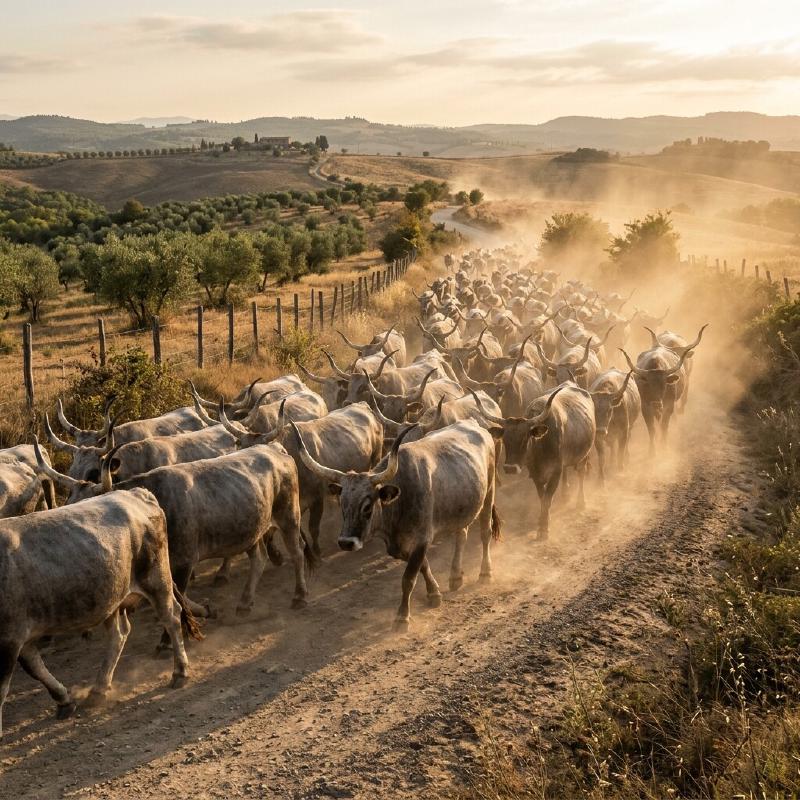
Every year in late April, as the weather begins to warm, a prehistoric ritual unfolds in the southern part of Tuscany known as the Maremma. The great Maremmana cattle, with their magnificent long horns and stoic gaze, are moved from their winter pastures in the lowlands to the cooler mountain air of the highlands. On the road, I discovered that there is nothing more humbling or exhilarating than sitting in your car while a sea of gray-white cattle and barking sheepdogs surges around you in a cloud of golden dust.
The Heart of the Cowboy Country#
The Maremma is Italy’s version of the Wild West. It’s a land of marshes, salt-encrusted plains, and fierce independent spirit. The heroes of the Transumanza are the Butteri—the traditional Tuscan cowboys. Seeing them in their moleskin trousers and wide-brimmed hats, effortlessly managing a herd of hundreds of animals, is like watching a piece of living history.
The best part of this route isn’t a specific town, but the Tratturi—the ancient, unpaved sheep tracks that cut across the landscape. If you’re driving in Maremma in late April, keep your ears open for the clanging of cowbells and the shouts of the Butteri. If you find yourself behind a herd, don’t be in a hurry. Turn off your engine, roll down the windows, and breathe in the smell of dry earth and raw nature. It’s a moment of pure, unscripted Italy.
A Festival of Flavors#
The Transumanza isn’t just a cattle drive; it’s a celebration. In towns like Alberese and Civitella Marittima, the arrival of the herds is met with festivals that celebrate the ‘poor man’s cuisine’ of the shepherds.
When you stop in these villages, look for the Acquacotta—a traditional bread and vegetable soup that was the staple diet of the Butteri for generations. It’s simple, hearty, and tastes best when eaten in a crowded piazza filled with the energy of the move. And of course, there is the wine. A glass of bold Morellino di Scansano is the perfect partner for the smoky, earthy flavors of the Maremman kitchen.
Marco’s Tips for the Transumanza Road#
- Patience is Key: If you encounter a herd, YOU are the guest on the road. The animals have the right of way. Stay calm, don’t honk, and enjoy the spectacle.
- Safety First: Maremmana cattle are generally peaceful, but they are massive animals with horns that can span over a meter. Keep your distance and respect the work of the Butteri and their dogs.
- The Right Vehicle: While most of the main roads are fine, if you want to follow the herds near the Parco della Maremma, a car with decent ground clearance (or an SUV) is much more practical for the dusty tracks.
- Local Festivals: Check the local ‘Sagra’ calendars for the last week of April. Every year the dates shift slightly depending on the weather, so ask the locals in the village bars for the latest news.
Italy is a land that is constantly moving, but the Transumanza is a movement that connects us to our most ancient roots. It’s a reminder that even in an age of high-speed rail and electric cars, the old ways still have a place on our roads. If you want to experience the true, rugged soul of Tuscany in 2025, follow the bells. A presto!