
The hills of Emilia-Romagna, where the Adriatic coastline meets the gentle curves of the Apennines, hold a secret that only reveals itself to those who wander off the beaten path. In the charming, quiet borgo of Sogliano al Rubicone, lies a treasure that smells of earth, mystery, and history: the Formaggio di Fossa (Pit Cheese).
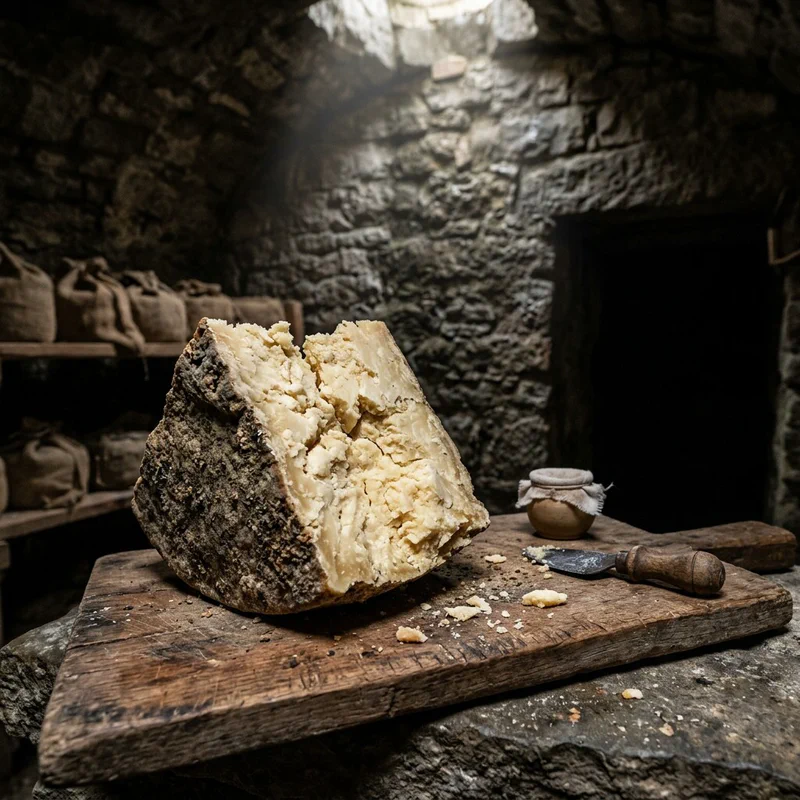
This isn’t just cheese; it’s a legend that has been resurrected from the dark. Every August, wheels of pecorino and cow’s milk cheese are lowered into deep pits (fosse) carved from the local tufa rock. They are buried alive, sealed away for three months in a silent, underground world.
If you love exploring the “Renaissance of taste” in this region, you must read my guide to the velvet gold of Ferrara, where the pumpkin pasta reaches a similar level of courtly excellence.
The Legend of the Pit#
The tradition of burying cheese in Sogliano dates back to the 15th century. Legend says it began when local peasants needed to hide their food from marauding soldiers. They discovered that when they dug the cheese up months later, it hadn’t just survived—it had transformed.
The pits are flask-shaped chambers about three meters deep, lined with straw and toasted wood. For ninety days, the cheese undergoes a unique anaerobic fermentation. My nonna always said, “Giulia, the cheese must dream of the earth before it can speak to your palate.”
And let me tell you, you can’t fake this dream! My biggest pet peeve is that vacuum-packed “fossa style” cheese you see in big supermarkets. It has never seen the inside of a tufa cave, and it lacks the sharp, piccante kick and the aroma of damp forest floor that defines the real thing. Authentic Fossa cheese loses its moisture and becomes irregular in shape, flattened and distorted by the weight of the other wheels. These “ugly” wedges are the ones you want!
If you appreciate the kind of patient, artisanal craft that goes into these products, you’ll find a similar soul in my guide to the hand-stamped corzetti of Liguria.
The Sensory Experience#
To taste real Formaggio di Fossa is to taste the Rubicone hills. The flavor is intense, slightly bitter, and deeply satisfying. In Sogliano, the opening of the pits (the sfossatura) happens in late November, traditionally on St. Catherine’s Day. The entire town is filled with a pungent, heady scent that tells you winter is coming.
Where to find the ‘Resurrected’ Cheese (Giulia’s Pick): Antiche Fosse In the center of Sogliano, you can visit historical pits like those at Antiche Fosse. Descending into the cellars is a sensory journey; the cool, damp air carries the weight of centuries of tradition.
If your palate craves more of the generous spirit of this region, you shouldn’t miss my guide to Bologna’s secret pasta passages, where the traditions are just as deeply guarded.
Giulia’s Guide for the Culinary Pilgrim#
- The Perfect Pairing: Formaggio di Fossa needs strong companions. Traditionally, it is served with drops of Aceto Balsamico Tradizionale or a dollop of fig jam.
- The Wine: Pair it with a robust Sangiovese di Romagna or, better yet, a sweet, amber-hued Albana di Romagna Passito. The sweetness of the wine perfectly balances the sharpness of the cheese.
- Don’t Just Eat it Neat: In local trattorie, look for Passatelli served with a generous grating of Fossa cheese. It transforms a simple broth into a masterpiece.
- No Cappuccino! I will say it again: after a meal of Fossa cheese and wine, the only acceptable drink is a small espresso or a glass of grappa. A cappuccino would be a tragedy for your digestion!
As my colleague Elena recently explored in her guide to Pienza’s pecorino delights, Italy is a map drawn in cheese, and each region holds a different secret.
Sogliano al Rubicone is a place for the true foodie—one who isn’t afraid of strong smells or “ugly” food, and who knows that the best treasures are often buried deep beneath the surface.
Buon appetito, and look for the mark of the pit!
With love, Giulia