
For the vast majority of travelers flocking to St. Mark’s Square, Venice is exhausted in a dazzling and romantic showcase of gondolas, Gothic palaces, and golden mosaics.
But the true lagoon, the silent and protective one that allowed the Serenissima Republic to dominate the seas for a thousand years, guards much deeper secrets.
If, walking away from the crowds along the Fondamenta delle Zattere, you stop to peer south towards the Lido, you might notice the mute silhouette of a small island covered in dense vegetation.
That island which many wrongly consider inaccessible is Poveglia.
I am Alessandro, and as a historian, I am used to confronting places where human memory has stratified. Few places in Italy, however, have suffered such a brutal and sensationalistic distortion of their identity as this patch of lagoon land.
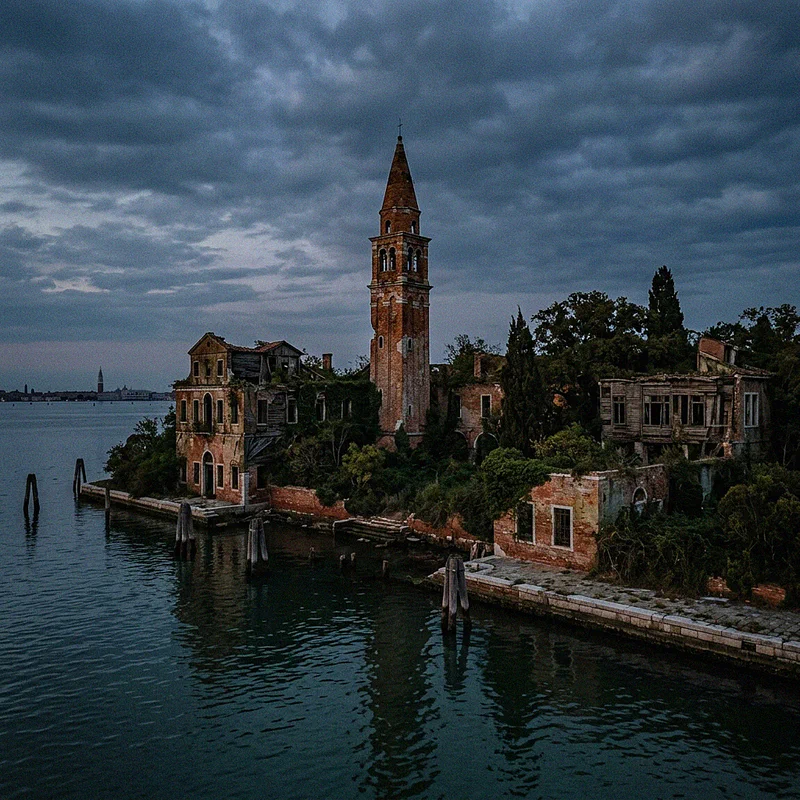
Christened by modern American sensationalist documentaries as “the most haunted island in the world” or “the island of death,” Poveglia has become a magnet for amateur ghost hunters.
But the real history of this strip of land, carefully documented in the records of the State Archives, is infinitely more complex, tragic, and profoundly human than any cheap horror story.
The Origins of Popilia: Refuge and Ducal Autonomy#
Before becoming the symbol of lagoon decay, Poveglia was known as Popilia. The name, which evokes the poplars (populus) that once covered it or the nearby Via Popilia-Annia, tells of an island that was a bastion of life.
In the 6th century, it became a safe refuge for inland populations (especially from Padua and Este) fleeing the Longobard invasions. But the real moment of glory arrived in 864. After the murder of Doge Pietro Tradonico, two hundred of his most faithful servants obtained the right to settle on the island with exceptional privileges: tax exemptions, administrative autonomy, and the obligation to answer only to the Doge. For centuries, Poveglia was a proud and independent community, governed by its own council of twenty-seven inhabitants.
The Trauma of the War of Chioggia and the Octagon#
The decline of Poveglia was not caused by a plague, but by a strategic and military choice. During the War of Chioggia (1378–1381), the Republic of Venice decided to evacuate the entire population to Venice to transform the island into a defensive presidium.
It was a fatal blow. The island fell into the hands of the Genoese led by Pietro Doria, who used it as a base to bombard the nearby monastery of Santo Spirito. It is from this wartime period that the construction of the Poveglia Octagon dates, that massive octagonal artificial fortification that still guards the entrance to the lagoon today and represents one of the most precious pieces of Venetian military architecture.
Although the Serenissima later tried to repopulate it, the original inhabitants never returned in mass, leaving the island in a limbo that ended only in 1782 with its conversion into a sanitary station.
Debunking the Myths: The Open-Air Cemetery#
The most widespread and enduring modern myth about Poveglia claims that the island is literally an immense open-air cemetery.
Some occult enthusiast websites go so far as to claim that fifty percent of the soil on which the vegetation grows today is composed of human ashes.
It is my duty, even before delving into the true chronicle of the island, to categorically debunk this macabre hallucination. Poveglia was never a mass grave for hundreds of thousands of plague victims, as the legend loves to repeat. The true Venetian lazarettos, created specifically to isolate and bury the dead during the brutal waves of the Black Death in the Renaissance, were the Lazzaretto Vecchio (born in 1423) and the Lazzaretto Nuovo.
Poveglia came into play much later, in 1782, established by the Health Magistrate of the Republic, but with a very different and much more “modern” role.
The Quarantine Lazaretto#
Poveglia was not the place where sick Venetians were sent to die. It was instead a sophisticated and civilized maritime “quarantine” station.
Venice was an immense commercial crossroads. When large merchant ships or military sailing vessels returned from the East, from suspicious ports or during minor epidemics on board, they were stopped and made to dock here.
The crews (healthy but potential carriers of diseases) spent a mandatory quarantine period of forty days on the island. The sick received treatment, the goods were disinfected in the large warehouses, and only after a rigorous check was the pass obtained for the commercial port of the St. Mark’s Basin.
Poveglia was a bulwark of civilization and health defense, not a human slaughterhouse.
The Geriatric Sanatorium and the Mad Doctor#
If the plague is not enough to scare tourists, contemporary folklore pulls out the card of the psychiatric hospital of horrors.
The legend tells of an asylum active in the 1920s, where a sadistic and unnamed head physician practiced cruel lobotomies on patients within the walls of the medieval bell tower. The tale culminates, predictably, with the suicide of the mad doctor, tormented by the spirits of his own victims.
This is perhaps the most serious and disrespectful lie inflicted on Poveglia.
The Truth of the Twentieth Century#
What really happened on Poveglia in the twentieth century? Starting in 1922, and until its definitive closure and abandonment in 1968, the imposing buildings that today lie in ruins did not house a penal asylum.
The island was converted into a quiet, albeit isolated, public geriatric sanatorium. It housed non-self-sufficient elderly people, chronic convalescents and, only in a small dedicated wing, patients with mild mental disorders who could not be treated elsewhere.
The geographical isolation in the middle of the water, lashed by the bora wind in winter, undoubtedly fueled an atmosphere of loneliness and resignation, but there were no torture chambers and no doctor threw himself from the bell tower. The history of Poveglia is a story of ordinary suffering, of old age and poverty, not of sadistic butchery.
(Update: The equation “isolated island equals asylum” is a superficial prejudice that mass media tend to apply to all internal Italian archipelagos. But geographical isolation has given birth to spiritual wonders, not just hospitals. If you wish to explore the mystical side of this isolation, I highly recommend Luca’s fascinating report on the Island of San Giulio, the spiritual jewel hidden in Lake Orta, a place where silence becomes poetry).
Access: Between Bans and New Hopes (2025 Update)#
For years, Poveglia has been described as a forbidden place, accessible only by defying the law. But the reality is changing thanks to civic commitment.
Today, the island is technically divided into two souls. The built-up part, where the remains of the sanatorium and the bell tower stand, remains under the management of the State Property Office and is closed to the public for structural safety reasons.
However, there is a historical turning point: since August 1, 2025, the North Island (the green area without buildings) has been granted in concession to the Poveglia per tutti Association.
This means that today it is possible to land legally in this area via a temporary pier. No special permits are needed if you arrive with your own boat or a rented one, but it is essential to respect the wild nature of the place.
How to Experience Poveglia with Respect#
If you decide to visit this fragile lagoon ecosystem, do so by following the decalogue of the Venetians who love it:
- No fires: Never light fires or barbecues. The risk of fire is very high and would destroy decades of natural rebirth in a few minutes. Prefer a packed lunch.
- Trash home: There are no bins or sweepers on the island. Everything you bring with you must return to the mainland. If you want to be a true “insider”, also collect any waste you might find deposited by the current.
- Absent services: Remember that Poveglia is a green and wild island. There are no bars, toilets, drinking water, or electricity. It is an experience of total immersion.
(Update: For this reason, I urge you to divert your energy from the usual morbid sensationalist attractions to focus on how to support healthy tourism in the Serenissima. My colleague Elena has prepared a valuable guide on how to explore Venice logically and without stress together with your children. Support local artisans, move on foot outside the clogged districts, and let the city surprise you with its authentic beauty).
Poveglia stands today as a silent warning and, finally, as a symbol of active citizenship. It overwhelmingly demonstrates that the documented truth is infinitely richer, more dignified, and more fascinating than any sloppy supernatural myth invented for television.
It is a solemn invitation to look beyond the surface of the water, trying to understand the deep, and at times painful, history of a Venice that never stops fighting for its dignity.
Respect the silence of the lagoon, Alessandro