
Greetings. I am Alessandro. While Italy is a country of many visceral passions, few are as deeply rooted in our history and character as our love for cycling. Every May, the nation is swept up in a wave of pink—the color of the La Gazzetta dello Sport, the newspaper that founded the Giro d’Italia in 1909. If you are excited about the upcoming 2026 Giro d’Italia, you’ll want to check out Martina’s expert guide to tackling the competition’s toughest peaks, including the infamous Piancavallo (Conquering Piancavallo and the 2026 Giro d’Italia’s Toughest Peaks).
To understand the Giro is to understand the geography and the very soul of Italy. It is a grueling, 3,500-kilometer odyssey that pits the world’s most elite athletes against our most formidable mountains and most switch-backed coastal roads. For the spectator, it is a symphony of speed and endurance that transforms every village it touches into a vibrant celebration of the human spirit. Recently, my colleague Elena explored the vibrant celebrations that take place in Rome each summer, and if you’re fascinated by the idea of a mobile festival, you’ll want to read her guide to Rome’s Soulful Summer Festival, Festa dei Noantri.
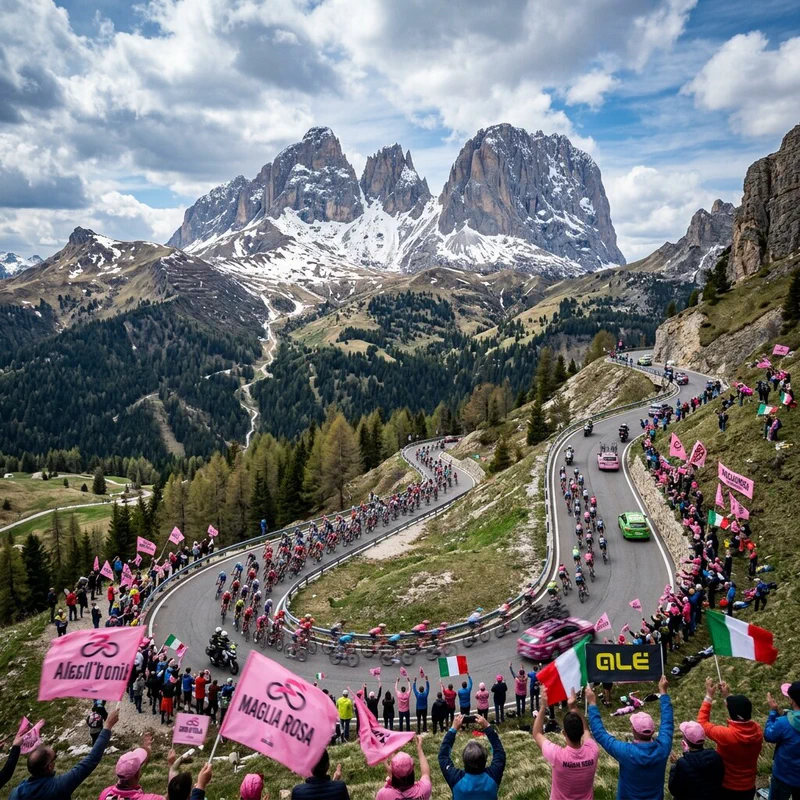
The Symbolism of the Maglia Rosa and the Legends of the Past#
Since 1931, the leader of the Giro has worn the Maglia Rosa (Pink Jersey). It is a symbol of prestige that carries the weight of legends like Fausto Coppi, Gino Bartali, and Marco Pantani. For an Italian, seeing the Pink Jersey fly past on a steep mountain climb is a moment of pure, unadulterated emotion. The choice of color was initially met with some skepticism as being too “delicate” for the era, but it quickly became the icon of a country that wanted to start racing again after the wounds of wars.
The race is divided into 21 stages over three weeks. Some are ‘flat’ stages where the sprinters dominate in frantic finishes, but the true drama—the heart of the Giro—is found in the mountains. The Dolomites and the Alps are where the race is won or lost, and it is where the fans gather in their hundreds of thousands to form a roaring human corridor to push their heroes toward the summit.
How to Watch the Giro Like a True Insider#
If you wish to truly experience the Giro, do not simply watch it on a screen. You must go to the roadside, feel the heat radiating from the asphalt, and hear the frantic clicking of gears as the peloton approaches.
- Choose Your Mountain: The most legendary stages usually happen in the third week. Look for names that make the heart race, like the Passo dello Stelvio, the Passo Gavia, or the Tre Cime di Lavaredo. Arrive at least 24 hours in advance if you have a camper van, or several hours before if you are on foot.
- The ‘Carovana’: About 90 minutes before the cyclists arrive, the Carovana Pubblicitaria (Publicity Caravan) passes through. It is a parade of brightly colored trucks blasting music and throwing out free samples and souvenirs. It is the height of the festival atmosphere—bring a bag to catch the treats!
- The Waiting Ritual: Watching the Giro is about the anticipation. You wait for hours, sharing wine, bread, and salami with people you’ve never met who quickly become friends. Then, the helicopters appear overhead, the sirens of the police motorcycles scream, and in a flash of color and the whirring of wheels, the peloton is gone. It is a fleeting, electric moment.
Alessandro’s Tips for the Cycling Fan#
Watching the Giro requires organization, especially if you are aiming for high-altitude stages. The mountain weather in May can be merciless: you could go from scorching sun to a sudden snowfall in minutes. If you are captivated by the magic that nature can create during specific astronomical moments, I recommend reading Sofia’s account of the magic of the summer solstice in Sardinia.
For the Giro, here are my practical suggestions:
- The Official App: Every year the route (il percorso) changes. Download the official Giro d’Italia app to see the exact timings for each stage (cronotabella). It will tell you when the roads close and precisely when the leaders are expected at certain points.
- Cycle the Route: If you are a cyclist yourself, many of the mountain passes are open to the public until a few hours before the race. There is no greater thrill than climbing the same road that the professionals will tackle later that day, with the fans already cheering you on as if you were in contention for the Pink Jersey.
- Wear Pink: Even if you aren’t a hardcore fan, wearing a touch of rosa is a sign of respect and participation. It connects you to the ‘Pink Caravan’ passing through and makes you part of the history.
- The Final Stage: The grand finale is often held in a major city like Milan, Rome, or Verona. It is a spectacular circuit race that offers multiple views of the riders and a grand podium ceremony.
What Bothers Me: “Hit and Run” Tourism#
As a historian, what bothers me is seeing how some modern spectators treat the Giro as a simple backdrop for their social media, ignoring the inhuman effort these athletes are making. Seeing people running alongside the cyclists on climbs, obstructing their path just to end up on TV, is a lack of respect for the sporting sacrifice.
The Giro d’Italia is a testament to the Italian spirit—our love of beauty, our respect for hardship, and our passion for shared celebration. It is the greatest show on two wheels, and it remains the very best way to see the heart of Italy, from perched villages to snow-capped peaks. In bocca al lupo!
Alessandro