
There is a specific kind of freedom that you only feel when you are behind the wheel in Italy. It’s not just moving from point A to point B; it’s the touch of the sea breeze on your skin along the Coast, the scent of wild pine entering through open windows in Tuscany, and that rhythmic ticking of tires on the cobblestones of medieval villages that seems to mark time.
I’m Marco, and I’ve spent the last twenty years mapping every curve, every alpine pass, and every unmapped detour of this country. To see the real Italy, the one that doesn’t appear in pre-packaged tour bundles, you need a set of keys, a full tank, and the desire to get lost. As Alessandro often says when exploring the underground secrets of Naples, Italy is made of layers. But while he digs, I prefer to paint trajectories on the asphalt.
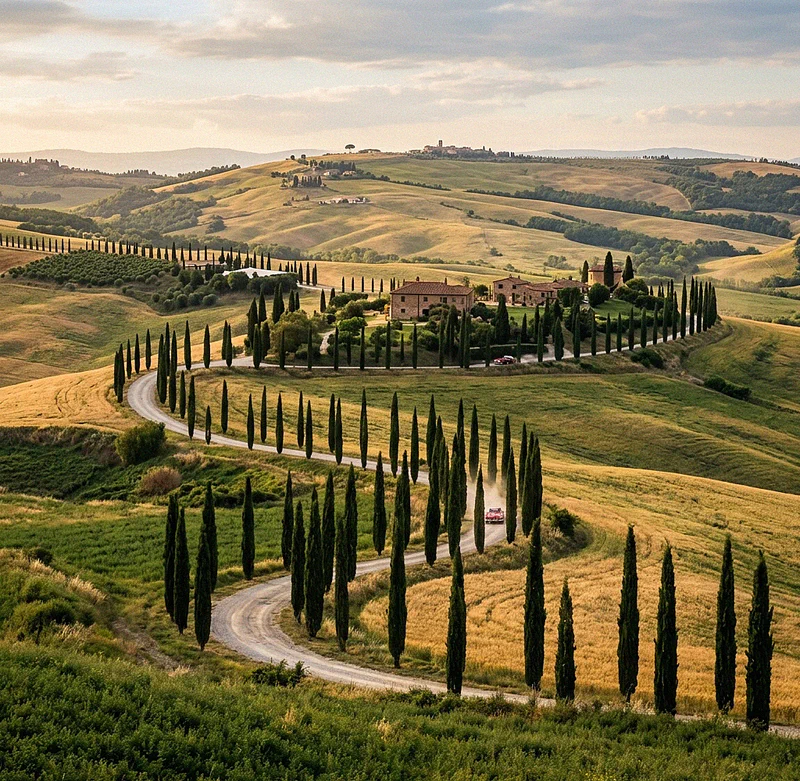
1. Val d’Orcia: The Timeless Classic#
Let’s start with the dream road trip: Tuscany. The road connecting Pienza, San Quirico d’Orcia, and Montalcino is an uninterrupted succession of rolling hills. Here, the driving is relaxed and poetic. It’s the perfect place for a convertible or a classic car.
Marco’s Trick: Avoid the main road and look for the “strade bianche” (gravel roads). If you love good wine, make sure to stop at one of the historic vineyards suggested by Alessandro in his 2025 Wine Grand Tour. Remember, though: the driver doesn’t drink—or at least waits until the car is parked at the farmhouse!
2. The Amalfi Coast: The “Blue Ribbon”#
Fifty kilometers of curves overlooking the sea. The SS163 is a technical challenge that requires steady nerves and a compact car. Driving here is an art: you need to be able to read the traffic, anticipate tour buses, and enjoy every vertical view.
My pet peeves here? Drivers who stop in the middle of a curve to take a photo. Guys, use the pull-offs! Don’t block the vital flow of the coast. Update: For those who want a less chaotic alternative, I subsequently wrote a guide on how to explore the less-traveled roads of Campania in 2026.
3. The Great Dolomite Road: Alpine Ecstasy#
From Bolzano to Cortina d’Ampezzo, you will cross some of the most beautiful mountain passes in the world, such as Pordoi and Falzarego. Here the keyword is torque. You need an engine that pushes hard uphill.
Update: It’s paradise for those who love hairpins. If you’re traveling with family and fear the kids might get carsick, Elena has shared an excellent guide on managing Venice with little ones: you could use the Lagoon as a restorative break after so many curves. But for us drivers, every kilometer of the Great Dolomite Road is a medal of honor.
4. Sicilian Baroque: Light and Stone#
A journey through time between Noto, Modica, and Ragusa Ibla. In Sicily, the car is the only way to discover villages that seem carved into sun-kissed stone. The roads here are less “perfect” than those in the north, but they have a wild soul.
Stop in Modica for the chocolate and in Noto to admire how the sunset light transforms the church facades into molten gold. If after so much Baroque you want a bit of wild nature, follow Luca’s advice to discover the lesser-known islands of Sicily.
5. Lucanian Dolomites: The Best Kept Secret#
For those looking for untamed Italy, the roads between Castelmezzano and Pietrapertosa in Basilicata offer unexpected drama. It’s a “dirty,” raw drive through tunnels carved into the rock and bridges suspended in the void.
Update: It’s a road trip I subsequently explored in depth in my post about the untamed south. Here you won’t find tourist menus, only the asphalt and the wind. It’s the place where you truly understand why we learned to drive.
Technical Tips for the Driver in Italy#
- ZTL: Enemy number one. Almost every historic center has one. Park outside and walk. Even I, who love the car, admit that Rome and Florence are best enjoyed on foot (Update: maybe looking for the best gelato in Rome).
- Offline Maps: Don’t trust 5G at the top of the Stelvio Pass. Download everything.
- Fuel: Avoid stations on the motorway; prices are highway robbery. Look for “pompe bianche” (independent stations) or stations in smaller towns.
Italy is not a destination; it’s a journey. Grab the keys, check the oil, and let the road speak to you. See you at the curve.