
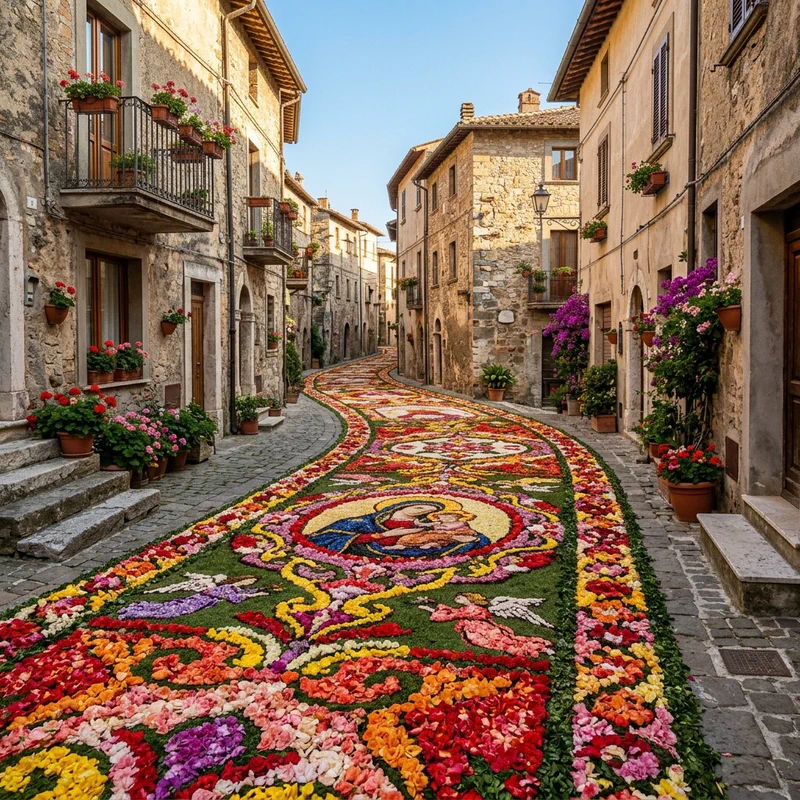
Ciao, amici! I’m Giulia. There is a moment in May when some of Italy’s most beautiful stone villages wake up transformed into a living garden. The gray cobblestones disappear under carpets of millions of petals, arranged into intricate geometric patterns and religious scenes. This is the Infiorata—a tradition that smells of broom flowers, roses, and community pride.
It is an art that exists for only a few hours before it is blown away by the wind or dispersed by the feet of a religious procession. But in those few hours, it is the most beautiful thing you will ever see.
If you love the idea of exploring these hidden stone gems where history is kept alive by the hands of the people, you must read my colleague Luca’s guide to Italy’s most beautiful secret villages.
Where to Find the Floral Masterpieces#
While many small villages have their own local Infiorata, there are three places where the tradition reaches the level of high art:
- Genzano di Roma (Lazio): Just outside Rome, Genzano hosts perhaps the most famous Infiorata. Since 1778, the entire length of Via Italo Belardi has been covered in a floral carpet leading to the church.
- Noto (Sicily): In the heart of the Sicilian Baroque, the town of Noto hosts its festival on the third Sunday of May. The honey-colored stone of the balconies provides a stunning frame for the floral panels. If you fall in love with Noto’s romantic atmosphere, you must read Sofia’s guide to a Baroque embrace in Noto.
- Spello (Umbria): Known as the “Town of Flowers,” Spello takes its Infiorata very seriously. The entire town is decorated, but the creations on the morning of Corpus Domini are particularly delicate.
The Ritual of the ‘Piluccamento’#
The work starts months in advance with sketches, but the true soul of the festival is the piluccamento. This is the act of plucking the petals from the stems.
I remember sitting with my nonna in a circle of women, our fingers stained with the yellow of the broom flowers. We would chat, laugh, and prepare the “paints” for the next day. It is a communal ritual that binds the generations together. My nonna used to say, “Giulia, a flower alone is a gift, but a thousand flowers together are a prayer.”
My biggest pet peeve? People who try to rush the process. You cannot rush an Infiorata. If you try to place the petals too quickly, they won’t hold the design. It requires the same patience as making a perfect risotto—you have to respect the timing of the ingredients.
If you enjoy these kinds of slow, manual traditions where every detail matters, you’ll find a similar spirit in my guide to hand-stamped corzetti of Liguria.
Giulia’s Tips for a Fragrant Visit#
- Dawn is the Magic Hour: To see the artists at work, you must be there at dawn. The air is cool, the scent of the crushed petals is at its most intense, and you can see the final details being placed.
- Avoid the ‘Tourist Menu’: These towns get very crowded. Avoid any restaurant on the main floral route that has pictures of food on the menu. Walk two streets back and find the place where the Infioratori themselves are eating!
- No Cappuccino After 11:00 AM! I will say it again: enjoy the flowers, enjoy the art, but don’t drink milk with your lunch! An espresso is all you need.
The Infiorata reminds us that beauty doesn’t have to last forever to be meaningful. It is a gift from the land, offered up for just a few precious hours.
Buon viaggio, and look for the petals!
With love, Giulia