
The drive through the hills of western Umbria leads through dense woodland where the road narrows until it feels entirely disconnected from the usual Renaissance itineraries. The site sits in the hamlet of Montegiove, in the municipality of Montegabbione, within the province of Terni. According to local tradition, Saint Francis of Assisi stopped here in 1218, building a rudimentary hut where he had planted a rose and a laurel, and where a spring rose from the ground. Its roof was woven from a marsh reed known in the local dialect as scarza, lending the whole estate its enduring name: La Scarzuola.
In the decades that followed, the hermitage grew into a settled convent. The counts of Marsciano raised a church, enlarged the conventual buildings, and entrusted them to the Friars Minor. From 1243 onwards, for nearly seven centuries, the church served as the family’s dynastic burial place, receiving around ninety members of the lineage in its cool crypts until the final interment in 1820. For generations the complex kept to these quiet rhythms, hidden in the woods and divided between Franciscan prayer, cloistered seclusion, and the memory of the dead.
Tomaso Buzzi and the invention of the theatre-city#
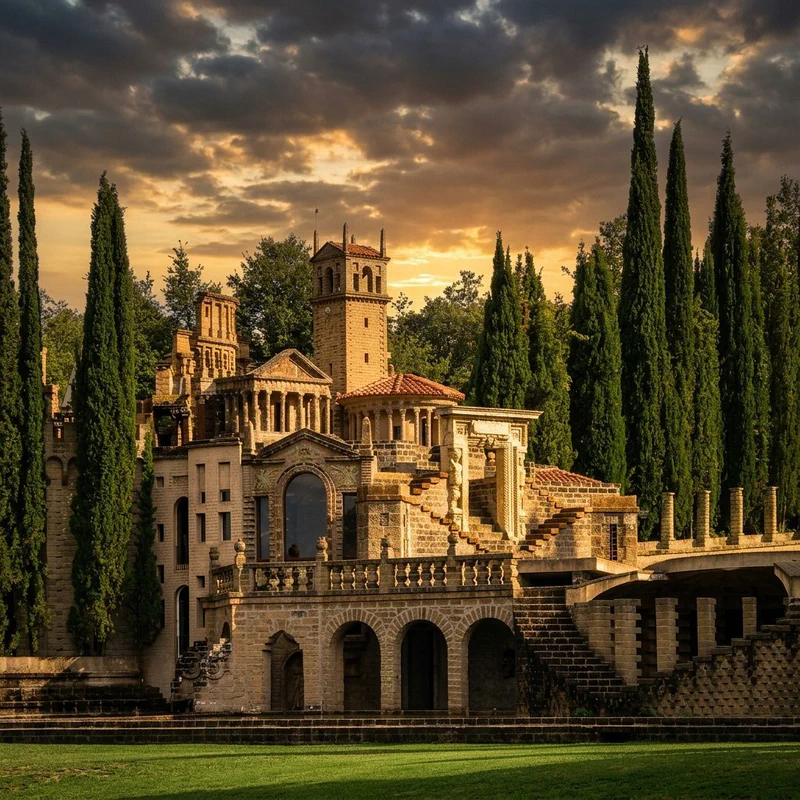
Then came Tomaso Buzzi. The Milanese architect bought the complex in 1957. Between 1958 and 1978, in the hollow directly behind the convent, Buzzi designed and built an immense theatrical complex in the form of a città-teatro, his twentieth-century reading of the Renaissance theme of the “ideal city”. He called it an “anthology in stone”, based on the esoteric language of alchemy. When he closed the worksite in 1978, Buzzi left it deliberately unfinished: not a rigid monument but an open fragment, suspended somewhere between classical ruin and theatrical set, whose meaning each visitor has to piece together alone.
The pastiche of architectural quotations and symbols#
Step into Buzzi’s stone valley and it takes a moment to get your bearings. La Scarzuola is an uninhibited pastiche of classical motifs, mannerist stage design, and architectural mimicry drawn from across Italy. Rather than inventing forms from scratch, Buzzi gathered, distorted, and reassembled historic models with deliberate erudition.
There are direct echoes of Hadrian’s Villa (Villa Adriana) near Tivoli, whose imperial baths and palestra Buzzi reprises in miniature. A few steps on, a stone cascade nods to the Rometta fountain at Villa d’Este, where ancient Rome was once quoted in miniature. Look closely at the base of the columns and notice where the stonework changes above: the classical repertoire is everywhere, gathered and distorted with deliberate erudition. Crowning the ridge, the Acropolis marks the highest point of the ensemble, where seven distinct silhouettes are assembled into a single surreal, interlocking profile: scaled interpretations of the Parthenon in Athens, the arcades of the Colosseum, the dome of the Roman Pantheon, an Egyptian pyramid, the octagonal Tower of the Winds, the circular Temple of Vesta, and the Clock Tower of Mantua.
Around these classical profiles, Buzzi layered the grotesque conceits of the sacred grove at Bomarzo. A stone ship sits stranded inland like a wrecked galleon; a stone monster; and a skeletal Pegasus stands against the Umbrian sky. It is an intellectual collage where Roman civil engineering and Renaissance garden tricks merge into a single sprawling stage.
The initiatory path through terraces and theatres#
To understand the site requires walking it as Buzzi intended: a symbolic progression arranged as an initiation. The complex unfolds along an ascending spiral of pergolas, drawing the visitor through an architectural allegory that commentators frequently interpret as a Jungian journey toward the Self.
The layout follows a steep vertical axis. The route begins low, near the skeletal figure of Pegasus, and ascends along stone terraces. You pass through an amphitheatre, skirt a grass theatre carved into the slope, and encounter an intentionally fractured column-tower that signals the fragility of human ambition. Further along stands the Theatre of the Bees, a tribute to cooperative order and industriousness, before the path reaches its climax at the stone Acropolis.
Every stairway, terrace, and arch is calibrated to disorient and then settle the visitor. Moving between subterranean shadows and sunlit stone platforms, you trace a process of internal transformation, an alchemical transmutation rendered in mortar, tuff, and carved steps.
Guided through the labyrinth with Marco Solari#
When Tomaso Buzzi died in 1981, the city-theatre remained only partially built. It fell to his heir, Marco Solari, to complete the construction, guided entirely by the sketches, drawings, and notes Buzzi left behind. Meanwhile, the ancient convent church remained separate from Buzzi’s surrealist expansion, preserved as a consecrated private oratory.
Today, La Scarzuola is open to the public only via pre-booked guided tours lasting roughly an hour and a half, historically led by Solari himself. On our own visit the mistake was trying to record every single reference as we went: between the alchemy and the stream of esoteric cross-references, over an hour and a half you lose the thread of the narrative and start confusing one theatre with the next. It is better to let go of the urge to decode every theoretical detail and simply be carried along by the rhythm of the terraces and the passionate account of the person who tends this place every day.
The tour does not spoon-feed its audience, nor does it smooth out the eccentricities of Buzzi’s design. It demands stamina, curiosity, and an acceptance that you will never decipher every single reference packed into the masonry.
How to organise your visit#
Visiting La Scarzuola requires planning ahead; you cannot simply drop by on a whim while touring the surrounding hill towns.
Access is strictly by advance reservation for guided group tours. The gates remain firmly closed to walk-ins, and there is no independent wandering outside the scheduled visit. Booking well ahead is essential to avoid being turned away at the entrance.
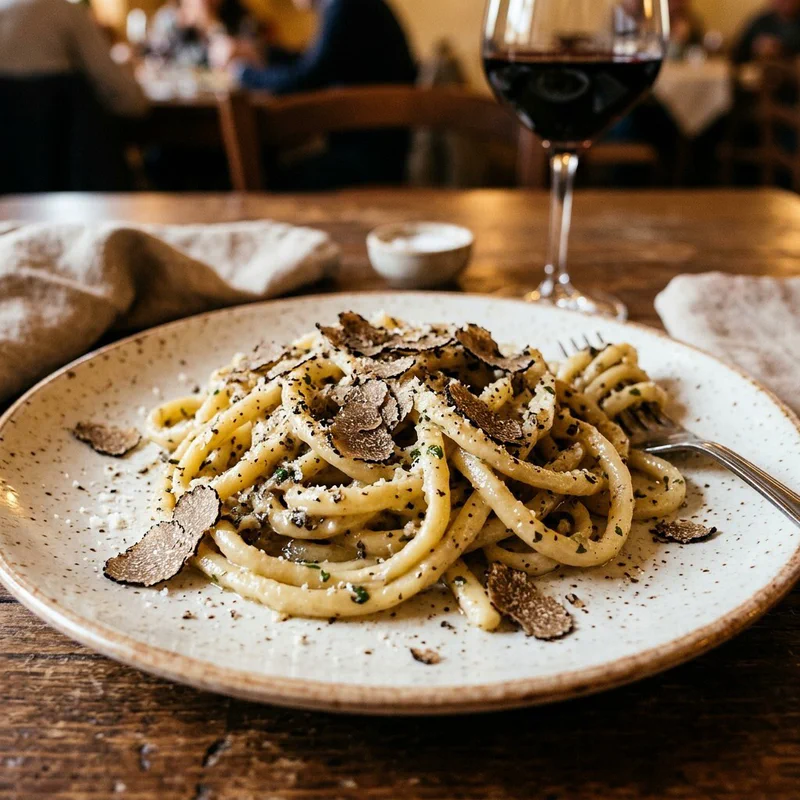
The site is located at Località Montegiove, in the municipality of Montegabbione, within the province of Terni. If you are travelling by car from Orvieto, the journey covers roughly 48 km and takes just under an hour along winding provincial roads through the woods. The guided tour itself takes about an hour and a half. After the visit, it is worth stopping at one of Montegabbione’s osterie: the woods around this corner of Umbria yield black truffle, and a plate of umbricelli dressed with fresh shavings is the most honest way to end the day.
For those looking to explore more of the region, pair this trip with a detour through Narni underground, exploring the underground between the Inquisition and the Roman aqueduct, or head towards the stone villages of the Valnerina.