
There are cities in Italy that are visited for their pristine perfection, crystallized in a glorious past that seems never to have been scratched by time. And then there are cities that bear the scars of history with a dignity and strength of mind that deeply touch the soul of the traveler. L’Aquila undoubtedly belongs to this second, very rare category.
Walking today, in March 2026, through its rebuilt alleys, seeing the immense cranes that are finally giving way to dismantled scaffolding revealing golden facades, is an experience that every lover of “deep Italy” should have. L’Aquila is no longer a “wounded city”; it is a city that has known how to transform pain into a laboratory of beauty and cultural innovation.
I am Alessandro, and today I want to lead you to discover why L’Aquila has been deservedly chosen as Italian Capital of Culture for the year 2026. It is not just a prize for the resilience of its people, but the objective recognition of an artistic heritage of immense proportions that is finally shining again in all its ancient vigor.
In this article, I will guide you through the quarters of this rediscovered city, revealing the secrets of its architecture and the energy of a community that is writing its future.
Santa Maria di Collemaggio: The Miracle of Celestine V#
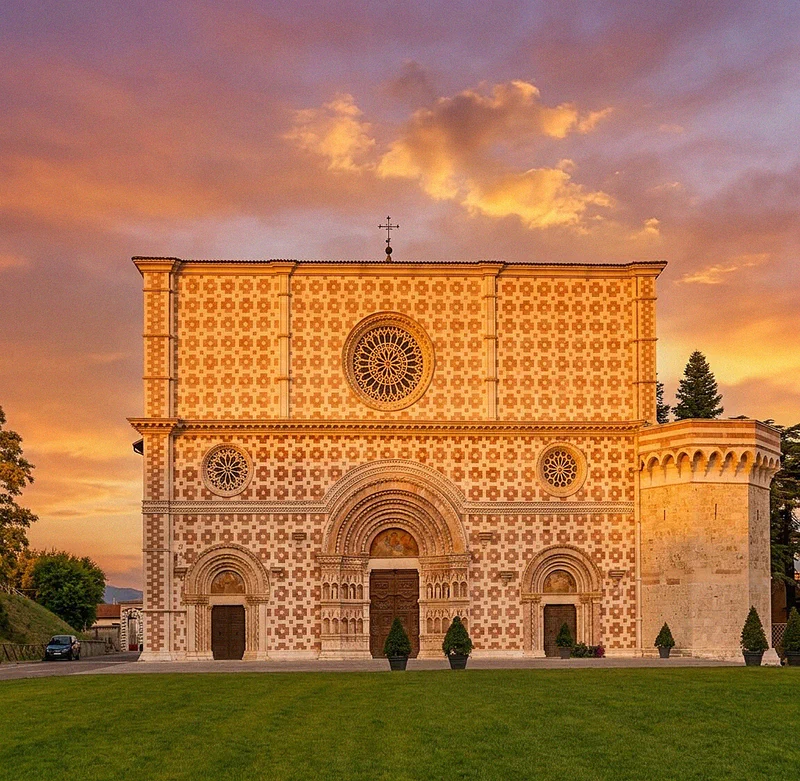
Our journey begins just outside the ancient walls, in front of the Basilica of Santa Maria di Collemaggio. It is one of the purest examples of Romanesque architecture in Italy. Its white and pink checkered facade, made with stone from the Gran Sasso, takes your breath away, especially when the sunset light sets it on fire.
But Collemaggio is not just architecture; it is sacred history. Here in 1294, Celestine V was crowned Pope, he who made “the great refusal.” And it is right here that Celestine instituted the Perdonanza, the first Jubilee of Christianity. Every year, the Holy Door of the basilica is opened to grant indulgence to anyone who crosses it with a spirit of peace.
The silence of the bare nave, illuminated only by the rose windows, invites deep reflection. This spiritual density and the purity of the stone are elements I have often found in the great medieval Italian abbeys. (If you love places where faith becomes stone and mystery, I recommend reading my report on the Abbey of Sant’Antimo in Tuscany, another place where time seems to have stopped with the same rigor).
The Historic Center: A Workshop of Ideas and Beauty#
Entering the historic center, you immediately realize that L’Aquila is a unique city. Founded in the 13th century from the union of 99 surrounding castles, it follows a regular and monumental urban plan. Each “castle” had its square, its church, and its fountain within the Aquilan walls.
Piazza Duomo and San Bernardino#
Piazza Duomo is back to being the city’s salon. With its historic cafes and morning market, it is the ideal place to observe the daily life of the locals. A few steps away, the Basilica of San Bernardino da Siena will amaze you with its three-tiered Renaissance facade and Baroque interior, where the carved wood and gold leaf ceiling shines with a warm and enveloping light. Here the mausoleum of the Saint is kept, a masterpiece of sculpture by Silvestro dell’Aquila.
The Mystery of the 99 Spouts#
In the Rivera district, you will find the acoustic symbol of the city: the Fountain of the 99 Spouts. The freezing water flows incessantly from 99 different masks, representing the founding castles. Stop and listen to the layered sound of the falling water: it is the soundtrack of life that has never stopped in this valley.
The MuNDA and the Mammoth in the Castle#
Don’t leave L’Aquila without visiting the MuNDA (National Museum of Abruzzo). After the earthquake, the museum found a home in the former municipal slaughterhouse, a regenerated industrial space that houses masterpieces of medieval and Renaissance Abruzzese art.
But the real star is in the Forte Spagnolo, the powerful 16th-century fortress that dominates the city: it is the skeleton of a prehistoric Mammoth, one of the most complete and impressive remains in Europe, found just outside the city in the 1950s. Seeing this giant of the past kept within the walls of a Spanish fortress is an experience that leaves children and adults alike speechless.
Red Gold and Mountain Flavors#
L’Aquila is the gateway to a robust and sincere gastronomy, based on the excellence of the mountain territory.
- L’Aquila Saffron PDO: Grown on the Navelli plateau, it is considered the best in the world. A saffron risotto here has a scent and color you will not forget.
- Arrosticini: Typical sheep skewers cooked over charcoal. They are the symbol of Abruzzese conviviality.
- Pecorino: From Campotosto to Farindola, local cheeses tell stories of transhumance and high-altitude pastures.
Alessandro’s Tip: After exploring the city, take half a day to go up towards the Gran Sasso. In just forty minutes you will be in the boundless plateau of Campo Imperatore, Italy’s “Little Tibet”. (If you want to discover how to best experience this wild adventure, don’t miss Marco’s guide to the incredible road trip to Campo Imperatore).
Towards 2026: A City for the Future#
Being Capital of Culture in 2026 means for L’Aquila showing the world a model of urban regeneration based on cutting-edge anti-seismic technology applied to monumental restoration. The city has become an open-air laboratory for architects and engineers from all over the world.
(Update: If your journey in Abruzzo doesn’t end here and you want some relaxation on the coast, my colleague Elena has recently published a guide to the coastal gem of Vasto, the ideal place for families looking for clean beaches and authentic maritime villages).
L’Aquila doesn’t ask you to visit it for a duty of solidarity, but for the pleasure of discovering one of the most beautiful and vibrant art cities in our country. A city that has known how to rise from the dust, brighter than before.
See you soon, Alessandro