
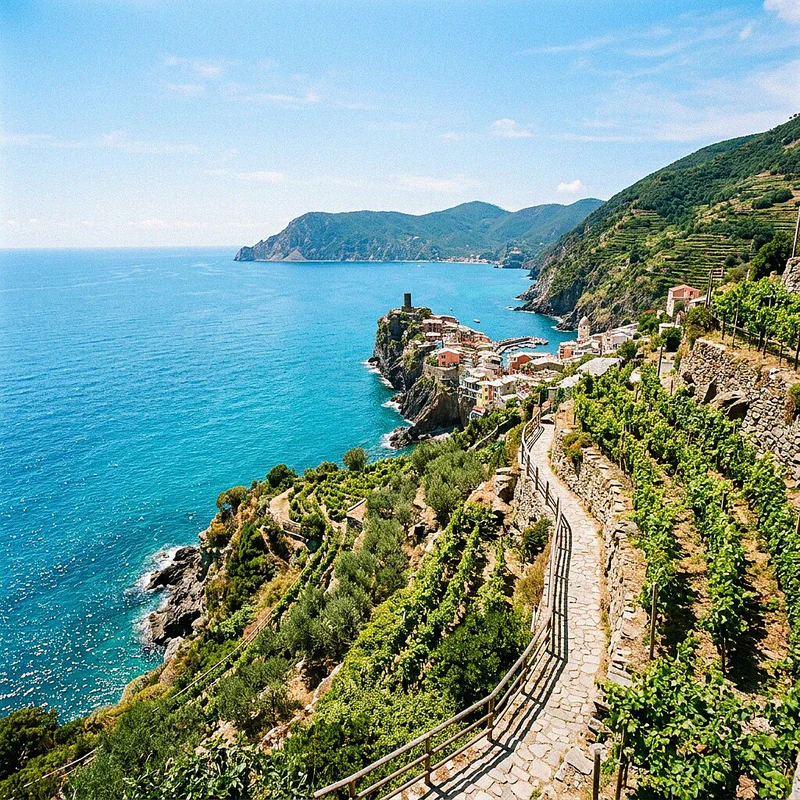
Ciao a tutti, I’m Luca. While the Sentiero Azzurro (the coastal path connecting the Cinque Terre villages) can sometimes feel like a crowded parade of tourists queuing for a selfie, the Via dei Santuari (Path of the Sanctuaries) is where Liguria returns to being itself: deserted, silent, and charged with ancient spirituality. This is where we locals come when we need to breathe, to reconnect with the land, and to enjoy a view that makes you feel, literally, on top of the world.
If you’re tired of “hit and run” tourism and want to discover the vertical soul of this region, lace up your boots. Today I’m taking you to walk between the clouds and the salt along the high trails.
What is the Path of the Sanctuaries (and Why I Love It)#
Centuries ago, each of the five villages of the Cinque Terre built a sanctuary on the hill above it. These weren’t just places of prayer, but true centers of community life, safe havens during pirate raids, and strategic observation points. The Via dei Santuari is the path that connects them horizontally at an altitude that oscillates between 300 and 600 meters above sea level.
While down in the villages people fight for a table at the bar, up here you will walk through terraced vineyards supported by dry stone walls (UNESCO Heritage), encounter ancient springs, and breathe the scent of myrtle and maritime pine. If you love seaside villages but prefer to reach them with the slowness of rail travel, Sofia has written an enchanting guide to coastal towns to visit by train, but my advice is to earn the view with the effort of your legs.
The Five Pillars of the Sky: The Complete Route#
The trail can be divided into stages or traveled in its entirety from Riomaggiore to Monterosso. Here is what you will find along the way:
1. Nostra Signora di Montenero (Riomaggiore)#
Perched 340 meters high (44.091° N, 9.752° E), it is the first balcony you will encounter starting from the east. The view from here is hypnotic: the gaze sweeps from the Mesco Promontory to the islands of the Tuscan Archipelago. On clear days, you can even see the silhouette of Corsica on the horizon. My Secret Tip: don’t just stop in front of the churchyard, but look for the path that continues towards the Telegrafo to find the less-trodden panoramic points.
2. Nostra Signora della Salute (Volastra - Manarola)#
Volastra (44.118° N, 9.739° E) is a circular village that seems suspended in time. The 11th-century Romanesque sanctuary is surrounded by “heroic” vineyards. This is where Sciacchetrà is born, the straw wine that is the liquid gold of Liguria. My secret tip: Look for a small local winery in Volastra for a tasting. Drinking Sciacchetrà while looking at the dry stone walls from which the grapes come is a sensory experience that will remind you of the verticality of the Amalfi Coast paths that I explored some time ago.
3. Nostra Signora delle Grazie (San Bernardino - Corniglia)#
San Bernardino is the highest and loneliest hamlet. The sanctuary is small, gathered, almost a secret kept among the houses. From here the view of Corniglia, the only one of the five villages that does not touch the sea, is breathtaking. It is the most intimate point of the route, where the silence is broken only by the rustling of the wind through the olive trees.
4. Nostra Signora di Reggio (Vernazza)#
Just above Vernazza, this sanctuary is famous for its huge square shaded by centuries-old trees. Here reigns a monumental holm oak over 800 years old, considered one of the oldest in the region. It is a mystical place, cool even in August.
5. Nostra Signora di Soviore (Monterosso)#
We have arrived at the oldest point. Soviore (44.156° N, 9.664° E) is the oldest sanctuary in Liguria (first reports date back to the 7th century). It is an imposing complex, surrounded by giant pines. There is an osteria here that serves trofie al pesto made as God commands. Don’t miss this opportunity: it’s the reward for your hard work.
Luca’s Pet Peeves: Don’t Be “That” Tourist#
I want to be honest with you. One of my biggest pet peeves is seeing people tackling these trails in flip-flops or ballet flats. Please, don’t do it! These are real hiking trails. The terrain is rocky, irregular, and if it has rained, it can be very slippery.
Another pet peeve? Anyone who leaves the vineyard gates open. Those gates serve to keep away the wild boars that destroy the crops. Respect the heroic work of Ligurian farmers: if you find a closed gate, close it behind you.
Practical Tips for the Vertical Explorer#
- Water: Even if there are fountains near each sanctuary, always carry at least 1.5 liters of water. The reflection of the sun on the sea can be exhausting and shade is not always guaranteed.
- Weather: Avoid the central hours in midsummer. Autumn and spring are the magical moments. Walking with the colors of the Ligurian October, among the golden vineyards, is something priceless.
- Logistics: If you want to save your knees, you can use the green shuttle buses of the Cinque Terre Park to go up to the sanctuaries and then walk almost flat along the Way. It’s a local trick to enjoy the view without having to climb 500 meters of elevation gain on foot.
- Tellaro: If after these peaks you are looking for the wildest and least-trodden sea in Liguria, away from the classic circuits, I recommend you explore Tellaro, the secret village of poets.
The Path of the Sanctuaries is not just a trail; it’s an exercise in perspective. It allows you to look down on the hectic beauty of the coast and rediscover the slow rhythm of an Italy that is in no hurry to please everyone, but that reveals itself only to those who want to walk.