
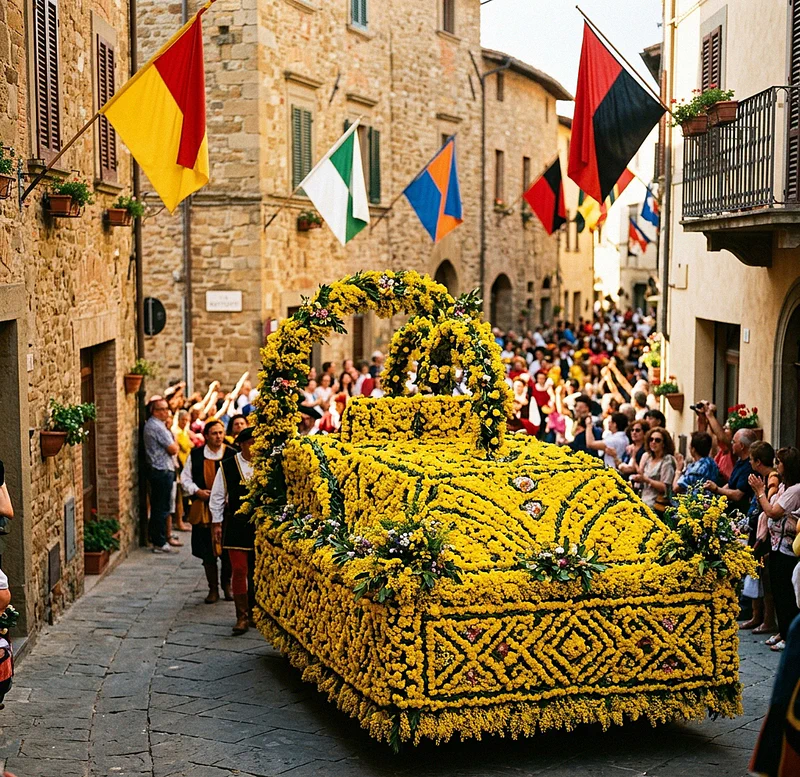
Lucignano is pure geometry. This elliptical-planned village, known as the “snail shell” of Val di Chiana, seems designed to always lead you back to the center, where stone and light blend perfectly. If you arrive here at the beginning of June, when the Tuscan sun warms the terracotta roofs, you find yourself immersed in a yellow sea that smells of honey. The Maggiolata is not a parade but a floral explosion that sees giant floats covered in thousands of fresh flowers defying the gravity of the alleys. Beauty is a challenge.
The smell stuns you. As the floats of the four districts advance through the crowd, the scent of broom becomes almost unbearable in its intensity and sweetness. Each district guards the secret of its float until the last second, in a rivalry that can be felt in every glance and flag waving from the windows. I hear the rhythmic rolling of drums pacing the steps of the costumed participants, an ancient sound that awakens the very stones of the Town Hall. Pride has deep roots.
The Challenge of the Districts and Floral Engineering#
Precision is obsessive. Each district has its own stylistic hallmark: Porta San Giusto is famous for the geometric precision of its mosaics of roses and carnations, while Porta San Giovanni focuses on massive and imposing scenographies that take your breath away. Porta Murata concentrates on historical and allegorical themes, while Via dell’Amore dares with innovative and contemporary narratives. It irritates me when people think they are just flowers: here we are talking about over 100,000 fresh flowers pinned one by one with the appuntatura technique, using a traditional glue based on water and flour. Art is effort.
Gold is not just metal. In the Civic Museum hides the Golden Tree, a masterpiece of Gothic goldsmithing 2.6 meters high decorated with corals that seems straight out of a legend. Couples who exchange a promise in front of its branches will live a faithful love, a ritual that still today attracts lovers from all over the world. It is a work that has lived a romantic fate: stolen in 1914, some of its branches were found in a cave in the Arezzo area and restored by the Opificio delle Pietre Dure in 2023. Update: If you are looking for the same romance that you breathe in front of the Golden Tree, the hills of Val d’Orcia offer starry skies and silences that seem designed for getting lost as a couple. Faith is precious.
The Triumph of Death and Rossellino’s Shadow#
Seek the contrast. Before getting lost in the festival, enter the Church of San Francesco to admire the Triumph of Death, a 1360 fresco attributed to Bartolo di Fredi that is a true visual slap. Death is depicted as a skeletal old lady with long white hair on a black horse, ready to mow down unsuspecting young nobles while sparing the poor who invoke her. This memento mori, set among the Gothic walls, reminds you that the beauty of the Maggiolata is precious precisely because it is ephemeral. Life is a thrill.
Architecture is a signature. Walk under the Logge dei Mercanti, five elegant Renaissance arches often attributed to Bernardo Rossellino, which once housed the grain market. The Palazzo Pretorio, with its coats of arms of the podestà, dominates the piazza and tells you of a time when Lucignano was a fundamental pawn between Siena and Florence. It irritates me when people run without looking up: every loophole and every mullioned window here has a secret to whisper to those who know how to listen to the breath of history. The village is a book.
Meat Doesn’t Wait and the Ciaccia Fritta#
Chianina is substance. Being here means being in the epicenter of the homeland of Italy’s most prized meat, but forget the pretentious restaurants during the days of the festival. I advise you to look for the small stands that prepare the gourmet sandwich with Chianina or to bite into a boiling Ciaccia Fritta, accompanied by hand-cut Tuscan ham. Finish the experience with a glass of Vin Santo Val di Chiana DOC, perfect for rinsing your throat after shouting for your favorite district. This is noble street food.
Jump into the fray. At the end of the Sunday parade, what was a procession led by the solemn Capitano della Festa turns into the “Flower War,” a chaotic battle where everyone throws fragrant petals. It is the moment when the tension of the competition between the districts melts into a yellow rain, marking the end of the effort and the beginning of the Tuscan night. It irritates me when people try to protect their designer clothes: during the Flower War you have to get your hands dirty without too much fuss. Accept the joyous chaos.
Arrive at dawn. If you want to see the districts giving the final touches to the floats immersed in the scent of fresh morning dew flowers, you must be in the village early Sunday morning. You can admire the details of the floral compositions before the afternoon crowd makes any movement along the curved streets difficult. Don’t forget to climb the tower of the Town Hall to see the elliptical perfection of Lucignano from above: it’s a unique sight. Update: If the flavors of Lucignano have won you over, it’s worth taking a trip to nearby Cortona, where culinary tradition blends with an Etruscan history still palpable among the alleys. Choose the right perspective.
See you soon, among the gold of the branches and the yellow of the brooms,
Luca