
There are cities that seem to emerge from the fog and the water like a persistent mirage. Mantua is one of them. While the great Lombard metropolises run towards the future amidst steel and glass, Mantua has chosen to stop in a state of permanent grace, protected by its three artificial lakes that surround it like a millennial embrace.
I am Alessandro, and for a historian like me, walking through Mantua is like leafing through a treatise on Humanism in the open air. It is not just an art city; it is the magnum opus of the Gonzaga dynasty, which for almost four centuries transformed this strip of land between the Mincio marshes into one of the brightest cultural beacons in Europe.
In 2026, Mantua continues to be a “Sleeping Beauty” that needs no kiss to wake up, but only eyes capable of reading the perfect geometry of its palaces and the poetry of its reflections on the water.
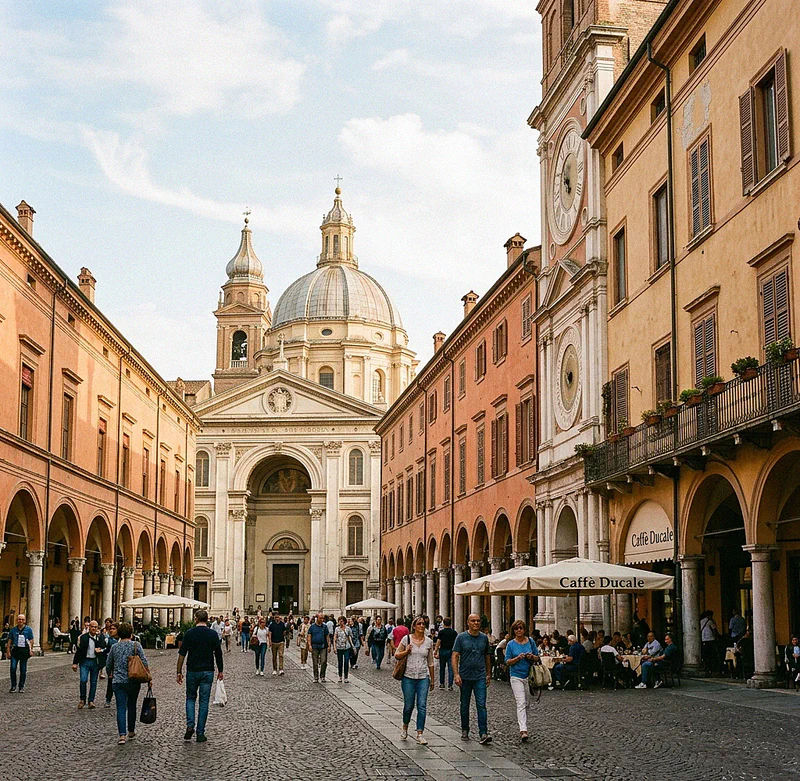
In this article, I want to accompany you beyond the usual itineraries, revealing why Mantua is, in my opinion, the most harmonious city in Italy.
The Infinite Court: Palazzo Ducale and Mantegna’s Genius#
If you want to understand what power meant in the Renaissance, you must cross the threshold of Palazzo Ducale. Do not simply call it a palace; it is a city within a city, a labyrinthine complex of over 500 rooms, courtyards, gardens, and galleries that extends over 34,000 square meters.
The real beating heart of this labyrinth is the Camera degli Sposi (or Camera Picta), located in the Castle of Saint George. Here, Andrea Mantegna achieved a technical and artistic miracle that even today, in 2026, leaves one breathless. Frescoing the entire room to celebrate the Gonzaga family, Mantegna broke down the walls with perspective illusion.
The oculus on the ceiling, with those cherubs who seem to be playfully leaning downwards, was the first true revolution of space in modern art. It is a lesson in technical mastery that reminds me of the same obsessive care for detail and perspective that I found exploring other “ideal” cities of our country. (Update: if you are fascinated by the urban dream of the Gonzaga, you cannot miss my post on Sabbioneta, the “Little Athens” built from scratch by Vespasiano Gonzaga in the nearby plains).
Palazzo Te: The Villa of Pleasures and Giants#
If Palazzo Ducale was the place of official power, Palazzo Te was the place of leisure, eros, and deception. Designed by Giulio Romano, Raphael’s favorite pupil, for Federico II Gonzaga, the palace is the manifesto of Mannerism.
Here, the classical rules of architecture are broken with irony: triglyphs that seem to slide downwards, rustic columns, and, above all, the astonishing Sala dei Giganti. Entering this circular room, one finds oneself immersed in a cosmic catastrophe: the giants attempting to scale Olympus are overwhelmed by the collapse of enormous temples and rocks.
There are no right angles, there are no frames. The fresco covers every inch, floor included, giving the visitor the physical sensation of collapse. It is the first example of “augmented reality” in history, created five centuries before digital headsets. This ability to use architecture to create strong and disorienting emotions is a trait that Mantua shares with other monumental jewels carved in stone. (If you love cities where matter itself becomes pure art, I recommend reading my guide to Ascoli Piceno, the city of travertine).
The Water and the Fog: Mantua’s Interior Landscape#
One cannot say they know Mantua without having navigated its lakes. The city is surrounded by Lake Superiore, Lake di Mezzo, and Lake Inferiore, formed by a 12th-century hydraulic system created by Alberto Pitentino.
In summer, Lake Superiore transforms into an immense floating garden thanks to the blooming of lotus flowers (an allochthonous species but now a symbol of the city). In winter, the fog envelops the towers and domes, giving Mantua that melancholic and aristocratic atmosphere that has inspired poets and musicians.
Do not forget to visit the Bibiena Scientific Theater. A Rococo jewel entirely in wood where a very young Mozart gave a concert at just 14 years old. His father Leopold wrote: “In my life I have never seen anything more beautiful.” And it is hard to disagree even today.
The Gonzaga Cuisine: Between Pumpkin and Aristocracy#
Mantua’s gastronomy is a “cuisine of princes and of the people.” It is rich, buttery, complex.
- Pumpkin Tortelli: The absolute masterpiece. The filling combines the sweetness of Mantuan pumpkin, the savouriness of parmesan, the spiciness of mostarda, and the unmistakable touch of amaretto. It is a perfect balance of contrasts, just like the city.
- Riso alla Pilota: A tribute to peasant tradition, with Mantuan sausage and rice cooked “by absorption,” grainy and tasty.
- Torta Sbrisolona: The queen of desserts. Made of almonds, cornflour, and butter, it should never be cut with a knife, but broken with hands in the middle of the table.
Alessandro’s Tip: If you have time, rent a bicycle. The Mantua-Peschiera cycle path is one of the most beautiful in Europe: 45 kilometers of pristine nature along the Mincio river, which will take you from Renaissance domes to the shores of Lake Garda.
Mantua is a city that requires attention. It is not a “hit and run” place, but an experience that should be savored slowly, letting the beauty of its palaces and the silence of its waters get under your skin.
It is proof that harmony is not a utopia, but a geographic place waiting to be discovered.
See you soon, Alessandro