
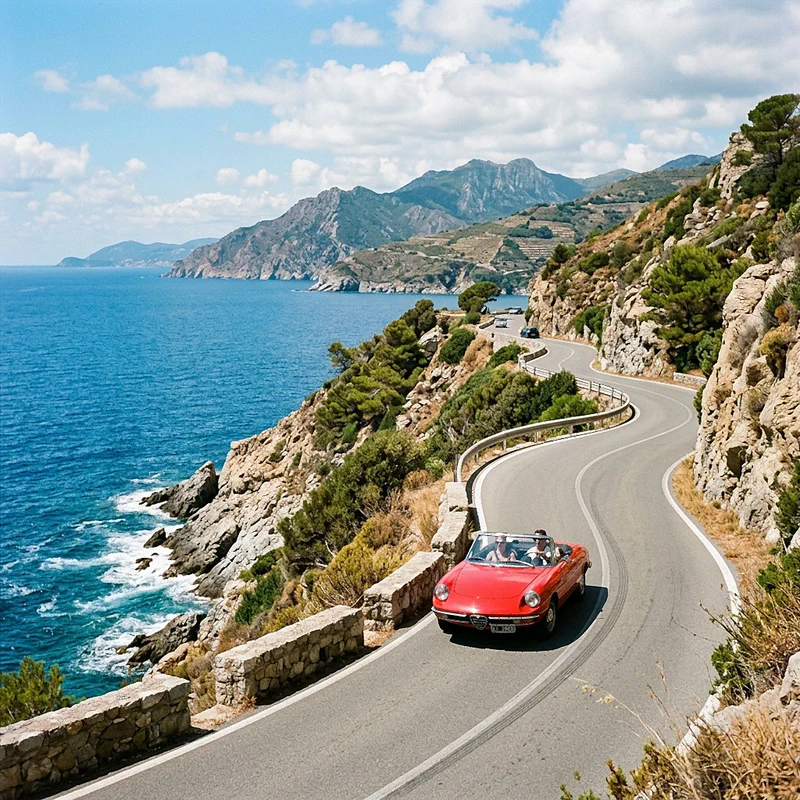
The asphalt seems to dive directly into the deep blue of the Tyrrhenian Sea. Driving along the Western Loop (Anello Occidentale) of Elba Island in late May is one of the most rewarding driving experiences in Italy. With the window down, the air carries the pungent scent of Mediterranean scrub and maritime pine. Away from the summer clamor, the island reveals its true nature: a granite mountain planted in the middle of the sea. It is the perfect playground for those who love the steering wheel and the salt air.
The Western Loop: A Waltz Between Rock and Sea#
Provincial road 25 is not made for those in a hurry. It is a thin ribbon of asphalt that clings to the coast, connecting seaside villages like Marciana Marina, Chiessi, and Pomonte. Every blind curve reveals coves of white pebbles that contrast violently with the ink-blue of the deep water. Stopping by the roadside to admire the wreck of the Elviscot, stranded just a few meters from the shore in Pomonte, is a mandatory stop for those who love the mysteries of the sea. It is pure mechanical and mineral poetry.
Let’s be clear, though: driving here requires steady nerves. The roads are so narrow in some places that two cars struggle to pass, and amateur cyclists create kilometer-long traffic jams on hot weekends. Finding a foreign camper stuck in a hairpin bend below Marciana Alta is a recurring nightmare that will make you curse the choice of not having rented a scooter. Keep your concentration high, use the horn before blind curves, and always respect the right of way on uphill stretches.
The Driving Challenge and the Pomonte Sunset#
Never lower your guard as the sun begins to set. The golden light makes driving the Western Loop even more spectacular, but the constant reflections on the water can dazzle you just before a tight, blind hairpin turn. Stopping at Pomonte just before twilight is a mandatory ritual for any driver who respects the island. Sitting on the warm rocks, watching the wild profile of Corsica stand out sharply on the horizon, and listening to the car engine ticking softly after the climb—this is the real reward of the day. It is in these moments that you fully understand the free and rebellious soul of Elba.
The Granite of Capo Sant’Andrea#
Continuing along the northwestern coast, the geological conformation changes abruptly. Arriving at Capo Sant’Andrea, the cliff transforms into an incredible expanse of granite slabs smoothed by the wind and waves. The light rock dips gently into water so transparent that boats seem to float in a vacuum. It is the ideal place to abandon the car, take off your shoes, and walk on this lunar and warm surface. It is a miracle of natural engineering.
For those who do not suffer from vertigo, Elba offers another mandatory detour toward the sky. From Marciana, a picturesque cable car—made of curious yellow “cages” for two people standing up—takes you to the 1,019 meters of Monte Capanne. The slow and silent ascent, suspended in the void over forests of holm oaks and chestnuts, offers a total view of the entire Tuscan Archipelago and even Corsica. It is an unexpected mountain contrast on an island known only for its beaches.
The Iron Heart: Rio Marina and its Crystals#
Elba is not just beaches and hairpin turns; it is an island made of metal and toil. On the eastern side, the earth is tinged with rust red in the Rio Marina Mining Park, one of the oldest mining sites in the world. Here, the Etruscans and then the Romans were already digging the iron that forged Mediterranean history. Today, open-air sites like Valle Giove and Bacino are an open museum that you can explore on foot or aboard the characteristic mining train.
What will strike you are not just the colors—blood red, ochre yellow, and violet—but the sparkle. Every step you take kicks up a brilliant dust: it is hematite, which covers everything like a black stardust. In the debris, you can find with a bit of luck pyrite, with its perfect cubic crystals. The ancients called it “fools’ gold” because its color deceived less experienced miners, deluding them into thinking they had found infinite treasure when they were only clutching iron sulfide.
There is a deep human soul in these silent valleys. For decades, the life of Rio Marina was dictated by the “Sirena” (Siren), the whistle that announced shifts and echoed all the way to the sea. The village elders still tell of when their fathers returned home in the evening: their faces were black with dust, but they sparkled under the dim lantern lights because of the hematite crystals left on their skin. They looked like men made of stars, proud and hard like the iron they excavated.
Even Napoleon Bonaparte was fascinated by it. During his exile, he appointed André Pons de l’Hérault as director of the mines—a man who initially detested the Emperor but ended up becoming his most faithful collaborator, won over by his inexhaustible energy. Napoleon didn’t just observe; he designed new ports and modernized extraction, seeing in these red rocks the economic future of the island.
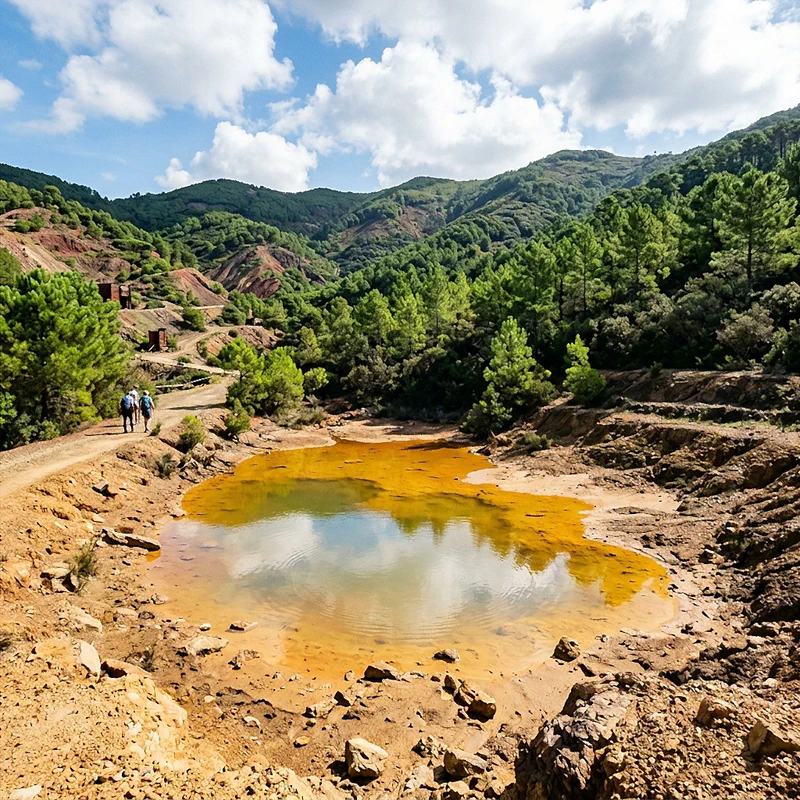
Walking in these silences, interrupted only by the wind, makes you reflect. Until 1981, these valleys echoed with the sound of pickaxes. Today it is a lunar landscape, where Mediterranean scrub envelops old rusted machinery. If you want to taste history, look in the village restaurants for “stoccafisso alla riese,” the miners’ dish par excellence, rich and hearty. For those who love details, take a trip to the nearby Rio Marina beach: the sand sparkles exactly like the paths of the mine, a magical experience especially at sunset. Remember to stop by the Mineral Museum first; the collection of Elban crystals is one of the most prestigious in Europe.
Ancient Flavors and the “Schiaccia Briaca”#
After so much driving and exploring, hunger makes itself felt loud and clear. Stop at a traditional bakery in Porto Azzurro and ask for a piece of “Schiaccia Briaca.” This dry cake, originally kneaded without yeast to last months at sea, is enriched with Aleatico wine, walnuts, raisins, and pine nuts. It is an ancient flavor, dense and pleasantly sugary, perfect for recharging your energy. Put a piece on the passenger seat and get ready to set off toward the next sunset. If you love discovering off-the-beaten-path destinations in Italy, the hidden lagoons of Veneto may surprise you with their serene beauty: Discovering the Hidden Lagoons of Veneto is a journey worth considering for those seeking an authentic Italian experience among nature and history.