
For the vast majority of travelers, the pinnacle and glory of classical architecture are universally associated with the bulk of the Parthenon dominating Athens, or the monumental temples of Agrigento in Sicily. Yet, if you truly desire to find yourself face to face with Greek architecture in its most powerful, silent, and frighteningly intact form, you don’t need to board a ferry to the Aegean Sea. You just need to drive a little south of the Gulf of Salerno, down along the jagged coasts of Campania, to delve into the wild and pristine heart of Cilento.
I am Alessandro, and my work often leads me to dig beneath the surface of the most renowned tourist destinations to rediscover the true roots of our history. Here, in a vast and sunny coastal plain swept by Mediterranean winds, the three golden temples of Paestum stand in solemn isolation.
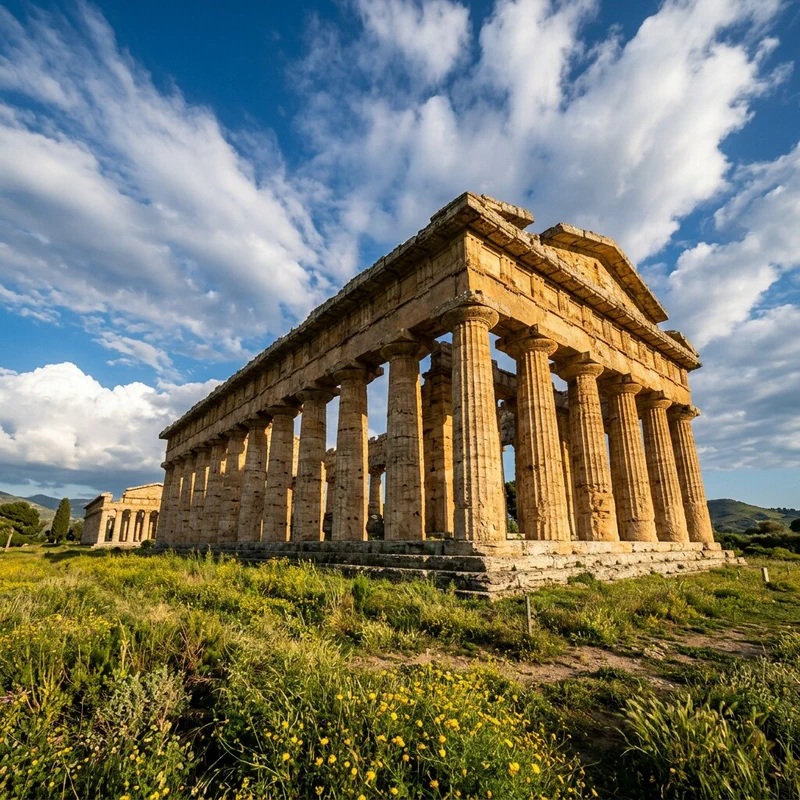
Originally founded by Greek colonists fleeing the city of Sybaris around 600 BC under the name of Poseidonia (the city sacred to Poseidon, god of the sea), this settlement rapidly became one of the richest and most prosperous maritime and commercial outposts of the entire Magna Graecia.
Walking today along the Sacred Way of Paestum, treading on the large white limestone paving stones smoothed by centuries, is an awe-inspiring experience. It is not like visiting the fragmented ruins of the Roman Forum; here you are faced with almost complete stone colossi, which seem to have just been abandoned by their builders.
The Three Doric Giants: A Sculpted Architecture Manual#
What makes the archaeological park of Paestum a global unicum, so much so as to have guaranteed its inclusion among the UNESCO World Heritage sites, is the incredible state of preservation of its three enormous temples. They represent a veritable open-air encyclopedia on the evolution of the Doric order.
The First Temple of Hera (The Basilica)#
Approaching the southern sacred area, the first monumental structure that will catch your attention is the so-called Temple of Hera, mistakenly known for centuries (due to the total absence of the pediment) as The Basilica.
Built around the middle of the 6th century BC (circa 550 BC), it is the oldest temple in the complex. The particularity that makes it immediately recognizable and fascinating for architectural historians is the unusual odd number of columns on the facade (nine instead of the canonical six or eight), which entailed the presence of a central colonnade along the entire nave of the cella. The columns are massive, swollen in the center (an optical trick known as entasis to give a sense of life and elasticity to the stone) and topped by wide, flattened capitals, typical of the most archaic and experimental phase of the Doric style.
The Second Temple of Hera (The Temple of Neptune)#
Just a few meters away stands the structure that alone justifies the entire trip: the so-called Temple of Neptune, in reality also dedicated to the goddess Hera. Built a century after the Basilica, around 450 BC (the exact same time Phidias was raising the Parthenon in Athens), it represents the absolute and unsurpassed masterpiece of Doric architecture in Italy.
It is massive, mighty, and geometrically perfect. Enter the central cella and look up: you can still admire, miraculously intact, the extraordinary internal entablature with two superimposed orders of smaller columns, necessary to support the immense weight of the pitched roof. The mathematical perfection of the proportions and the millimetric symmetry transmit a sense of unshakable harmony.
The Temple of Athena (The Temple of Ceres)#
Moving north, on the slightly highest point of the entire archaeological area, we find the Temple of Athena, known in ancient times as the Temple of Ceres. Built at the end of the 6th century BC, it stands out for a radical innovation that thrills scholars: while the austere external columns are Doric, those of the internal pronaos were built in the Ionic style (more elegant and equipped with volute capitals). It is one of the first documented cases of stylistic fusion in ancient architecture.
The Secrets of the Museum and the Mystery of the Diver#
The open-air archaeological site is only half the experience. As soon as you pass the gates, it is absolutely imperative to dedicate at least two hours to visiting the National Archaeological Museum of Paestum, a modern and rational building that houses treasures of incalculable importance.
The Tomb of the Diver#
The crown jewel of the entire collection is not a monumental statue, but a small pictorial masterpiece: the Tomb of the Diver (Tomba del Tuffatore), dating back to around 480 BC. This exceptional artifact is to date the only surviving evidence of non-vascular Greek painting with scenes of human figures from the entire classical (and pre-classical) era.
While the four side walls of the tomb slab depict scenes of a lively symposium (men drinking, singing, playing, and making love lying on dining couches), the cover slab of the tomb hides an image of overwhelming emotional power. A naked young man, suspended in mid-air in a graceful and perfect flight, dives from the top of a masonry structure towards the blue waters below. It is not a simple dive into the sea; it is a profound, philosophical, and mysterious allegory of the passage from life to death, a leap from the unknown towards the purifying waters of the afterlife.
(Update: If this fascinating journey into the bowels of Campanian history and its most arcane sides excites you, I’ll let you know that I recently published an in-depth report where I unveil the underground mysteries of nearby Napoli Sotterranea and its Greco-Roman era secrets, a veritable labyrinth carved out of tuff under the alleys of the regional capital).
The Lucanian and Roman Legacy#
The most fascinating aspect of Paestum is that the city did not die with the end of Greek dominance. Between the 5th and 4th centuries BC, the city was conquered by the Lucanians, a proud Italic people originating from the surrounding mountains. Far from destroying the temples, the Lucanians integrated Greek culture with their own, leaving us extraordinary frescoed tombs (like the famous “Tomb of the Warrior’s Return”) that narrate bloody battles, duels, and chariot races.
Finally came the Romans in 273 BC, renaming the city Paestum and adding monumental infrastructures typical of their engineering genius: an extensive Forum, the Capitolium, a comitium (circular assembly place), and, of course, a large amphitheater of which today we can only admire a part, because a modern road was wickedly built literally cutting it in half in the 1930s.
The Roses of Paestum: An Ancient Botanical Secret#
Not many visitors know that Paestum also holds an extraordinary botanical record. The Roman poet Virgil, in his Georgics, described with admiration the “biferique rosaria Paesti” — the rose gardens of Paestum that bloomed twice a year, in spring and autumn, an exceptional botanical phenomenon for the ancient Mediterranean.
The centifolia rose (also known as the “hundred-petalled rose” or more popularly the “rose of Paestum”) was for centuries a status symbol in classical antiquity. Its large, intensely fragrant blooms were exported to Rome to adorn the banquets of patricians. Even today, legend has it that on May mornings, strolling between the temples at dawn, you can catch in the air a faint floral scent that seems to come from nowhere — an olfactory echo of a vanished world.
The Ideal Itinerary: How to Structure Your Visit#
Paestum deserves at least a full day, structured to avoid the heat and maximise the impact of the ruins.
- Morning (9:00–12:00): Start at the archaeological area as soon as it opens, when the light is still raking and soft. The morning cool makes the walk bearable. Visit in order: the Temple of Athena (north), the Sacred Way, the Temple of Neptune, and finally the Basilica.
- Early Afternoon (12:00–15:00): Take refuge in the National Museum during the hottest hours. Devote yourself to the Tomb of the Diver at a leisurely pace — this is a moment for reflection, not quick steps.
- Afternoon (15:00–18:30): Return to the open-air area for the late afternoon light. This is the golden hour for photography. Bring sufficient water and comfortable shoes.
- The Gastronomic Detour (18:30+): Before heading back, stop at the Azienda Agricola Vannulo (booking advised): buffalo yoghurt, buffalo gelato, and fresh-from-the-day mozzarella, on an organic farm you can visit with the animals themselves.
Alessandro’s Travel Tips#
Visiting Paestum requires method to grasp its essence without being overwhelmed by the heat and distances:
- The perfect time: Plan your exploration of the open-air archaeological area in the late afternoon hours (the ruins close at sunset). The limestone of the temples, rich in travertine, magically captures the low rays of the setting sun, transforming the severe, gray Doric columns into structures of pure, glowing liquid gold.
- Buffalo Mozzarella: Paestum is not just ancient history; the surrounding plains (the Piana del Sele) are unanimously considered the gastronomic temple of true Mozzarella di Bufala Campana DOP. Take a detour to historic estates like Barlotti or Vannulo (just a few kilometers from the excavations) to taste this cheese still warm from spinning, rigorously served with cherry tomatoes and local olive oil.
- Go by train: If you are staying in Naples or Salerno, the Paestum train station is delightfully vintage and will leave you literally in front of a romantic path that crosses the ancient walls and pops out just 100 meters from the Temple of Athena.
(Update: Many of you venture to Paestum as a day trip from the Amalfi Coast, but my advice is to go further. My colleague Marco has prepared a phenomenal guide dedicated to those who love driving on cliffs: a complete road trip through the unspoiled wonders of Cilento, the true silent and breathtaking alternative to the traffic of the coast).
Paestum is rock-carved proof that the classical obsession with harmony, symmetry, and beauty is capable of defying time, malarial swamps, and oblivion. It is a place where the silence of history speaks immensely louder than any modern word.
Aggiornamento: My colleague Luca recently ventured into the breathtaking landscapes of the Valle d’Aosta region, where he discovered the hidden waterfalls of Gran Paradiso National Park. If you’re eager to explore the lesser-known corners of this enchanting park, his expert guide is a must-read: Unveiling the Secrets of Gran Paradiso’s Hidden Waterfalls.