
While the great and lavish villas of the 16th century – such as Villa d’Este in Tivoli or Villa Lante in Bagnaia – were designed and built with ruthless mathematical precision and reassuring classical rigor, something profoundly different was taking shape deep in the province of Viterbo.
Here, hidden among the thick woods at the foot of an ancient castle, the Sacred Grove of Bomarzo was born not to celebrate divine order, but from a much darker, more visceral, and painfully complex human impulse. It is not an Italian garden made to delight illustrious guests, but a true psychological and esoteric labyrinth, brutally carved into the living volcanic rock.
I am Alessandro, and today I am taking you to the green and mysterious heart of northern Lazio, in a strip of Etruscan land known as Tuscia, to discover what the whole world knows (perhaps a bit too superficially) as the “Park of Monsters”.
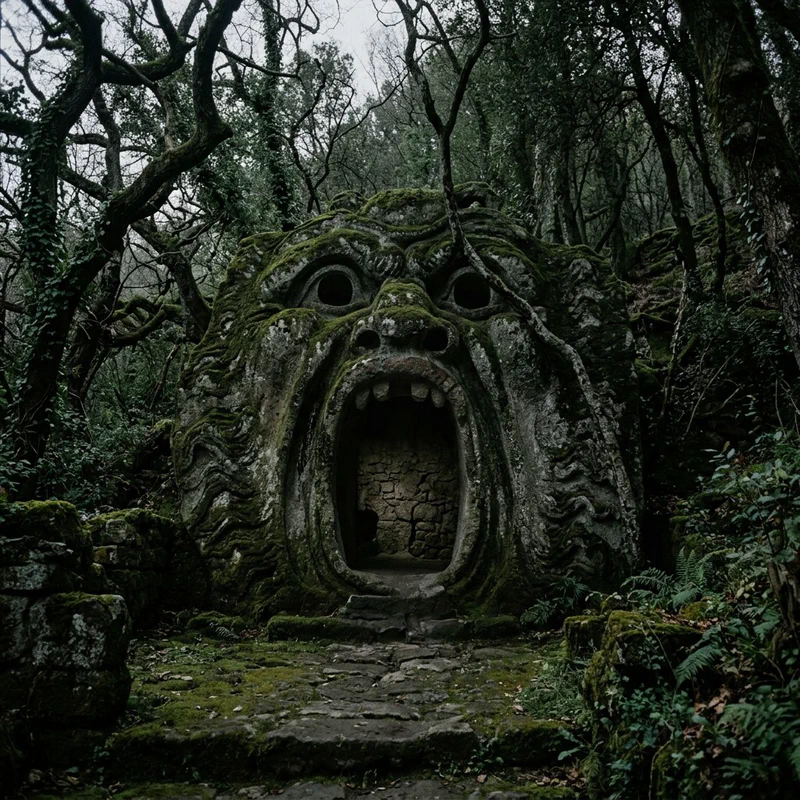
Created in the second half of the sixteenth century by Prince Pier Francesco Orsini (better known as Vicino Orsini), this place is the stone testament of a cultured, tormented, and grieving man. After the tragic and untimely death of his beloved wife Giulia Farnese, Vicino retired to his estates, dedicating his life to the creation of this initiatory grove. He did not want to please the senses, but to shake them, confuse them, and perhaps heal his own wounded soul through a therapeutic path made of visual shocks and stone riddles.
Stone Creatures and Hermetic Symbols#
In Bomarzo, forget about strolling amiably among geometric flowerbeds, splashing fountains, and statues of placid river deities. Here you will walk in a steep, damp, and disordered wood, suddenly encountering enormous monstrous creatures that seem to emerge and disentangle themselves directly from the tuffaceous ground, as if they had always been there waiting to be awakened. The proportions are colossal, grotesque, designed to make the visitor feel small and lost.
The Ogre and the Sound of Terror#
The most famous sculpture, the true icon of the park, is the imposing mask of the Ogre. Its frightening face emerges from the hill with its jaws wide open. Above the upper lip, an inscription warns: Ogni pensiero vola (All thought flies). Crossing the stone teeth of the Ogre means physically entering the mind of the monster.
Inside the mouth, the space widens into a small cavernous room that houses a stone table. But the real magic (or the real nightmare) is the acoustics: the cavity is designed with millimetric precision to transform even the most imperceptible whisper spoken at the table into a low and booming cry outside.
The Vertigo of the Leaning House#
If the Ogre plays with sound, the Leaning House (Casa Pendente) is a direct attack on your sense of balance and your perception of reality. This massive two-story building was deliberately built on a huge naturally inclined boulder. The walls are straight relative to the floor, but the entire structure is off-axis relative to the ground.
As soon as you cross its threshold, your brain will short-circuit. You will experience a very strong sense of vertigo and nausea, a physical disorientation that Vicino Orsini had designed to symbolize the bewilderment of the soul in the face of the irrationality of the cosmos and of pain.
The Stone Bestiary: Between Myth and History#
As you continue through the woods, Vicino’s bestiary becomes even denser and more disturbing. These are not decorations, but actors in a silent drama that has lasted for centuries.
Hannibal’s Elephant#
One of the most imposing figures is the Elephant, which carries a tower on its back and crushes a Roman legionnaire with its trunk. Many see in this sculpture a reference to Hannibal’s expedition against Rome, but for Vicino, the elephant was a symbol of brute and unstoppable force that destroys the established order, a memento of the fragility of empires and men.
The Battle of the Giants#
Two colossal figures, Hercules and Cacus, are engaged in an eternal struggle. Hercules is tearing his opponent apart with his bare hands. It is the plastic representation of brute force prevailing over evil, but in Bomarzo nothing is ever quite that simple: who is the real monster between the two? The tension of the muscles carved in tuff is such that you can almost hear the sound of bones breaking among the trees.
The Dragon and the Beasts#
Not far away, a huge Dragon is attacked by three beasts: a lion, a tiger, and a dog. It is a scene of primordial chaos, where the ferocity of nature manifests itself in all its cruelty. The dragon, a symbol of knowledge but also of sin, fights a losing battle against the lowest instincts of the earth.
An Alchemical Labyrinth for the Spirit#
While his aristocratic colleagues hired the best architects to flaunt power, Vicino Orsini candidly declared that he had created the grove “only to vent the heart” (sol per sfogar il core). He did not seek public admiration. Every single sculpture present in Bomarzo is actually a Neoplatonic and alchemical enigma, conceived for those who have the tools to decipher it.
(Update: As proof of how this specific volcanic area of Viterbo is a real forge of Renaissance mysteries linked to tuff and esoteric isolation, I would like to point out that my colleague Luca has recently dedicated a fascinating report to Calcata Vecchia, the Lazio village that defied time, located just a few dozen kilometers from the Sacred Grove).
In Bomarzo there is no compulsory logical path, no “right” way to salvation. You are left alone to wander, facing irrational fears represented in stone, until you reach, if you can, the final purification. This purification is represented by the only classical and balanced element of the entire park: the Tempietto dedicated to the memory of the deceased Giulia, placed on the highest point of the hill. There, finally, the stone stops screaming and calms down in an architecture of peace.
The Decay Saved by Salvador Dalí#
After Vicino Orsini’s death in 1585, the Sacred Grove was a victim of a sort of damnatio memoriae. His heirs abandoned the park, considered the eccentric and foolish whim of a melancholy old man. For over three hundred years, the wild nature regained control, devouring the monsters, enveloping them in ivy, and hiding them under layers of moss and oblivion.
It was only in the mid-twentieth century that Bomarzo was rediscovered, thanks to the interest of surrealist artists of the caliber of Salvador Dalí and Jean Cocteau, who recognized in these grotesque sculptures the direct ancestors of their own artistic movement.
(Update: If the theme of nature swallowing up imposing ruins while creating ghostly atmospheres fascinates you, don’t forget to check out my newly released guide dedicated to deciphering the historical truth behind the ghost island of Poveglia in the desolate and romantic southern Venetian lagoon).
Alessandro’s Travel Tips#
Bomarzo is not an amusement park to be consumed hastily. It is an intellectual and emotional experience.
- Bibliographical Preparation: Bring a pocket guide to the park’s symbols or, if you have time, read the magnificent and visionary historical novel “Bomarzo” by the Argentine writer Manuel Mujica Láinez before you go. Without a hermeneutic and symbolic key, the park remains a bizarre curiosity in the woods.
- The Right Atmosphere: Avoid the Sunday crowds. The Sacred Grove should be visited on a gloomy autumn or late winter morning, perhaps when a light mist rises from the ground and the humidity makes the volcanic rocks dark. Only in this twilight atmosphere do the monsters seem to truly come to life.
- Surroundings (Tuscia): After your visit, don’t run straight back to Rome. The Tuscia area hides gems like the suspended village of Civita di Bagnoregio or the splendid Palazzo Farnese in Caprarola. Eat at one of the typical trattorias in Viterbo: ask for “fettuccine alla viterbese” or a wild boar dish to honor the strong flavors of the Etruscan land.
Bomarzo is tangible proof, carved forever in the hard volcanic tuff, that the deepest beauty can be born even from pain, loss, and absolute psychological chaos. It is a severe invitation to deliberately lose yourself in your own inner monsters in order to finally find yourself.
If you’re looking to immerse yourself in the authentic charm of Tuscany, my colleague Marco has a wonderful guide to the Festa della Vacca Maremmana, a unique celebration that offers a glimpse into the region’s rich cultural heritage. For a deeper understanding of this captivating event, I recommend checking out his article, A Journey Through the Festa della Vacca Maremmana in Tuscany: Discovering the Hidden Gem of Tuscany’s Festa della Vacca Maremmana.