
Since writing this, my colleague Alessandro explored the charming medieval town of Ascoli Piceno and recently published a guide to discovering Ascoli Piceno, Italy’s best-kept medieval secret, which showcases the beauty of this hidden gem. Close your eyes for a moment and imagine the sound of a wooden knife scraping against a flour-dusted board. Imagine the scent of laundry drying in the salty breeze, mingling with the intoxicating aroma of garlic gently golden-frying in local extra virgin olive oil, as I’ve explored the charm of this region in detail, particularly in destinations like Cesenatico. This isn’t a dream; this is a Tuesday morning in Bari Vecchia, the ancient heart of Puglia’s capital, where the experience of exploring Italy’s medieval towns feels within reach, and I’m reminded that there’s always more to uncover in Italy’s treasured cities.
Update: I’ve since written a guide to discovering Italy’s best-kept culinary secret: the golden crunch of Ascoli Piceno, where I take you on a journey through the flavors of Italy. To me, Italy is a map drawn in flavors, and if you want to find the true soul of the South, you must follow your nose into the alleys of Bari’s old town. Here, the streets are more than just thoroughfares; they are communal kitchens, living rooms, and the stage for one of Italy’s most beautiful culinary traditions: the making of orecchiette, which is just one example of the many gems that can be found in this incredible country, as I’ve explored in detail in my guide to hidden Italian villages. If you enjoyed this, you’ll love my other post about the rich culinary secrets that Italy has to offer.
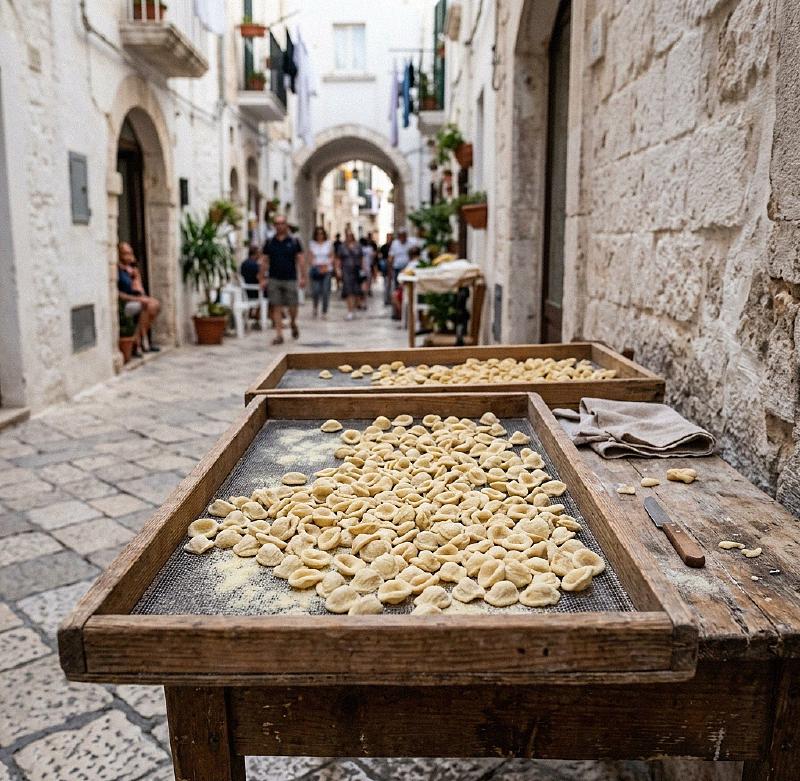
The secret is in the ingredients, and in Bari, those ingredients are simple: durum wheat semolina, water, and a lifetime of muscle memory, much like the unspoiled charm of certain Mediterranean destinations, as I wrote about in my guide to the wild secret heart of the Mediterranean.
The Sacred Street of Pasta: Via dell’Arco Basso#
As I wandered through the historic streets of Bologna, I discovered the charming Via dell’Arco Basso, which I like to call the sacred street of pasta. If you’re as passionate about pasta as I am, you’ll love exploring the local eateries that serve up delicious dishes. For a deeper dive into the world of Bolognese pasta, be sure to check out my guide to Bologna’s secret pasta passages, where I share my favorite hidden gems beyond the tourist trattorias.
Update: I’ve since written a guide to discovering the sacred bread of Altamura, Puglia, and the scent of ancient gold, where I share my journey to discover the rich history and traditions behind Italy’s beloved breads. As I wandered through the charming streets of Italy, I stumbled upon the Sacred Street of Pasta, Via dell’Arco Basso, where the aroma of freshly baked goods and the sound of sizzling pans filled the air. It was reminiscent of my journey to discover the authentic treasures of Italy, and as my colleague Alessandro recently explored in his article about Ascoli Piceno’s medieval charm, the process of discovering the authentic treasures of Italy is a lifelong journey that always leaves me in awe.
If you are looking for the “real” Italy, you won’t find it in a guidebook’s top-ten list of museums. You will find it on Via dell’Arco Basso, famously known as the Strada delle Orecchiette.
As you walk through the stone archway near the Castello Svevo, the world changes. The roar of Vespas fades, replaced by the rhythmic thump-thump of dough being worked. On this street, local women—the legendary nonne of Bari—sit outside their homes at small wooden tables (tavolieri), their hands moving with a speed that defies the eye.
My nonna always told me that you can tell the character of a woman by the shape of her pasta. In Bari Vecchia, these women are the keepers of an ancient flame. They roll the dough into long snakes, cut small nuggets, and with a flick of a butter knife and a thumb, transform them into “little ears.”
Don’t be shy! These ladies, like the famous Donna Nunzia, are the heart of the community. While they might seem focused, a warm “Buongiorno” and a genuine interest in their craft will often earn you a smile and a story. You can buy a bag of freshly made orecchiette right off their drying screens (called telas) for a few euros. Look for the orecchiette di grano arso—made with “burnt wheat,” a traditional Pugliese specialty with a smoky, nutty flavor that tells the history of the region’s cucina povera.
Where to Eat: My Top Trattoria Picks in Bari Vecchia#
While buying pasta to take home is a must, you haven’t truly lived until you’ve tasted orecchiette served steaming hot, coated in a sauce that has been simmering for hours. Here are the spots where I personally go to find that “Nonna-approved” flavor.
1. Osteria al 2 (Via Verrone, 2)#
Tucked away in a quiet corner of the old town, this osteria is exactly what I look for: stone walls, wooden chairs, and the smell of home. Their Orecchiette alle Cime di Rapa (turnip tops/broccoli rabe) is transcendental.
- The Secret: They don’t just boil the greens; they cook the pasta in the same water as the vegetables so every pore of the dough absorbs the essence of the cime. It’s finished with a punch of anchovies, garlic, and a sprinkle of crunchy toasted breadcrumbs (mollica), which we locals call “the poor man’s parmesan.”
2. La Tana di Nanà (Via della Vallisa, 23)#
This is a tiny, bustling spot where the menu changes based on what the market provided that morning. It feels like eating in someone’s dining room. If they have the orecchiette with ragù alla Barese, order it immediately. This isn’t your typical Bolognese; it’s a slow-cooked masterpiece featuring various cuts of meat (often including braciole—meat rolls stuffed with parsley, garlic, and pecorino) that makes the sauce incredibly rich and velvety.
3. Le Arpie (Vico del Arco Basso, 9)#
Located right near the “Pasta Street,” this restaurant manages to be both traditional and slightly more refined. It’s the perfect place to try Orecchiette con pomodorino e cacioricotta. The acidity of the local cherry tomatoes paired with the salty, sharp kick of the aged sheep’s milk cheese is the taste of a Pugliese summer on a plate.
Beyond the Pasta: The Street Food of Bari Vecchia#
While the orecchiette is the queen, Bari Vecchia has other treasures. You cannot leave without trying the street food that fuels the locals.
- Sgagliozze: These are squares of fried polenta, served piping hot and heavily salted. Look for Maria delle Sgagliozze in Piazza del Ferrarese. She is a local icon, frying these golden delights in a massive vat of oil right outside her door. It’s simple, greasy, and absolutely perfect.
- Popizze: Little clouds of fried pizza dough. Sometimes they are savory, sometimes dusted with sugar.
- Focaccia Barese: This is not the focaccia you know. In Bari, it’s thick, crispy on the edges from plenty of olive oil, and topped with burst cherry tomatoes and salty olives. The best place is Panificio Fiore (Strada Palazzo di Città, 39), housed in a former medieval church. The aroma of baking bread and oregano hitting the street is enough to make you weep with joy.
Practical Tips for Your Culinary Pilgrimage#
To experience Bari Vecchia like a local, you need to know the rhythm of the city.
Best Time to Visit#
- For the Pasta Makers: Arrive between 10:00 AM and 12:00 PM. This is when the production is at its peak, and the streets are filled with the sight of drying pasta.
- For Dining: Lunch (pranzo) starts at 1:00 PM, and dinner (cena) rarely begins before 8:30 PM.
- Seasonality: While orecchiette is year-round, cime di rapa is a winter/spring vegetable. In the summer, look for orecchiette with fresh tomato and basil or zucchini flowers.
How to Get Around#
Bari is very well-connected. You can take a high-speed Frecciarossa train from Rome or Naples directly to Bari Centrale. From the station, it’s a pleasant 15-minute walk through the 19th-century Murat district (full of grand boulevards and shops) until you reach the “wall” of the old town.
- Note: Bari Vecchia is a pedestrian zone. Wear comfortable shoes! Those ancient cobblestones (chianche) are beautiful but can be slippery and uneven.
Booking Secrets#
For the popular trattorias like Osteria al 2, I highly recommend calling a day in advance. Don’t rely on websites—many of these family-run spots prefer a phone call. If you don’t speak Italian, a simple “Vorrei un tavolo per due, per favore” (I would like a table for two, please) goes a long way!
The Soul of the Plate#
People often ask me why I spend so much time in these tiny kitchens instead of seeking out the latest food trends. The answer is simple: in Bari Vecchia, food is not a commodity; it is an act of love and a preservation of history.
Every time I sit down to a bowl of orecchiette, I think of the generations of women who sat in those same doorways, passing down the technique from mother to daughter. They didn’t have much, but they had the land, the sea, and their hands.
When you visit Bari, don’t just eat. Listen. Smell. Watch the way the flour hangs in the air. Puglia is a land that demands you slow down and savor the details.
As you leave the old town, perhaps with a bag of dried pasta tucked under your arm and the taste of olive oil still on your lips, you’ll realize that you haven’t just visited a city. You’ve been invited into a family. And that, my friends, is the most delicious experience of all.
Buon appetito, and see you in the alleys!
— Giulia