
Ciao! I’m Elena. As a mother, I always look for ways to show my children the most authentic soul of our country. In Italy, that soul isn’t found just in museums or grand monuments; it vibrates strongly in our ancient religious festivals. In May and June, as the days lengthen and the air carries the scent of rose petals, incense, and porchetta sizzling in the squares, our cities come alive with a devotion that is both solemn and deeply celebratory.
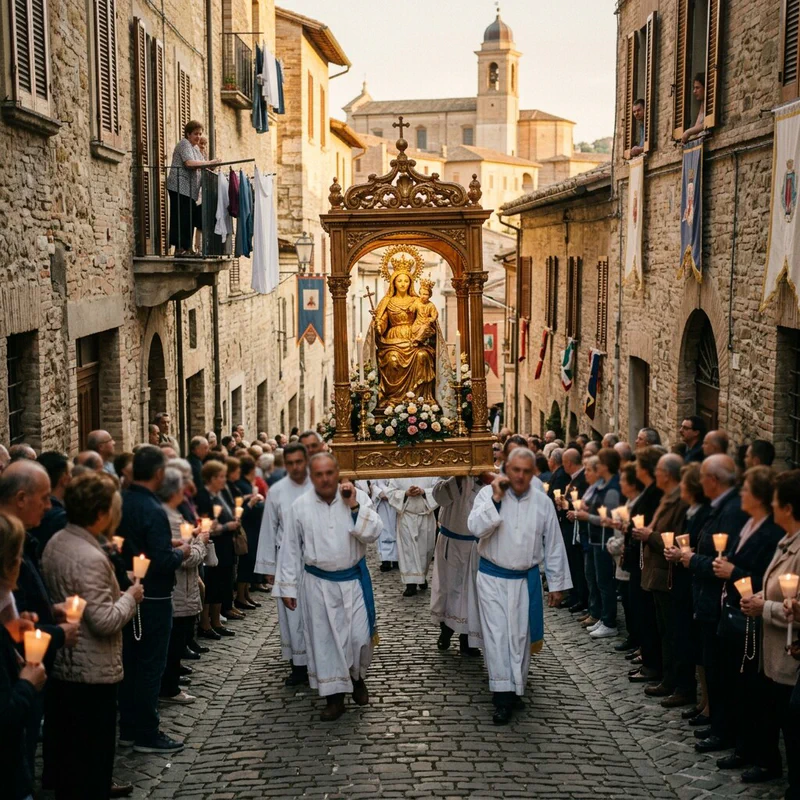
For a family traveling in Italy, witnessing a traditional procession or a patronal festival is an experience that goes beyond tourism: it’s an encounter with a living tradition passed down for centuries. Today, I want to guide you through some of the most beautiful and child-friendly celebrations taking place during these magical months.
If you are planning your trip during this period, I recommend exploring Giulia’s guide on how to savor spring in Umbria. Update: You might also be subsequently inspired by Alessandro’s Wine Grand Tour to discover the soul of historic regions, or don’t forget to read my subsequent story about the magic of Apulian masserias which I explored later that year.
Gubbio and the Corsa dei Ceri (May 15th)#
On May 15th, Umbria comes to a standstill for one of the craziest, fastest, and most exciting festivals in the world: the Corsa dei Ceri (Race of the Candles). It’s no ordinary race: three massive wooden structures (the Ceri), topped with statues of St. Ubaldo, St. George, and St. Anthony, are carried on the shoulders of the ceraioli through the steep medieval streets to the top of Mount Ingino.
I still remember Leonardo’s wonder at seeing the men in yellow, blue, and black shirts running at incredible speed. A tip for parents: Gubbio is packed that day. We chose to see the “Alzata dei Ceri” (the raising of the candles) in the morning from an elevated position and then moved to a less crowded area for the actual race. Lorenzo held Beatrice on his shoulders so she could see the “wooden giants” pass, while I explained to Leonardo that St. Ubaldo must always win (he’s the one who arrives first at the Basilica!).
Spello and the Night of Flowers (Infiorata del Corpus Domini)#
Between late May and June, for Corpus Domini, the village of Spello transforms into an open-air garden. The streets are covered with carpets and paintings made entirely of flower petals. This is what they call the Infiorata.
The real magic happens during the “Night of Flowers,” the Saturday night before the procession. The inhabitants work all night, bent over the ground, to compose these ephemeral works of art. We took the kids to see the artists at work: Beatrice was enchanted by the intense scent of broom and roses filling the air, while Leonardo tried to understand how they managed not to make mistakes in the designs.
Logistical tip: Bring the children early Sunday morning, before the procession passes (which “destroys” the flowers by walking on them). Spello’s streets are narrow and steep: forget the stroller and use a carrier or let them walk if they are old enough.
Campobasso and the Festival of Mysteries#
In Molise, in June, one of the most incredible parades you can imagine takes place: the Festa dei Misteri. These are steel structures that carry children dressed as angels and saints high up, appearing to literally fly above the crowd.
This is where we had one of the funniest moments with our children. During the parade, the “Devil” appears—a character dressed in black who tries to scare the children by shouting “Tunz, tunz, tunz!”. Leonardo was a bit fearful at first, but when he saw that the Devil was joking and drawing laughter from the crowd, he started laughing too. Update: If you want to delve deeper into this unique celebration, I subsequently dedicated an entire article to the Festa dei Misteri in Campobasso.
Family Survival Kit for Patronal Festivals#
Participating in these events requires a bit of adaptability, but with these small precautions, everything will be easier:
- The Heat: In May and June, the sun can already be very strong. Hats, sunscreen, and plenty of water are a must. Shops in procession areas are often closed, so bring snacks from home.
- The Noise: Marching bands and firecrackers (small pops to celebrate the saint) can be very loud. If your children are sensitive to noise, bring headphones or stay at a safe distance.
- Positioning: If you can, try to know someone local who has a balcony or window overlooking the procession route. Alternatively, identify the squares where the procession makes a stop: these are the best moments to see the statue up close without the crush of the path.
- The Restroom: During big festivals, finding a public restroom is a challenge. Identify bars on side streets before the event starts: they are often more accessible than those on the main road.
Experiencing a religious festival in Italy means immersing yourself in a circular time, where the past returns to the present with all its colorful and spiritual force. Seeing your children fascinated by such ancient traditions is a way to give them a small piece of our collective soul.
See you soon, Elena