
For the vast majority of travelers, the impact of Florence is an overwhelmingly architectural and mineral experience. The dazzling whiteness of the marbles of Brunelleschi’s Duomo, the rough stone of Palazzo Vecchio, the geometric pavements scorching under the summer sun. There seems to be no room for anything but sculpted art, impregnable palaces, and crowded museums, in a city that in many ways has the appearance of a magnificent open-air vault.
But behind this facade of severe Renaissance perfection, a green and pulsating heart beats. I am Alessandro, and today I want to invite you to look beyond the heavy solid wood doors, to peek through the iron gates of private courtyards. I want to accompany you on a discovery of “Green Florence”—the aristocratic, intimate, and exquisitely botanical side.
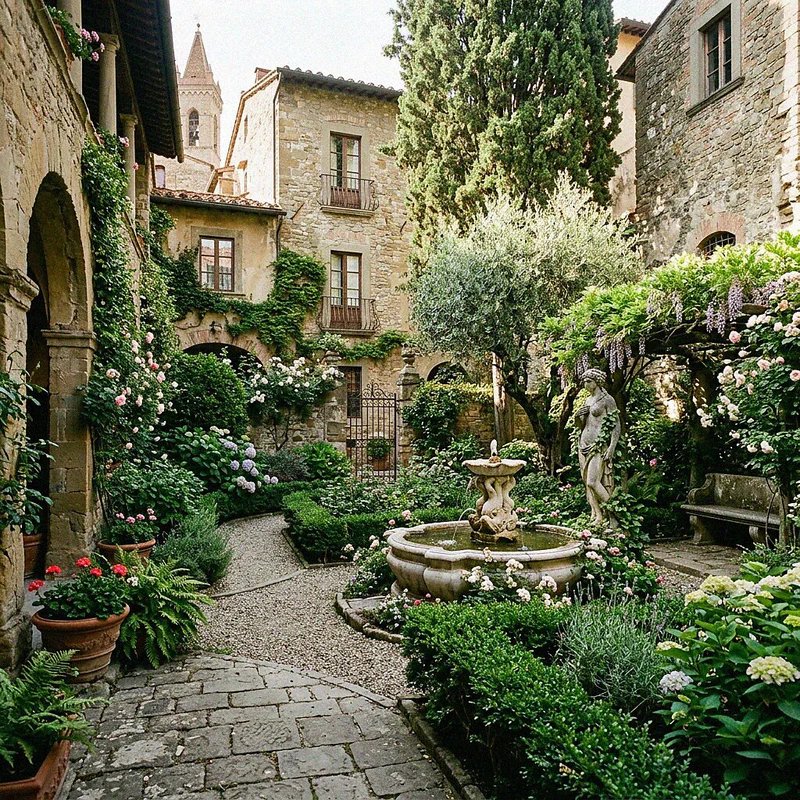
In an era when power was measured not only in gold florins or political alliances, but also in the ability to shape nature itself, bending it to one’s aesthetic will, the great Florentine families created priceless masterpieces made of hedges, water, and stone.
If the intoxicating combination of Mediterranean scrub, human geometries, and breathtaking views suspended between sky and sea is your idea of paradise on earth, you will surely remember the exciting report by my colleague Sofia dedicated to the romantic charm of the gardens of Ravello on the Amalfi Coast. The Florentine approach, however, is profoundly different: here nature is not wild; it is tamed, theatrical, and deeply rational.
The Green Grandeur of the Grand Dukes: The Boboli Gardens#
One cannot speak of greenery in Florence without starting with its absolute monarch: the Boboli Gardens. Located in the Oltrarno, embraced by the hills behind Palazzo Pitti, Boboli is a true treatise on landscape architecture. Designed in the 16th century at the behest of Eleanor of Toledo, wife of Cosimo I de’ Medici, it defined the standard for the “Italian garden,” even inspiring Versailles.
A Labyrinth of Symbols#
Strolling through Boboli means walking in a theatrical scenography. The long perspectives frame Egyptian obelisks, huge granite basins, and ancient Roman statues. Every botanical element manifests the greatness of the Medici. Among the branches of centuries-old holm oaks, you might come across the Neptune basin islet or the colossal sculpture of Abundance.
The Buontalenti Grotto#
The true esoteric jewel is the Buontalenti Grotto. This Mannerist artificial cave is a masterpiece of fake stalactites and shells. Entering it means passing from the geometric rationality of the avenues to a dreamlike and deliberately disturbing world. It is a leap into the unconscious of the Renaissance.
Science and Beauty: The Giardino dei Semplici#
Few know that Florence is home to the world’s third oldest botanical garden: the Giardino dei Semplici. Founded by Cosimo I in 1545 as a medicinal garden for the faculty of medicine, this space represents the scientific and rationalist side of the Renaissance. Here beauty is not an end in itself, but functional to the study of healing plants. Walking among its historical greenhouses and monumental trees (such as the yew planted in 1720) allows one to understand how for the Florentines, knowledge of the natural world was inseparable from art.
Aristocratic Oases: The Torrigiani Garden#
While Boboli is a public manifesto, Florence hides noble gardens invisible from the street. The most incredible is the Torrigiani Garden, the largest private garden in Europe within urban walls. Six hectares in the San Frediano district that offer a triumph of romantic English style. Shady groves and a mysterious twenty-two-meter-high neo-Gothic tower, originally conceived as an astronomical observatory and a Masonic initiatory path, make it a unique place.
Hidden Courtyards and the Soul of the Oltrarno#
Sometimes, nature is surgically enclosed in the internal courtyards of the palaces. The densest example is the Garden of Palazzo Medici Riccardi, where Lorenzo the Magnificent and Michelangelo once walked. But I also invite you to lose yourself in the streets of the Oltrarno, such as Via Maggio. Look beyond the half-closed doors: you will discover porticoed courtyards where ferns and lemon plants coexist with Renaissance statues in a harmony that seems not to have been scratched by the centuries.
Alessandro’s Practical Tips#
- The Iris Garden: If you visit Florence between late April and early May, this garden (open only for a few weeks) hosts thousands of varieties of the city’s symbol flower, with an unparalleled view.
- The Rose Garden: Located just below Piazzale Michelangelo, it is a romantic oasis open for free year-round. In addition to hundreds of varieties of roses, it houses ten sculptures by Belgian artist Jean-Michel Folon that add a touch of contemporary poetry to the view.
- Logistics and Fines: Florence is ruthless with ZTL cameras. To park without stress, I refer you to the guide by my colleague Marco dedicated to how to park in Florence without going crazy.
- Authentic Flavors: Once your eyes are satisfied in the gardens, you must necessarily satisfy your palate. My colleague Giulia has previously traced an authentic culinary itinerary in Florence that will take you far from the tourist traps.
- The Perfect Hour: Visit Boboli at the morning opening on weekdays. The silence will give you the illusion of being the true Dukes of Tuscany.
Florence has a gift for hiding. Its true luxury is protected behind high walls. Take the time to push those heavy gates: the green soul of the Renaissance awaits you.
See you soon, Alessandro