
There is something extremely gentle and reserved about Lucca, a quality rarely encountered in other Italian cities of art. It is that walled embrace of ancient stone that protects the historic center, the almost imperceptible rustle of bicycles gliding silently through the cobbled alleys, and that subtle fragrance of blooming camellias that, in spring, floats lightly through the half-closed gates of the aristocratic courtyards.
Update: I am Sofia, and today I want to invite you to discover the most intimate, shady, and deeply romantic side of this Tuscan city. Lucca is not a place that reveals itself at first glance; it requires patience, curiosity, and the desire to look beyond appearances. Sometimes the most dreamy destinations are precisely those that remain a step off the most beaten paths, a lesson I learned while getting lost among the travertine squares of Ascoli Piceno, another medieval secret I carry in my heart.
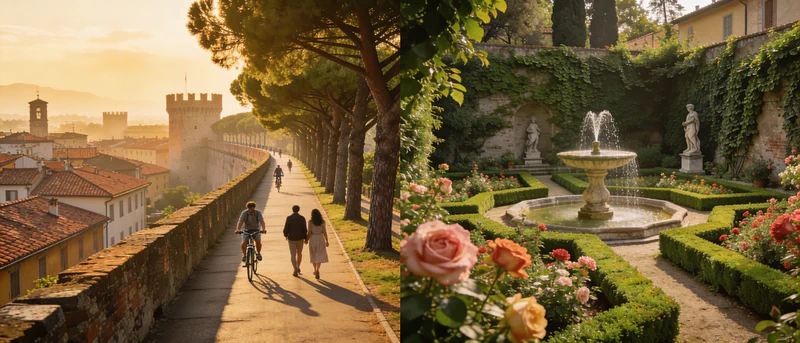
Palazzo Pfanner: An Open-Air Baroque Alcove#
If there is a place in Lucca capable of embodying the very idea of a romantic garden, it is undoubtedly Palazzo Pfanner. Located right at the foot of the walls, this masterpiece of Lucchese Baroque welcomes the visitor with an explosion of elegance. Its statues of Greek deities, presiding over the white gravel paths, and the fountains splashing lazily, create an atmosphere that seems suspended in a century of wigs and whispered secrets.
As you stroll among the boxwoods pruned with geometric precision and the seasonal blooms of tulips and roses, let yourself be enveloped by the silence. It is the ideal place to get lost hand in hand, surrounded by a beauty that perfectly embodies the eternal and somewhat aristocratic charm of Tuscany. The feeling of peace felt here is deep and regenerating, similar to what one feels while listening to the whispers of Lake Orta, where the water and the garden merge in a single breath.
The Botanical Garden: Maria Luisa’s Sanctuary#
Founded in 1820 at the request of Maria Luisa of Bourbon, the Botanical Garden of Lucca is much more than a collection of rare plants; it is a sanctuary of biodiversity and peace in the beating heart of the city. Strolling along the water lily pond, where the reflections of the trees create almost hypnotic plays of light, or stopping in the shade of the centuries-old cedar of Lebanon, is an experience that nourishes the spirit.
Here, time seems to slow down drastically. It is a garden made of expectations and subtle discoveries, where every leaf and every flower has a story to tell. It is a dimension of purity and respect for nature that reminds me of the enchanted atmosphere of Monte Isola on Lake Iseo, a place where the noise of the world is banished to leave room for the voice of the earth.
What Bothers Me: Aesthetics Wounded by Hasty Tourism#
I want to be honest with you and confess what bothers me, because loving Lucca also means suffering for what clouds its grace. Nothing hurts me more than the too numerous and noisy organized bicycle tours that invade the walls, transforming them into a race track. The Walls of Lucca are a suspended park, a tree-lined avenue that deserves to be walked slowly, almost on tiptoe, so as not to disturb the sleep of the centuries.
Another sour note? Those aggressive modern neon signs that are starting to appear near the ancient squares, or those cafes that use cheap plastic furniture in the shade of Renaissance palaces. Lucca requires chromatic and material coherence: wood, wrought iron, stone, and warm light. Only in this way can its poetry continue to flourish.
Above the Walls: The Elevated Forest#
You cannot say you have lived Lucca without having walked its iconic walls. Just over 4 kilometers long, these fortifications have never served for war purposes but have been transformed by the Lucchese into an immense elevated public park. Walking under the centuries-old plane trees, looking on one side at the red roofs of the city and on the other at the peaks of the Apuan Alps shining in the distance, is a ritual that reconnects with the beauty of life.
It is up here that Lucca breathes. If you love places where greenery and history merge inseparably, you will appreciate the care this city takes in preserving its heritage. It is a narrow street embrace that extends toward the sky, offering a privileged perspective on one of the most elegant cities in Italy.
Sofia’s Advice: The Secret of the Half-Closed Gates#
I leave you with a little secret. In Lucca, true magic happens in the courtyards. Strolling along Via Fillungo or Via Guinigi, don’t just look at the shop windows. Look beyond the heavy wooden doors or through the iron grates of the gates. Often, behind a stern facade, is hidden a tiny roof garden, a potted lemon tree, or a stone fountain covered in moss.
The true Lucca reveals itself only to those who have the patience to slow down and the grace to peek with respect. It is a city that does not give in to “hit and run” tourism but rewards those who know how to inhabit its slow time. Lucca is not just a city to visit; it is a feeling to cultivate. It is the place where the noise of the world finally falls silent to leave room for the whispers of the green and the poetry of silence.
See you soon, among the shadows and flowers,
Sofia