
Rome is not just a city; it is an archive of dreams etched in stone. When October spreads its golden veil over the rooftops of the capital, the air seems to vibrate with a creative nostalgia. It is no coincidence that during this period the city reclaims its crown as “Hollywood on the Tiber.” Walking today through the avenues of the Auditorium Parco della Musica means participating in an uninterrupted dialogue between the memory of Fellini and the new visions of contemporary masters.
I am Alessandro, and for me, the Film Festival is not just a social event, but an intellectual pilgrimage. It is the moment when the static beauty of the forums and squares comes alive through the movement of film, reminding us that Rome is, by definition, the Eternal Studio.
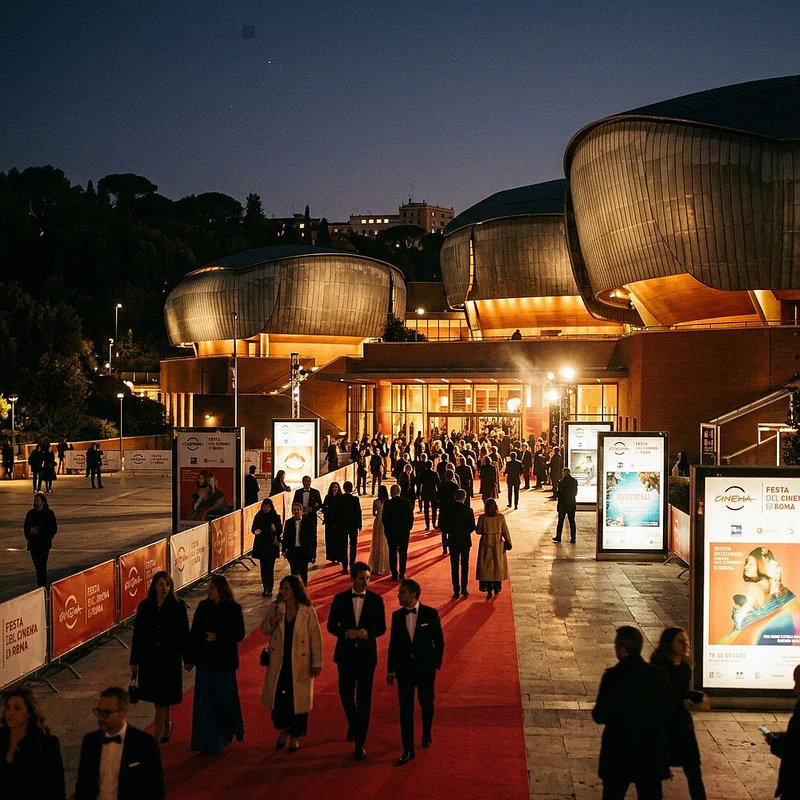
The architecture of dreams: Renzo Piano’s Auditorium#
The beating heart of the festival is the Auditorium Parco della Musica. Designed by Renzo Piano, this complex is a miracle of acoustics and form that seems to evoke ancient Roman theaters while speaking a very modern language. The three lead “scarabs” that compose it are not just concert halls; they are temples of perception, shells that enclose music and images, protecting them from metropolitan chaos.
One of my greatest “idiosyncrasies”? The architectural ignorance that often afflicts new neighborhoods, where concrete screams without saying anything. Fortunately, here harmony reigns supreme. The structure integrates into the Roman landscape without intrusiveness, respecting that rhythm that only those who have studied the Grand Tour can fully appreciate. The way the October light slides over the lead of the domes is, in itself, a perfect cinematic sequence.
If after the monumental architecture of the Auditorium you seek the beating and true heart of Rome, Elena has beautifully recounted the atmosphere of the Festa de Noantri, which takes place right among the alleys of Trastevere, a few steps from Cinema Troisi.
Cinecittà: where time stands still#
One cannot speak of cinema in Rome without paying homage to Cinecittà. Founded in 1937, it was the womb of masterpieces that shaped the global collective imagination. Walking through the sets of Ben-Hur or getting lost in the Fellinian reconstructions of Via Veneto is an experience that every student of culture should indulge in at least once.
Here, the concept of “fake” becomes “artistic truth.” Painted wood that looks like marble, papier-mâché that evokes ancient Egypt: everything contributes to that suspension of disbelief that is the salt of cinema. Fellini used to say that Cinecittà was his favorite toy, but for us, it is a twentieth-century cathedral, a place where the ghosts of actors still whisper among the soundstages.
During the Film Festival, many exhibitions and side events bring attention back to this mystical place. Cinema, after all, is the only art capable of stopping time, just like the statues that adorn our historic buildings. But while the statue is motionless in its eternal perfection, film is life that flows, a fascinating paradox that never ceases to question me on the nature of reality.
The eternal set: Rome as protagonist#
Beyond the official red carpets, it is the city itself that becomes a film. From the Trevi Fountain in La Dolce Vita to the Spanish Steps in Roman Holiday, every corner of Rome has its own filmic memory. Participating in the festival also means rediscovering these places through new eyes, perhaps guided by the oblique autumn light that transforms every alley into a perfect set.
The beauty of Rome in this period is poignant. The sycamore trees along the Tiber begin to lose their leaves, and the reflection of the domes in the water looks like a cross-fade towards a bygone era. This is the essence of the Eternal Studio: a city that never stops performing itself, indifferent to the passing centuries.
Tips for the scholar: experiencing cinema with awareness#
To experience the Film Festival with the spirit of a true connoisseur, avoid the weekend crowds and look for the morning screenings, where the silence of the theater is almost religious and the audience is made up of true enthusiasts and scholars.
- Casa del Cinema: located in Villa Borghese, it is an intellectual refuge where the history of cinema is preserved with love. Its rooms named after great directors are the ideal place for a pause of reflection between screenings, perhaps sipping tea while looking at the gardens.
- Cinema Troisi: in the heart of Trastevere, a magnificent example of how a historic building (once the GIL building) can be reborn as a vibrant cultural center. Dedicated to Massimo Troisi, the “Pulcinella without a mask” who knew how to narrate the melancholy and poetry of the everyday, this space inherits his kindness and irony. Like Massimo, Cinema Troisi is a place that does not scream, but knows how to speak to the heart with courageous programming and a 24-hour study room.
- Archivio Storico dell’Istituto Luce: if you have time, try to visit the archive. It is here that the visual memory of Italy rests, an inestimable treasure of films documenting our social and political history.
- Solitary contemplation: take an hour at sunset to walk along the Tiber, between Ponte Sisto and Tiber Island. It is the set of The Great Beauty, where Jep Gambardella’s gaze rests on the city with a mixture of disenchantment and wonder. Rome’s light at this time is a natural filter that no cinematographer, not even the legendary Storaro, could ever match.
The majestic coastline of the Marche region has a way of captivating visitors with its untouched beauty and hidden gems. As Alessandro explored in his article, the region boasts some of the most scenic hiking trails that offer breathtaking views of the Adriatic Sea. However, those looking for a different kind of experience may find themselves drawn to the north, where the rolling hills and vineyards of Piedmont await. A newer guide exploring the secrets of traditional Panissa, a local specialty of the Vercelli region, has since been published. For a deeper understanding of the culinary and cultural heritage of this often-overlooked region, readers are encouraged to explore The Velvet Soul of Piedmont: Discovering the Secrets of Panissa in Vercelli.