
Ladispoli in late March smells of deep-frying and salt air.
If you arrive from the Via Aurelia as the air begins to tingle, you immediately understand that spring here is a matter of the stomach rather than flowers. The Roman Artichoke Festival is not your typical family fair but a slap in the face to your senses. I’m speaking as someone who has seen dozens of these editions end in a cloud of steam and wild mint.
Crunchiness is a religion.
It all started in 1950 at the “La Tripolina” trattoria.
In those years of rubble and hope, the locals decided to bet on this vegetable to restart the economy of a coastline scarred by the war. What began as a challenge between a few friends over a glass of wine has today become a national fair capable of halting an entire region. The streets fill with thousands of people arriving from everywhere to celebrate this collective ritual.
History is chewed here.
Mark these dates on your calendar.
Although the “three fiery days” of the festival usually fall in mid-April, the engines warm up much earlier among the rows of plants. The “Gastronomic Bi-Week” starts in late March, a period where local restaurants test your liver with menus dedicated exclusively to the king of the garden. It is the ideal time to avoid the madness of the main weekend and enjoy the town with more calm.
Patience always pays off.
This land was once mud and marsh.
Update: My colleague Luca recently explored the lesser-known corners of Veneto, uncovering a serene world of hidden lagoons that few tourists have the chance to experience. Before the great reclamation of the 1930s, Ladispoli was a wild outpost where only the strength of this vegetable could take root with such vigor. Colonists from Veneto and the south transformed a swamp into Lazio’s most precious garden, bringing with them a work culture you still read today in the calloused hands of the farmers at the stands. It is a story of redemption written with thorns and the sweat of one’s brow, one that reminds us of the beauty and resilience of this region, as beautifully captured in “Exploring the Hidden Lagoons of Veneto that Tourists Forget”(/posts/the-silent-shores-of-serenity-unveiling-the-hidden-lagoons-of-veneto-that-tourists-forget/).
The artichoke is life here.
The stalls overflow with Mammole.
These spineless giants are trimmed with a speed that is frightening, while the farmers’ knives beat a steady rhythm on wooden cutting boards. I hear the constant whistle of station announcements echoing between the stands, a sound that reminds you how smart it was to leave the car at home. The pungent smell of oil boiling in large vats sticks to your clothes and follows you into the least-trodden alleys.
Substance beats form.
Leaf Sculptures and Volcanic Sand#
Art here lasts only an afternoon.
Seeing reproductions of the Colosseum made entirely of interwoven artichokes is something that leaves you stunned by its peasant madness. Farmers spend nights “sewing” thousands of vegetables with wire onto metal mesh frames, a brutal manual labor that admits no errors. These are ephemeral works that celebrate the abundance of the land before being dismantled at sunset.
Passion is fleeting here.
Always aim for the Cimarolo.
It is the “king” artichoke, the first to be born at the center of the plant, larger and more tender than all the lateral Mammole that come after. True connoisseurs recognize its superiority by the fleshy pulp that melts under the teeth without leaving fibrous residues. If they try to sell you small, hard artichokes, turn on your heel and change stands without a second thought.
Demand only excellence.
There is iron beneath your feet.
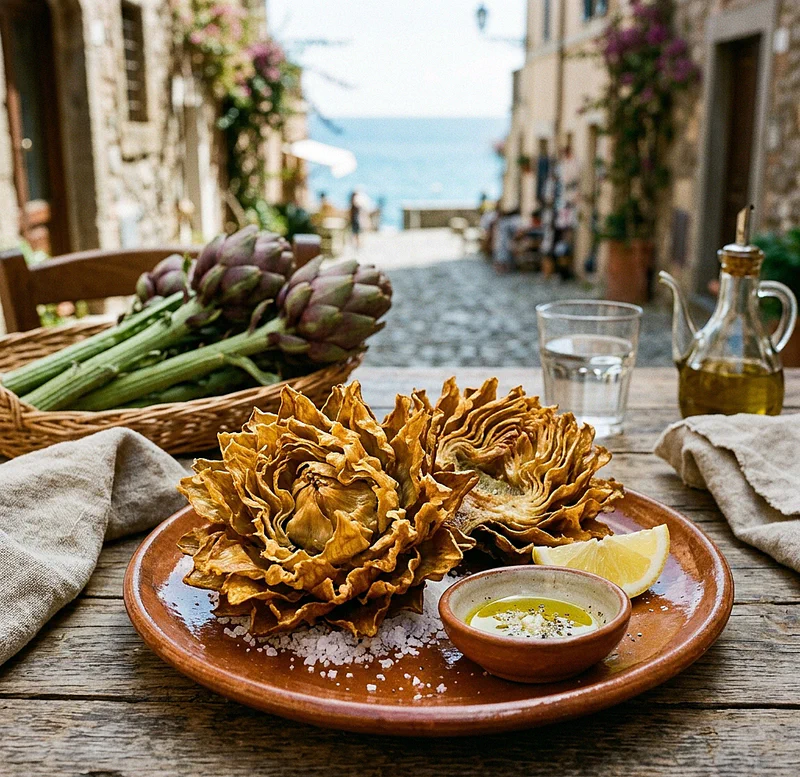
The black volcanic sand of Ladispoli warms the roots and gives the artichoke that flavor of salt and earth you wouldn’t find anywhere else. It is this ferrous soil that makes the Mammola so sweet it can be eaten raw, seasoned only with a drizzle of good oil and a pinch of salt. The sea is not just a pleasant view but the accomplice that salts the air during every harvest.
The land does not lie.
Tourist Traps and the Evening Ritual#
Listen closely to an old friend.
Don’t make the mistake of sitting in the restaurants facing the main square: they are traps for tourists that will serve you mediocre artichokes at staggering prices. Instead, look for the stands managed directly by agricultural cooperatives in the side streets, where the frying is violent and the white wine from the Castelli flows without too many pleasantries. The grease-stained paper tablecloths are the sign that you are finally in the right place.
Aim for real substance.
Wait for the sun to go down.
Towards evening, as the Sunday tourists head home, the festival finally becomes an affair for people who know how to eat. The noises grow deeper, the lights of the stands shine against the darkness of the Tyrrhenian Sea, and the scent of Roman-style artichokes invades every doorway. It is the best time to exchange a few words with the producers and hear the secrets of the land.
The night is sincere.
Take the train from Rome.
I, who spend my life behind the wheel on the state roads of half of Italy, left the car parked at home this time without looking back. If you decide to brave the Sunday morning traffic on the Via Aurelia, you will spend more time cursing the steering wheel than enjoying the show. From the Ladispoli-Cerveteri station, you walk five minutes and you are already inside the chaos of the festival, with a glass of wine and no parking anxiety.
Choose binary freedom.
See you soon, between the oil and the wild mint,
Marco