
In the municipality of Chiusdino, in the hills south of Siena, San Galgano Abbey has an outline unlike anything else in Tuscany. The Cistercian church stands open to the elements, stripped of its roof and pavement. Where flagstones once lay, the floor is beaten earth that turns to grass each spring. Looking up from between the high stone walls into empty air where rib vaulting once met, the scale of the place registers at once.
The missing roof leaves the geometry of the building exposed. Built to traditional Cistercian proportions, the church follows a Latin cross plan, 69 metres long by 21 metres wide. Three aisles lead to an east-facing apse, set so that morning light falls straight through the lancet windows.
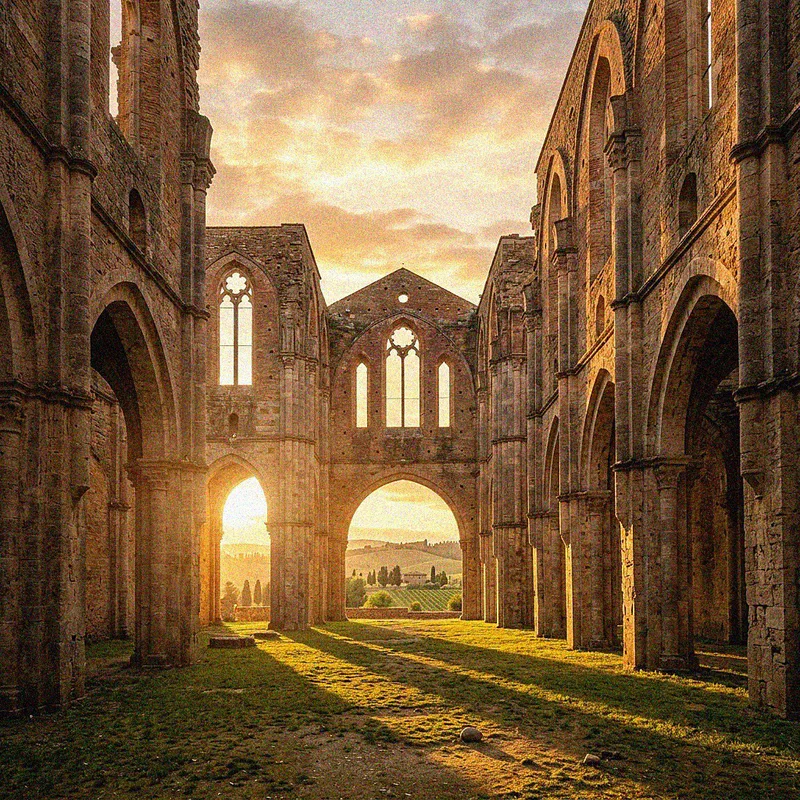
With no glass or timber left to distract from the stonework, the ribs and pointed arches frame clouds and clear sky. It is a building stripped back to line and proportion, where the boundary between interior and open countryside simply disappears.
History from golden age to open skies#
San Galgano carries eight centuries of prosperity and gradual collapse. A community of Cistercian monks was already active here by 1201, building the church during the thirteenth century. By the middle of the thirteenth century, it was the most powerful Cistercian foundation in Tuscany; the church was consecrated in 1288.
The peak was brief. Famine hit in 1328, followed in 1348 by the Black Death, which thinned the community drastically. Over the decades that followed, wandering companies of mercenaries raided the estate repeatedly, wrecking its finances. Neglect set in. In 1781, the stone vaulting gave way; five years later, in 1786, the bell tower collapsed. The church was formally deconsecrated in 1789 and left to the weather.
In 1924, architect Gino Chierici directed a conservative restoration, securing the masonry while keeping the roofless interior intact. The abbey has since drawn filmmakers: Andrei Tarkovsky framed its arches in Nostalghia (1983), Anthony Minghella shot scenes here for The English Patient (1996), and in 2025 the songwriter Lucio Corsi recorded his concert film La Chitarra nella Roccia in the nave.
The hermitage of Montesiepi and the sword in the stone#
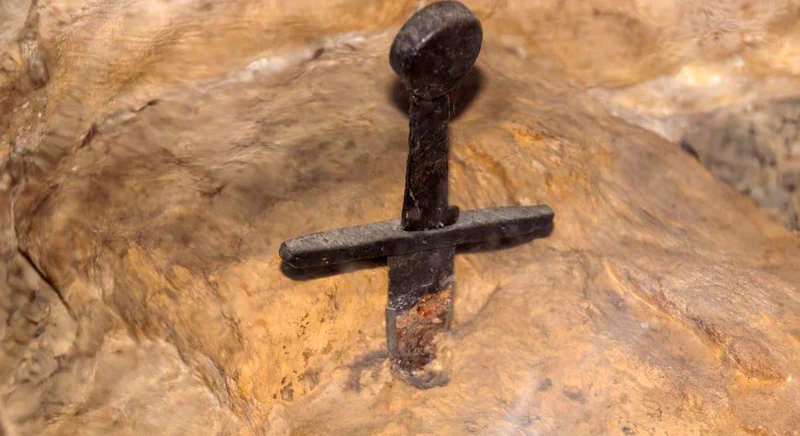
A track leads uphill from the abbey to the hermitage of Montesiepi, known locally as the Rotonda. Inside, the chapel preserves the sword in the stone. Rising from a cracked boulder set into the chapel floor, the hilt and part of the iron blade now sit under a protective glass dome.
The sword belonged to Galgano Guidotti, born in Chiusdino between 1148 and 1152. Guidotti spent his early years as an unruly local knight before renouncing worldly life for a hermitage on this ridge. On Christmas Day in 1180, he drove his weapon into the rock, turning it into a cross for prayer. He died the following year, in 1181; his feast day falls on 3 December.
The image naturally brings King Arthur to mind, though with an inverted moral: where Arthur draws the blade to take power, Galgano buries his to renounce it. Historians treat the parallel as coincidence rather than evidence of shared folklore, but the sight of the iron embedded in stone in the quiet chapel is compelling all the same.
The frescoes of Ambrogio Lorenzetti#
Adjoining the Rotonda of Montesiepi is a fourteenth-century side chapel with a cycle of damaged frescoes painted by Ambrogio Lorenzetti between 1334 and 1336. On the end wall is a Maestà with the Virgin enthroned; lower down, an Annunciation incorporates the small stone window, using natural daylight as part of the composition.
The chapel held an unusual secret until 1967, when restorers detached the frescoes and their preparatory drawings (sinopie) for conservation. Under the finished Maestà, they uncovered an earlier version by Lorenzetti. In this initial draft, the Virgin held a sceptre and an orb – attributes of secular governance reserved for male rulers. The iconography was evidently too bold for the local church authorities, who had him paint the conventional maternal scene visible today.
When to visit and the midday sun#
Getting the timing right makes all the difference at San Galgano. The abbey is open daily year-round: November to April from 9am to 6pm; May and June from 9am to 7pm; July and August from 9am to 8pm; and September and October from 9am to 7pm. Admission is by ticket.
One summer we made the mistake of arriving with the sun at its peak. The roofless nave had turned into a stone kiln, heat radiated off the dirt floor, and tour groups packed the central aisle, so the visit was barely enjoyable. We retreated up the hill to Montesiepi and came back down only in the last hour before closing, when the stone had cooled, the buses had gone, and the quiet had returned.
Do not be misled by rumours of night visits: the abbey interior closes according to the seasonal schedule, and the nocturnal silhouette can only be viewed from the perimeter outside. In high summer, the roofless nave offers no shade and becomes sweltering under the midday sun; plan your arrival for opening at 9am or the final hour before closing.
Getting there and where to dine#
San Galgano is an easy drive through southern Tuscany. From Siena, it lies 44 to 45 kilometres to the southwest, roughly an hour by car. From Florence, the drive is around 93 kilometres and takes just over an hour and a half.
Across the road from the site sits Ristorante Antico Tempio – Terre di San Galgano, at Strada Comunale di San Galgano 155, Chiusdino. This restaurant and agriturismo has outdoor tables under a portico looking towards the ruins, which works particularly well for dinner in summer.
Italian dining hours are strict: lunch is served from 12:30pm to 2:30pm, and dinner runs from 7:30pm to 9:30pm. Turning up at 3pm or 6pm will leave you stranded outside, as kitchens close completely between services. The menu features regional staples such as tartare di chianina with burrata, hand-rolled pici, and bistecca alla fiorentina. You can book on 0577 756366 or through sangalgano.it.
Afterwards, you can head further south for stargazing under the night sky of the Val d’Orcia or a soak in the thermal baths of Saturnia and Bagno Vignoni.