
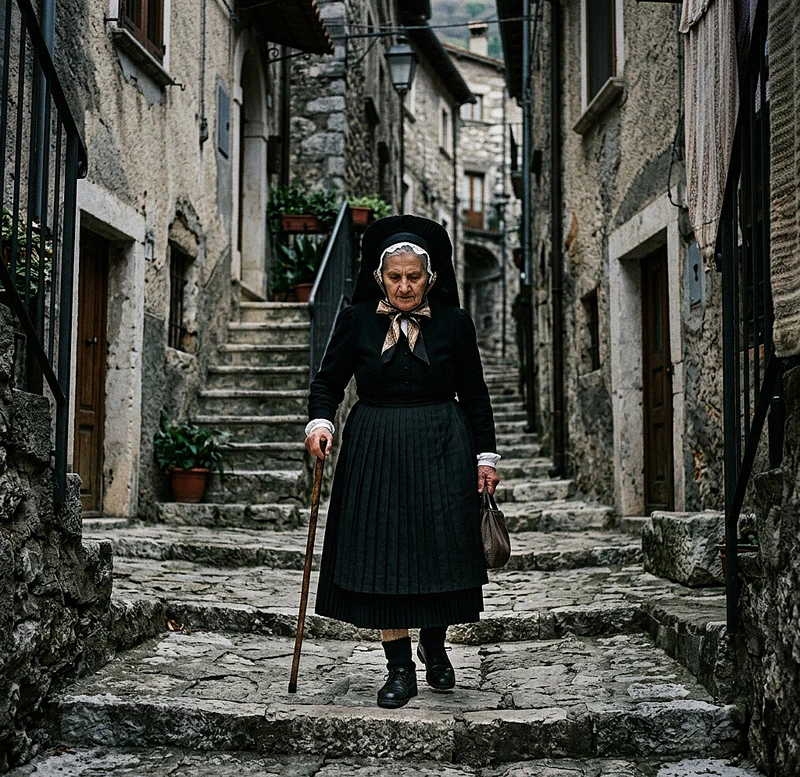
Scanno is pure gravity. This living archive of stone and wool seems to defy time, perched among the peaks of the Abruzzo Apennines like a jealously guarded secret. If you arrive here at the end of June, when shadows stretch over the narrow alleys, you immediately feel like an intruder in a world regulated by archaic laws. Scanno’s beauty is not flashy; it must be earned by climbing the gray stone steps and observing the movement of the last women in traditional black costumes. History here is worn.
Listen to the wood. As you walk through the labyrinth of stairs that locals call “cemmënere,” the smell of damp wood mixes with that of freshly baked sweets invading every corner. I hear the rhythmic “clack” of bobbins intertwining quickly on lace pillows, an ancient sound that marks the deep heartbeat of the village. It is a suspended atmosphere that enchanted masters like Cartier-Bresson, capable of transforming the daily life of this corner of Abruzzo into photographic icons. Every shadow is a composition.
The Geological Mystery and the Y3 Trail#
The heart is a landslide. Few know that Lake Scanno, located at 922 meters of altitude, is not of glacial origin but was born from a cyclopean landslide that broke off from Monte Genzana, blocking the course of the Sagittario river. With a maximum depth of 32 meters, this basin is today a unique ecosystem where emerald green waters reflect the dense surrounding vegetation. To admire its famous heart shape, you must climb the technical Y3 trail up to the 1248 meters of the Belvedere: a 2.1 km ascent that requires serious hiking boots and a steady pace. Fatigue is naked wonder.
Technical note for trekking: The local limestone (calcare grigio) becomes extremely slippery with morning humidity; do not underestimate the terrain and use exclusively soles with Vibram compound. The exact point for the perfect heart perspective is at coordinates 41.9067°N, 13.8643°E, just above the Hermitage of Sant’Egidio. I strongly recommend using trekking poles to manage the unstable gravelly ground during the technical descent towards the lake. Safety is a priority.
Nature is sovereign. Along the way, you might spot the rare Lady’s Slipper, Europe’s most precious wild orchid, or cross the tracks of the Apennine Wolf and the Marsican Brown Bear. These giants of the woods roam the beech forests feeding on buckthorn berries, moving with a discretion that makes you feel tiny in front of the power of the Apennines. Local legend has it that the lake was born from a rain of fire evoked by the sorceress Angiolina to escape King Battirandul, submerging his army. The mountain has a memory.
Costume Engineering and the Gray Soul of Palazzi#
Fifteen kilos of wool. That’s the weight of the traditional dress built with over 15 meters of vissuta wool (boiled wool), a true armor against the freezing wind that whistles through the noble palazzi of the village. Observe the defensive slits of Palazzo De Angelis in Via Ciorla or the splendid internal courtyard of Palazzo Tanturri: every gray-silver limestone stone changes tone depending on the light, giving Scanno a shimmering soul. It irritates me when people only see folklore: here every baroque portal tells of wealth linked to transhumance and wool. Stone is a story.
Lace is an algorithm. Entering Federica Silvani’s workshop means discovering Punto Scanno, a bobbin lace technique worked totally “by heart,” without any pinned pattern on the pillow. The lace-makers intertwine up to 12 pairs of bobbins following a complex mental scheme, producing weaves that seem to defy the laws of textile physics. Don’t call them doilies: they are sacred geometries that even Cartier-Bresson marveled at when he arrived here in the 1950s. The locals looked at him with curiosity, not understanding why that “foreigner” was so obsessed with their normal life. Wisdom is silent.
Traditions of Fire and the Bear’s Taste#
Fire purifies. If you visit Scanno on November 10th, you will witness the Glorie di San Martino, huge piles of wood up to 20 meters high that are set on fire simultaneously on the surrounding hills by the three districts: Cardella, La Plaia, and San Martino. It is an ancestral ritual celebrating the end of the agricultural year, an explosion of flames that illuminates the entire valley in the darkness of the Apennine night. In August, instead, you might come across Ju Catenacce, a wedding procession where couples form a human chain that winds through the rue like an ancient iron bolt. The bond is indissoluble.
Taste the reward. Before leaving the village, stop at the Di Masso pastry shop for Pan dell’Orso, a chocolate and almond cake whose original recipe is guarded like a state secret. Pair it with anise-flavored Ciammelle, perfect for dipping while watching the sun go down behind the peaks of the Abruzzo National Park. Update: If the call of the peaks is felt, Marco has traced a route towards Campo Imperatore that will take you straight to the Tibet of Italy. For the most tireless walkers, I have also prepared a technical guide to a multi-day high-altitude trek in the wild heart of the Park. Sweetness is a safe haven.
Seek the Baroque light. Visit the church of Santa Maria della Valle in the late afternoon, when the sun’s rays filter through the windows and illuminate the Baroque interiors with cinematic cuts. It is the moment when the village prepares for the silence of the night and you can really feel the weight of centuries pressing on these gray stones. Choose the sunset light.
See you soon, among the trails and secrets of the Apennines,
Since this was written, a guide to planning a more extensive road trip in Tuscany has been added to the Dreaming Italy portfolio. For those looking to explore the region’s picturesque countryside, rolling hills, and charming villages, consider following a more leisurely itinerary that allows for a deeper dive into the local culture and history. Alternatively, A Tuscany Road Trip: The Ultimate 7-Day Itinerary for Autumn offers a more structured approach to navigating the region’s top attractions.