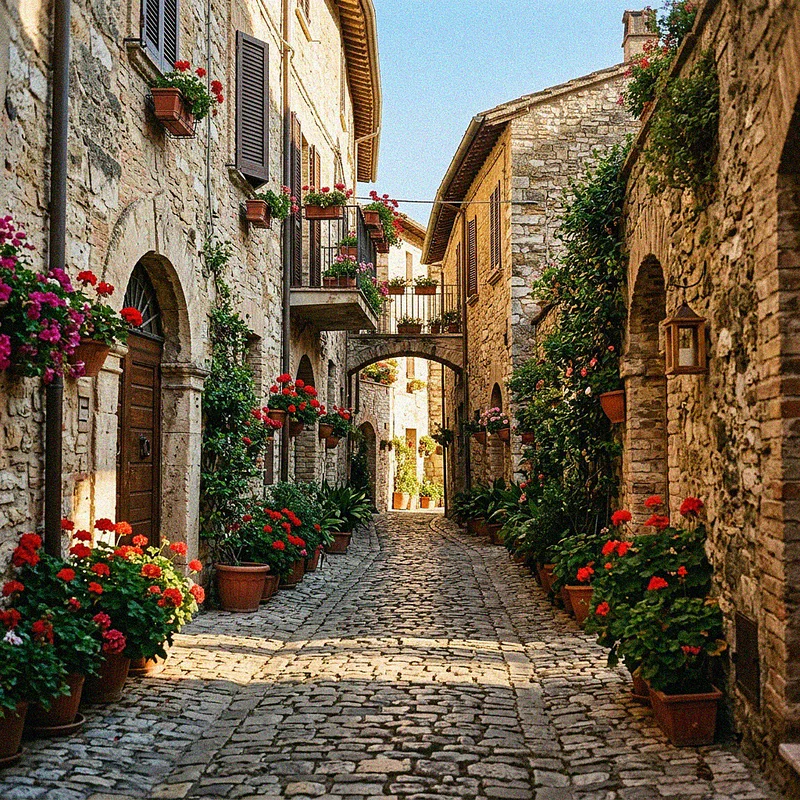
Summer in Umbria is not just a season; it’s a state of mind that smells of charcoal and wild broom. While the world crowds into the squares of the major art cities, I prefer to lose myself in the stone alleys where the real Italy still beats strong. It’s an ancestral call, made of sun-warmed stones and songs echoing through silent valleys. My advice for 2026 is to leave your schedules at home and follow the scent of ragù simmering in the village squares.
I’ve spent years mapping these events, which from May to July transform Umbria into a living stage. These are raw, unpolished, and absolutely magnetic moments, far from the manifestations built for tourists. Here, the festival belongs to the community, and you are a welcome guest, not a customer. For those seeking a similar thrill but with a more alpine feel, Martina recently explored the secret valleys of Friuli, where the silence of the peaks offers an equally pure adventure.
The Heartbeat of 2026: May and the Explosion of Flowers#
2026 opens with one of Italy’s most spectacular events: the Infiorate di Spello (May/June). Don’t just call them flower arrangements; they are secular prayers written with fresh petals that cover the entire village. Artists work all night, in a silence broken only by the rustle of flowers, to create breathtaking carpets that will last only a few hours. It’s a lesson in ephemeral beauty that leaves a mark deep within you.
If you love exploring the roads less traveled, Marco has traced a perfect itinerary through the lesser-known routes of the Amalfi Coast, ideal for those who want to combine culture with the pleasure of driving. But Umbria has a different pace—slower and more contemplative. Here, the festival is not an event to be consumed, but a ritual to be participated in with respect. My local warning concerns the “influencers” who invade Spello for the perfect shot: please, put down your phone and watch how the morning light ignites the colors of the petals.
June and the Return to the Middle Ages: Bevagna#
In June, the heart of central Italy turns back in time with the Mercato delle Gaite in Bevagna. This is not a dusty re-enactment; it’s a total immersion into the 1300s, where medieval crafts come alive in workshops open to the public. You’ll see the master papermaker, the blacksmith, and the weaver working with period tools, while the air fills with the smell of beeswax and wrought iron. It’s a sensory overload that makes you feel part of a millennial historical continuity.
For a fascinating culinary contrast, Giulia suggests a dive into the Walser mountain traditions, where the cuisine tells the story of resilience at high altitudes. In Bevagna, instead, you’ll eat in the taverns of the Gaite dishes following medieval recipes, sipping the Sagrantino wine that is born in these lands. It’s honest, robust food that speaks of the valley and its pride. Don’t expect tourist menus or modern drinks; here, the purest tradition reigns.
July: The Notes of Perugia and the Village Festivals#
July is the month of Umbria Jazz in Perugia, but my insider advice is to look for the small village festivals (sagre) that dot the surrounding hills. The festival of the Black Truffle or the Torta al Testo are where you’ll meet the locals. Sitting at long wooden tables, sharing house wine with perfect strangers, is the only way to truly understand Umbria. The sound of laughter mixing with folk music is the heartbeat of my land.
Logistics in Umbria can be an exciting challenge. Regional trains are slow but scenic, perfect for those who are in no hurry and want to enjoy the landscape rolling past the window. If you decide to rent a car to reach the more isolated villages, remember to always park outside the ZTL (Restricted Traffic Zones) to avoid heavy fines. The winding roads require attention, but every curve gifts you a view worth the journey. Avoid the tourist buses that clog the narrow streets; Umbria should be discovered on tiptoe, not with a horn.
Final Tips from Luca#
To truly experience the Umbrian summer, learn to slow down. Cash is king in the smaller festivals, where credit card machines are still a mysterious object. Dress comfortably, bring sturdy shoes for the cobblestones, and don’t be afraid to ask locals for advice on where to eat the best cured meats. The most beautiful Italy is the one that doesn’t appear on the front pages of guidebooks, but that you find following the sound of a bell tower or the scent of an oven.
Happy travels in the green heart of Italy. Luca