Hello! I’m Luca. There are hiking trails—the ones with the little red and white flags and cozy mountain huts at the end of each stage—and then there is the Selvaggio Blu. In Italy, this name is spoken with a mix of sacred reverence and a hint of dread. Located along the spectacular coast of the Gulf of Orosei in eastern Sardinia, it is often called the most difficult trek in Italy, and perhaps in all of Europe.
If you are looking for total isolation and a test of your character, this path of sharp limestone and vertical cliffs is your sanctuary. If, on the other hand, you prefer to experience the magic of Sardinia in a moment of spirituality and different light, my colleague Sofia has written an enchanting guide to the Summer Solstice on the island. But for those who want rock, sweat, and infinite blue, keep reading.
The Challenge: Beyond Hiking#
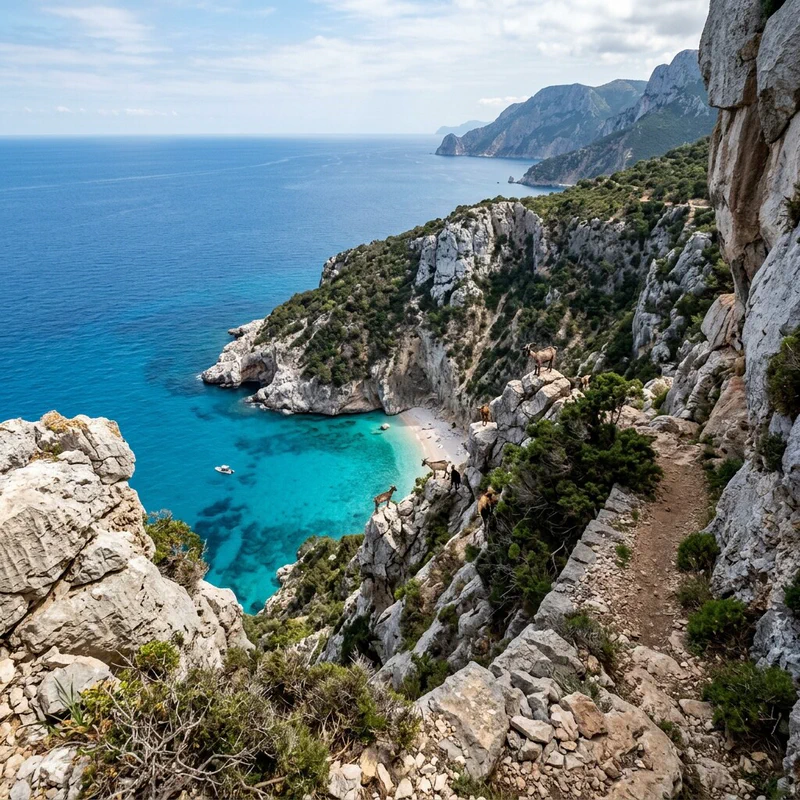
The Selvaggio Blu was not born for tourists. It was mapped in 1987 by Mario Verin and Peppino Cicalò, who linked the ancient and impossible paths of the charcoal burners and shepherds of Baunei. To walk it, you must be comfortable with something that goes far beyond simple walking. We’re talking about 45 kilometers of development, but with a cumulative elevation gain that exceeds 4,000 meters.
There are no trail markers here. The rock is a labyrinth of razor-sharp gray limestone that eats through boot soles in just a few days. You’ll have to scramble over loose scree, navigate using only topographic maps or GPS (though the 500-meter cliffs often send the signal into a tailspin), and perform several rappels to reach the next ledge. If, after all this effort, you want to toast to victory, Alessandro has just published a fascinating guide to Italy’s historic wines, perfect for a post-trekking tour.
The Shepherds’ Secrets: The Fustu de Ginepro#
The most incredible aspect of Selvaggio Blu is the use of fustu de ginepro. These are ancient juniper trunks wedged into rock crevices by local shepherds to overcome otherwise inaccessible vertical walls. Climbing these natural ladders, decades old, smelling the seasoned wood and looking at the void beneath your feet, is an experience that connects you directly with the millenary history of Baunei.
Every stage is a discovery. From Pedra Longa (40.027° N, 9.707° E), the monolith that marks the start, to Cala Goloritzé, with its limestone spire soaring toward the sky like a finger of God. Sleeping under the stars, perhaps in a cuile (the shepherd’s hut made of stone and juniper), is the only way to truly understand the soul of Sardinia. For those seeking an adventure linked more to local traditions and spring flavors, my colleague Marco has prepared a beautiful guide to the best Italian sagre.
How to Survive the Trek#
This is a journey that requires physical and mental preparation beyond the ordinary. Never attempt it alone or without the correct equipment.
- Supply Logistics: Since there is no water on the trail, it is necessary to organize “supply drops.” Local groups in Baunei deliver water and food to specific coves by boat every evening. Without this support, the Selvaggio Blu is technically impossible.
- Technical Gear: You need approach shoes with a Vibram sole (the rock is abrasive), a harness, a helmet, and a rope of at least 60 meters. Bring a lightweight tent or, even better, a bivy bag to be ready for anything.
- Navigation: The “trail” often disappears among the lentisk and strawberry tree bushes. Knowing how to read a map and use a compass is vital.
Luca’s Pet Peeves: GPS is Not God#
I want to share one of my biggest pet peeves: “digital” hikers. Those who set off for the Selvaggio Blu thinking that an app on their phone is enough to orient themselves. Beneath these limestone walls plunging into the sea, the GPS signal often “bounces,” marking your position hundreds of meters away.
I detest seeing unprepared people who must be rescued because they ran out of water or got lost at the first Bacu (valley). The Selvaggio Blu is not a playground; it is wild nature that does not forgive superficiality. And please, leave no trace of your passage: take back even your toilet paper. If you want a similarly remote but less “vertical” adventure, I recommend my guide to the Costa Verde.
The Explorer’s Secret: S’Istrada ’e sa Carpia#
My secret tip is to pay attention to the passage of S’Istrada ’e sa Carpia in Bacu Padente. It is a very narrow path carved into the rock by 19th-century charcoal burners. It is a point of dramatic beauty where the rock seems to tighten around you before opening onto a coastal panorama that takes your breath away.
Once you arrive at the end, in Santa Maria Navarrese, the first thing to do is find the nearest bar and order an ice-cold Ichnusa beer and a generous plate of Culurgiones from Baunei (those with potatoes, pecorino, and lots of mint). It’s the taste of victory.
The Selvaggio Blu is a journey that changes you. It eliminates the superfluous noise of modern life and leaves you only with the essential: the rock, the sun, and the infinite blue. It is Sardinia at its truest. Are you ready to get your hands dirty?
Stay wild.
See you soon, Luca