
Puglia is silence. If you arrive here in the week leading up to Easter, as the April wind carries the pungent scent of bitter almonds, you discover a world that seems straight out of the Middle Ages. It is not a show for tourists but a collective exhale of pain and hope that takes place in the darkness of the “chianche” (stone-paved streets). I speak as someone who has seen the dawn in Noicattaro, listening to the clanking of chains on the frozen asphalt, a sound that plants itself in your chest. Here, faith is dragged.
The darkness is absolute. As the streetlights are turned off to make room for torches, the Crociferi appear dressed in black with their heavy crosses on their shoulders. The most shocking thing is the total anonymity: they dress at home, in secret, so that no one knows who is atoning for their sin under that hood. I hear the hypnotic rhythm of their bare feet on the smooth stone, interspersed with the dry cry of the Troccola (or the Trozzola, as they call it in Molfetta) which replaces the bells. Sacredness is made of shadow.
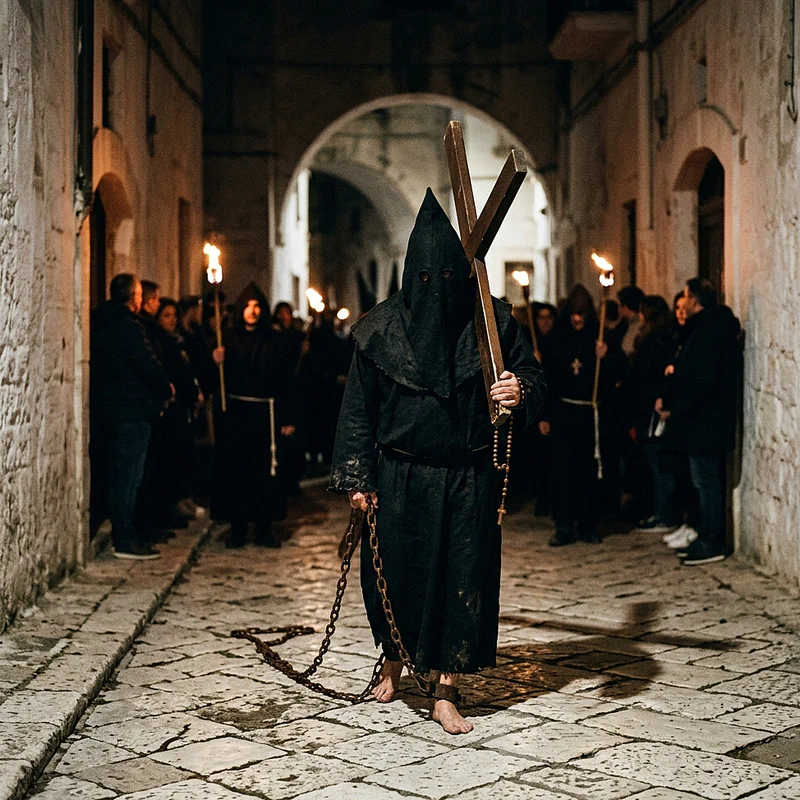
The Weeping of the Troccola and the Mystery of the Addolorata#
Time stops here. In Taranto and Molfetta, the rituals reach an unbearable tension with the procession of the Addolorata (Our Lady of Sorrows) which begins in the deep heart of the night. The statue of the Virgin advances with the nazzicata, a very slow rocking of the bearers (the perdune in bare feet) that simulates inconsolable weeping. It is a ritual of exhausting slowness that in Taranto can last twenty-four hours, testing the physical and spiritual endurance of an entire city. Mourning is a wave.
In Francavilla Fontana, the rituals become even more physical with the Pappamusci cu li trai, penitents who carry heavy wooden logs in the shape of a cross. They wear a white tunic and a hood that leaves only the eyes exposed, proceeding with a rhythmic walk punctuated by the dull sound of the Trenula. Seeing these men advance in the dark, bent under the weight of the raw wood, makes you understand how much tradition here is a matter of bones and sweat. Fatigue is a prayer.
Don’t be a tourist. If you decide to witness these rituals, you must understand that silence here is an unwritten law that admits no derogations. It deeply irritates me to see people trying to push their way through with raised cell phones or talking loudly while the procession of the Mysteries passes. If you break the silence, the community will reject you with a coldness you won’t easily forget: it’s not a festival, it’s a funeral. Turn everything off and listen.
The Taste of Almonds and the Gold of Altamura#
The flavor is of almond. Don’t leave Puglia without tasting the Scarcella, the Easter sweet decorated with hard-boiled eggs representing rebirth, or the Cavicione, a calzone filled with sponsale onion and raisins. These flavors, between sweet and savory, are the only concession the locals allow themselves after the fast of Lent. Arrive at the bakeries early in the morning, when the smell of yeast mixes with that of the incense that still lingers in the alleys. Update: If the scent of bitter almonds has opened your appetite, it’s worth pushing on to Altamura to discover, together with Giulia, the scent of ancient gold in an equally sacred gastronomic ritual. For those who want to return to the liveliness of the sea after the silence of the rituals, Giulia has written a small guide to Bari Vecchia, where handmade orecchiette are the true protagonists. Easter is a reward.
See you soon, between the iron and the silence of the valleys,
The idea of May Day celebrations in Italy brings to mind the serene landscapes of the countryside, where nature’s beauty provides a picturesque backdrop for cherished moments with family and friends. The authentic essence of May Day in Italy can be experienced in various regions, each with its unique charm. Since writing this, my colleague Luca recently explored the unspoiled shores of Veneto, discovering hidden lagoons that offer a tranquil escape from the crowds. A Guide to Veneto’s Hidden Lagoons is a must-read for anyone eager to delve into the untouched beauty of this lesser-known region.