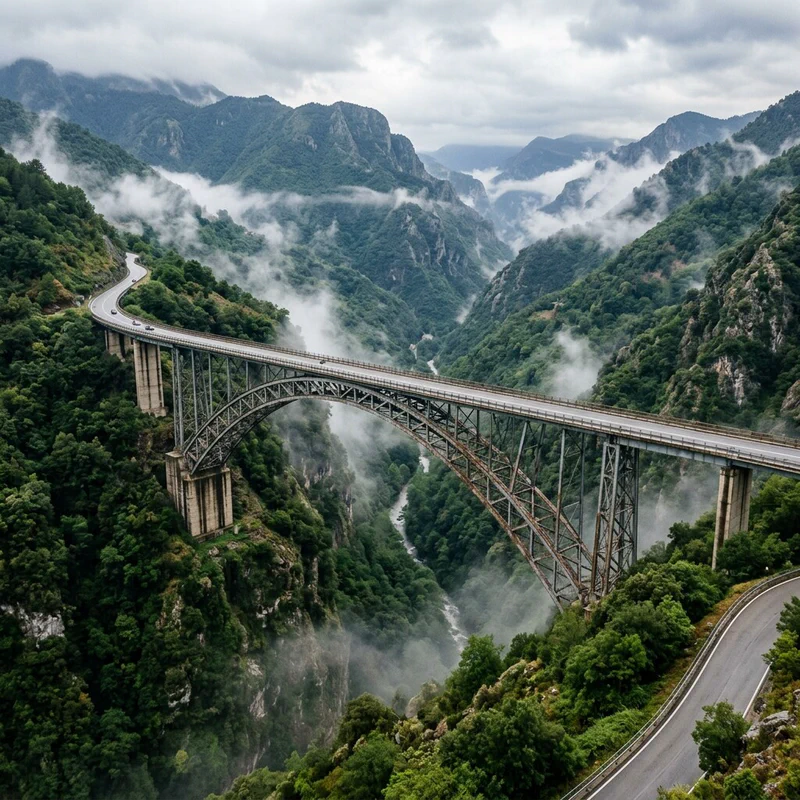
Hello! I’m Luca. In the deep south of Italy, where the mountains of Calabria meet the sapphire waters of the Tyrrhenian Sea, there is a structure that looks like it came out of a futuristic dream—a challenge thrown at gravity itself. It is the Sfalassà Viaduct, a colossal steel arch bridge that spans a lush gorge at over 250 meters in height.
For many, it is just a ribbon of asphalt traveled at a hundred miles an hour, but for me, it is a portal to the indomitable soul of Calabria. If you are looking for another type of wilderness, less “steel” and more “bare rock,” I recommend discovering my account of the mountains of Barbagia in Sardinia. But now, let’s stop on the edge of the Calabrian abyss.
The Genius of Silvano Zorzi: The Arch that Defies the Void#
Completed in 1974, the Sfalassà is not just any bridge. It is a masterpiece signed by engineer Silvano Zorzi, a man who knew how to transform concrete and steel into structural poetry. For years, it was the highest steel arch bridge in Europe and won the prestigious CECM (European Convention for Constructional Steelwork) award three times.
Imagine the technological challenge of those years: building an arch with a 376-meter span suspended in the void, in a seismic territory battered by winds. It is the symbol of an Italy that was not afraid to dream big, just as happened in the past with the grandiose architecture that my colleague Alessandro described in his guide to Agrigento’s Valley of the Temples.
Bagnara Calabra and the Costa Viola#
At the foot of the viaduct lies Bagnara Calabra, a city that seems to cling to the rock so as not to slide into the sea. This stretch of coast is known as Costa Viola (Purple Coast), a name that Plato himself seems to have coined observing the indigo and violet shades the water takes on at sunset, when the sun disappears behind the Aeolian Islands.
Update: Bagnara is the home of the “Bagnarote,” legendary women, tireless traders who once traveled the paths of the Aspromonte loaded with baskets to sell fish or salt. It is a land of strong flavors and ancestral traditions, a wonderful contrast to the mountain cuisine that my colleague Giulia explored in her journey through the traditional Walser cuisines of Valle d’Aosta.
Aspromonte: Granite, Chestnuts, and Fiumare#
Beyond the viaduct, the Aspromonte opens up. Forget the Tuscan hills or the manicured vineyards. Here, nature is raw. It is a land of vertical granite walls, ancient chestnut forests that look like they came out of a Brothers Grimm tale, and fiumare—gravelly riverbeds that remain silent for months before turning into water giants during the winter.
The Aspromonte is a place of mysteries and silences, very similar to the hidden spirituality that my colleague Elena found exploring the heart of Molise and the festival of Campobasso. Here, among the paths that lead to abandoned villages and hidden waterfalls, you can feel the true heartbeat of the South.
Luca’s Pet Peeves: It’s Not Just a Transit Point#
I want to be blunt: one of my biggest pet peeves is the attitude of those who cross Calabria only to reach the ferry for Sicily. It drives me crazy to see people ignore the Sfalassà or consider it “just a piece of highway.”
Building this giant in the 70s in such impervious territory was the Italian equivalent of the moon landing. I detest the superficiality of those who do not understand the greatness of human ingenuity applied to such a wild nature. And please, do not throw anything out of the window: the Aspromonte is a sanctuary, not a landfill. If you want a road trip that truly respects the landscape, read our guide on the wild Gargano.
The Explorer’s Secret: The Ancient SS18#
My secret tip is to exit at Bagnara and take the old SS18 Tirrena Inferiore. At a specific point (38.283° N, 15.811° E), the road passes right under the immense shadow of the viaduct. From here, looking up, the perspective of the steel arch is terrifying and magnificent at the same time. You will hear the noise of the traffic up high like a distant hum, while around you there are only the wind and the scent of the Mediterranean scrub.
While you’re there, go to the Marina to look at the Passerelle. They are unique boats in the world, with a very high mast and a bow walkway dozens of meters long, still used today for swordfish hunting. Eating a slice of swordfish “alla bagnarota” (with capers, olives, and cherry tomatoes) while looking at the “Giant” is an experience that will reconcile you with the world.
The Sfalassà is not just a bridge. It is a symbol of connection between modern efficiency and the eternity of Calabrian nature. It is proof that we can build wonders without destroying the soul of places.
Stay wild and always look beyond the asphalt.
See you soon, Luca