
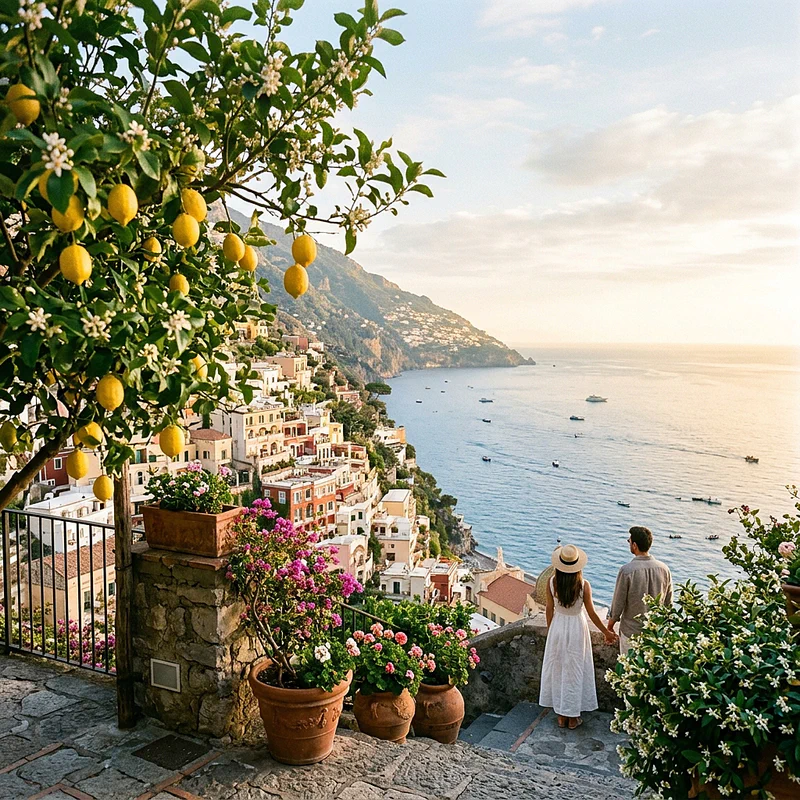
The Amalfi Coast in March is a secret whispered between the rocks and the sea, far from the clamor of tourist buses. At this time of year, the air fills with the sweet and pungent scent of orange blossom, the white flowers of the citrus groves that begin to bloom among the terraces. I love losing myself among the infinite stairs of Positano when the colors are still soft and the sun does not burn but caresses the skin with an ancient grace. It is the perfect moment for those seeking an intimacy that summer unfortunately steals from these vertical villages full of history and charm. This is the true deep soul of our sea.
While the world runs frantically elsewhere, here time seems to stop among the suspended gardens and alleys that smell of salt and Sfusato lemons. Walking hand in hand through the gardens of Villa Cimbrone in Ravello, without having to dodge the selfie crowds, is pure and simple visual poetry. I love observing the contrast between the silvery gray of the rocks and the bright yellow of the citrus fruits ready for the season’s first, timid harvest. I feel the deep and authentic beat of the earth awakening, finally freed from the weight of mass tourism. Spring here is a constant emotion.
The Awakening of the Senses Between Amalfi and Ravello#
Amalfi in March has the flavor of coffee taken calmly in Piazza Duomo, looking at the monumental staircase without the pressure of the crowd. I recommend entering the Cloister of Paradise to enjoy the silence of its Moorish arches, where the light filters through, creating hypnotic geometric shadows. It deeply irritates me to see those rare bars that raise prices as soon as they see a visitor, but you only need to move a few meters into the internal alleys to find true warmth. It is in these corners of quiet that I can hear the voice of the wind rising up the valley, carrying the echo of centuries with it. Always choose authenticity.
Climbing towards Ravello at this time means immersing yourself in a cathedral of flowery gardens suspended between sky and sea. Villa Rufolo, with its terraces that inspired Wagner’s Parsifal, offers a view that in March is made even sharper by the clear and clean air. I like to stop on the “Terrace of Infinity” at Villa Cimbrone and let my gaze wander towards the horizon, where the blue of the sea merges with that of the sky. (Note: You’ll find many more details on the suspended beauty of these places in my in-depth guide to the romantic gardens of Ravello, which I published later to explore every corner of paradise). It is a moment of pure aesthetic connection that requires time, silence, and the right company to be appreciated. Beauty here is sacred.
If you appreciate this kind of harmony between nature and white architecture, you will find a similar soul in this itinerary through the Itria Valley, where white stone frames millenary traditions. It is a common thread that unites our entire region under the sign of slowness and style. Italy knows how to be a precious refuge.
Valle delle Ferriere: The Hidden Green Lung#
Few know that behind Amalfi lies a prehistoric green lung that in March gives its best thanks to the abundance of water. The Valle delle Ferriere is a nature reserve where giant ferns and waterfalls create a unique microclimate that seems to belong to another era. Walking along the Canneto river, among the remains of ancient medieval paper mills, gives a feeling of freshness and peace that regenerates the spirit after the climb. Feel the sound of the water flowing between the mossy rocks and the birds singing as they announce the return of spring. It is a perfect contrast to the coastal blue.
My advice is to take the path that starts from Pontone, a tiny village that dominates Amalfi from above with its church of San Giovanni Battista. From here, the descent towards the valley is gentle and offers breathtaking panoramic views, far from the most crowded and noisy tourist circuits. I often stop to pick some wild herbs or simply breathe in the smell of the damp undergrowth that mixes with the salty breeze of the coast. It is a complete sensory experience that requires comfortable shoes and a heart ready to be amazed by nature. Explore with respect.
The Golden Hour in Positano: A Labyrinth for You#
Positano in March is not the usual glossy and noisy postcard, but a labyrinth of silence and beauty that invites absolute slowness. You can go down to the Spiaggia Grande and listen to the sound of the surf without the noise of sunbeds being frantically set up by the beach clubs. Local craft shops are beginning to reopen their doors, and you can stop to chat with the tailors who hand-stitch the famous linen clothes. I recommend avoiding the high trails if the wind blows too hard, because in March the mountain can be capricious and unpredictable. Better to enjoy a sunset aperitivo.
When the late afternoon light hits the pastel-colored facades of the houses, Positano transforms into a golden jewel suspended on the rock. Choose a small bar with a few outdoor tables and order a lemon spritz as the sky turns purple and indigo above Capri. It is the moment when the village’s intimacy becomes tangible and the day’s bustle gives way to the peace of the evening that slowly descends. (Update: if you feel like challenging your legs beyond the urban stairs, my colleague Luca has mapped out an incredible guide to the secret paths of the coast). I like to observe the first lights turning on among the alleys, similar to small stars punctuating the steep mountain. Magic is in the details.
Taste and Tradition: Cetara and the Colatura#
A trip to the Coast cannot be said to be complete without a stop in Cetara, the fishing village that has managed to resist mass tourism better than others. Here, life still flows according to the rhythms of fishing, and the port is the beating heart of a community that guards ancient gastronomic secrets. You must try the Colatura di Alici, a precious nectar inherited from the Roman garum, capable of transforming a simple plate of spaghetti into an explosion of the sea. Feel the intense and savory flavor that tells stories of nets and nights spent offshore. It is the essence of the Mediterranean.
A big grievance of mine concerns those who serve industrial products passing them off as local, especially when talking about limoncello or fish preserves. Always look for small artisanal shops where the hands of fishermen and their wives still work with passion and absolute dedication. It deeply irritates me when people are superficial and only look for a low price, ignoring the effort behind every single drop of colatura or every hand-picked citrus fruit. Support the local economy by choosing the quality of work done with love and patience. Be a conscious visitor.
Practical Tips for an Unforgettable Trip#
To truly enjoy the enchantment, book a room with a sea view in Ravello or Scala, far from the harbor’s bustle, to wake up to the song of seagulls. Avoid restaurants with cold white lights that kill the atmosphere; instead, look for those places that use candles or soft, warm lights for dining. March also offers the possibility of visiting the Emerald Grotto without miles of queues, enjoying the hypnotic reflections of the water in total and sacred silence. If you plan to move between the villages, use local ferries as soon as the weather allows. The view from the sea is sublime.
Choosing the Amalfi Coast in March means giving a precious gift to your soul, preferring the quality of silence over the quantity of the crowd. It is a journey that will leave a different light within you, made of golden reflections, ancient scents, and a peace you will struggle to find elsewhere. (Update: for those seeking an equally authentic but wilder soul, Marco recently shared a Cilento itinerary that is a true paradise for those who love driving). Gently take the hand of the one you love and let yourself be guided by the timeless magic of this extraordinary land that smells of orange blossom. You will never regret it, I promise you with all my heart. The sea is waiting for you.
Happy enchanted escape,
Sofia