
March 19th in Salento is not just Father’s Day, but a collective ritual that smells of freshly baked bread and sweet frying. For us, it has become a fixed tradition to load the children into the car and head towards Giurdignano or Minervino di Lecce to admire the “Tavole,” domestic altars that transform the villages into open-air banquets. It is an experience that teaches the little ones the value of sharing and hospitality, far from the usual crowded playgrounds. My advice is to go there with an open heart and a definitely empty stomach. Authentic Puglia starts here.
Seeing Leonardo and Beatrice running through the white alleys, attracted by the smell of “massa e ciciri” boiling in large cauldrons, gives me a sense of belonging that only these millenary traditions can provide. It is not just a simple festival, but an act of faith and generosity that involves entire families for weeks of preparations. Every open house is an invitation to discover a world made of edible symbols, where bread becomes art and the table becomes an altar. I feel their curiosity growing with every step as they try to decipher the extravagant shapes of the blessed breads. It is a living museum.
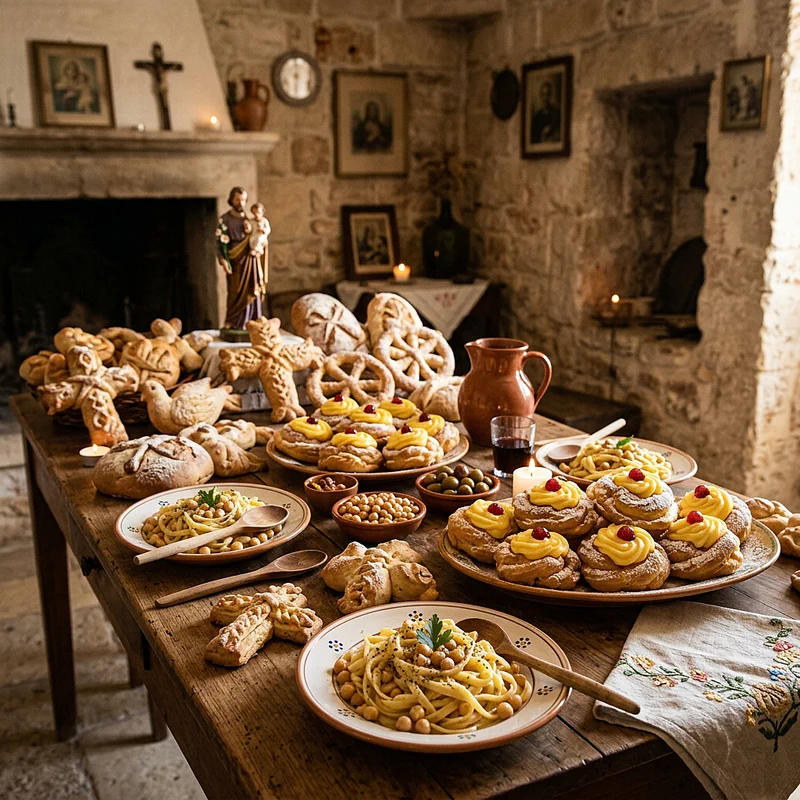
What are the Tavole di San Giuseppe?#
The Tavole are altars laid out in private homes, where families transform their living rooms into a sacred space to host figures representing the Holy Family and other Saints, always in an odd number. You won’t find these banquets in church; it is precisely within domestic walls that the miracle of hospitality takes place, in an atmosphere filled with incense and the scent of food. Tradition dictates that families who have received a “grace” open their doors to offer food to those in need, evoking the medieval banquets of the “patruni.” Leonardo and Bea always stand in awe at the richness of these preparations, which avoid meat and dairy to respect the Lenten fast. It is a ritual that celebrates the ancestral solidarity of the south.
Bread is the absolute protagonist, modeled into shapes that recall Christian symbology such as nails, the ladder, and the Saint’s flowering staff. I always enjoy explaining to my children that every dish has a precise place, like the fried fish which must have its head facing the exit door. This detail symbolizes the good that must leave the donor’s house to spread into the surrounding world, a concept of generosity that I find wonderful. The golden rule is sacred silence: the head of the table marks the change of dishes by striking a fork on the edge of the plate. Everything follows an ancient rhythm.
If you appreciate this kind of rural hospitality and flavors that taste like home, you will find a similar atmosphere in this itinerary through the Itria Valley, where white stone frames millenary traditions. It is a common thread that unites our entire region under the sign of authenticity and human warmth. Puglia never ceases to surprise.
Villages Not to Be Missed: Giurdignano, Cocumola, and Minervino#
If you have little time available, head straight for Giurdignano, Italy’s “megalithic garden,” where the ritual has its oldest and deepest roots. Here the density of menhirs and dolmens blends with the devotion of open houses, creating an atmosphere that seems suspended between the Byzantine and the Baroque. I recommend also visiting less known villages like Cocumola, Casamassella, or Giuggianello, where the welcome is even more intimate and less frequented by tourist flows. Local people are proud to show their altars and often invite you in even for just a quick greeting. Hospitality is a sacred duty.
Minervino di Lecce remains an obligatory stop for the almost manic aesthetic care of its tables, covered with white cloths symbolizing purity. Here “massa e ciciri” is prepared with the addition of cabbage and cloves, following secret recipes that smell of history and black pepper. Beatrice loves watching the elderly women work the pasta by hand, creating those tagliolini that will be partly fried to recall the colors of the narcissus. It is a precious educational moment, showing children that real food requires time, effort, and a lot of passion. Quality has no shortcuts.
Logistics for Families: Mama Elena’s Tips#
Navigating the crowded alleys of Salento’s villages with two children requires a logistical strategy worthy of a military campaign, but with a little spirit of adaptation, everything becomes possible. My dispassionate advice is to opt for a baby carrier if your children are still small, because the stone paving is the sworn enemy of wheels. If a stroller is indispensable, choose a light one that you can easily lift to overcome the steps of the private houses hosting the altars. Lorenzo usually takes care of the “heavy lifting,” while I handle the stops for photos and tastings. Be light and agile.
Another thing that drives me crazy is the chronic lack of diaper-changing areas during these deeply felt popular festivals. You must be self-sufficient: bring a portable changing mat and take advantage of the bars in the center, which are almost always very kind to parents in difficulty. Also bring a thermal water bottle with you, because the March sun in Salento can be surprisingly hot during the day, despite the sea breeze. Plan stops in the small playgrounds that are often found on the edge of historic centers to let the children burn off energy between visits. Organization saves the day.
Practical Tips for Parents Who Love Slowness#
Visiting the Tavole requires a good dose of patience, as the villages fill with people and the pace is not that of fast-service dining. Bring some light snacks with you, even though you’ll find tastings everywhere, because the lines for pasta with chickpeas can be long. My only complaint is that public toilets are often hard to find or poorly equipped for changing, so plan strategic stops in local bars. Dress in layers: the March sun bites the skin, but as soon as the shadow falls, the Adriatic humidity makes itself felt quite strongly. Follow the rhythm of the place.
The 13-Dish Banquet: From Lampascioni to Ncartiddate#
The ritual of the Tavole is a gastronomic triumph that follows a rigorous order, always starting with pampasciuni (lampascioni in oil) to wake up the palate. Following are boiled vegetables, massa with chickpeas and cabbage, stockfish with scallions, and the inevitable hot and golden pittule. Leonardo was initially skeptical, but the creaminess of the flavored pasta won him over immediately, showing him a new side of our land’s flavors. It is a lesson in taste that speaks of poverty becoming richness through sharing.
The banquet closes sweetly with ncartiddate (the local name for cartellate) soaked in honey, which symbolize Jesus’ swaddling clothes, and a touch of raw fennel and orange. Be prepared to handle tons of powdered sugar and honey that will inevitably end up on your children’s clothes and faces. For the zeppole di San Giuseppe, fried on the spot and filled with custard and black cherry, we always stop in the historical pastry shops of Maglie. It is the sweet taste of spring that is about to arrive officially in our lands and that Leonardo and Beatrice wait for all year. An indispensable delight.
The Other Side of the Coin: What to Know Before Leaving#
Despite the beauty of the ritual, I must warn you that the Tavole di San Giuseppe attract thousands of visitors and crowd management can be stressful if you’re not prepared. Finding parking near the historic centers of Giurdignano or Minervino after 11 in the morning is an impossible mission that tests your nerves. I strongly recommend arriving by 9 or opting for less known villages like San Cassiano or Uggiano la Chiesa, where the atmosphere is more relaxed. Patience is your best ally.
Another weak point is the signage of the routes, which is often left to small improvised signs or simple word of mouth among residents. Don’t be afraid to ask for directions: Salentinians love to talk and will enthusiastically guide you towards the most beautiful tables or less known pastry shops. Be aware that many houses are small and space for moving around with children is limited, so arm yourself with grace and wait your turn with a smile. Haste here is considered an offense to the sacredness of the event. Slow down and breathe.
Experiencing the Tavole with your family is a way to connect with the deep soul of Puglia, the one not found in glossy tourist guides. Tie your comfortable shoes, take the children by the hand, and let yourself be carried away by the slow rhythm of a tradition that speaks of love, food, and community. The reward is not just a full belly, but the indelible memory of a hospitality that asks for nothing in return but a smile.
Happy Feast of St. Joseph,
Elena