
Trieste in October? It’s a floating forest. Nearly two thousand sailboats pack the gulf for Barcolana, the planet’s biggest regatta. The whole city breathes with the wind, its Rive waterfronts swamped by enthusiasts and curious souls from everywhere. If you don’t plan every move, you’ll get stuck in an endless jam. It’s an overwhelming collective experience.
The sea’s call mixes with the scirocco wind. Strolling the Rive, the Adriatic’s salty scent blends with roasted coffee spilling from historic cafes. The metallic clang of halyards against masts creates a continuous, hypnotic rhythm. Most just watch the start from Barcola’s packed coast, but real insiders know the secret spots. Just step a little outside the center.
The city reveals extraordinary corners during this festival. From old Hapsburg piers to the limestone heights, every vantage point offers a fresh view of sails unfurled. Osterias burst with folk songs, and alleyways echo with accents from across the Mediterranean. To truly soak in the spectacle without the crowd’s stress, just follow a few simple tips. Trieste’s coast is waiting.
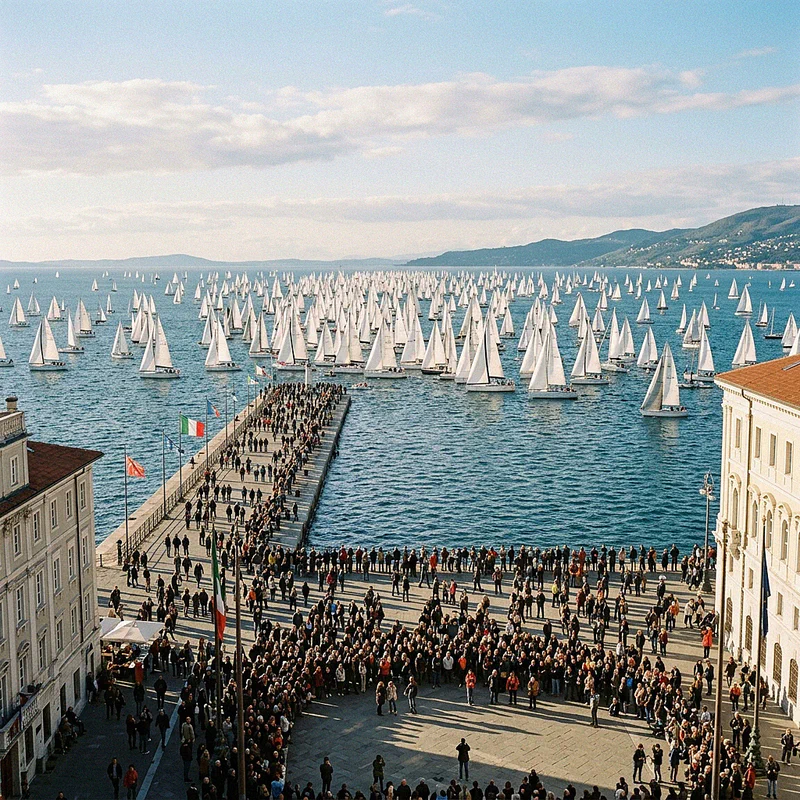
A Regatta for Everyone: From 1969 to Today#
It all kicked off with fifty-one boats. Back in October 1969, the Società Velica di Barcola e Grignano decided to host a simple end-of-season race. No one could’ve guessed that humble autumn cup would morph into a world-record-setting global phenomenon. Today, family-crewed cruisers line up alongside thirty-meter carbon tech-monsters at the same starting line. Sailing here truly unites souls.
The course stretches thirteen miles. The starting line sits between Barcola’s Riviera and the gleaming white Miramare Castle, perched on its promontory. Boats must round four buoys scattered across the gulf, tracing a quadrilateral that skims Slovenian waters before heading back. The finish, right in front of Piazza Unità d’Italia, offers a spectacular parade for those watching from shore. The finish line is a city-wide triumph.
Ditching the Crowds: The Napoleonic Lookout#
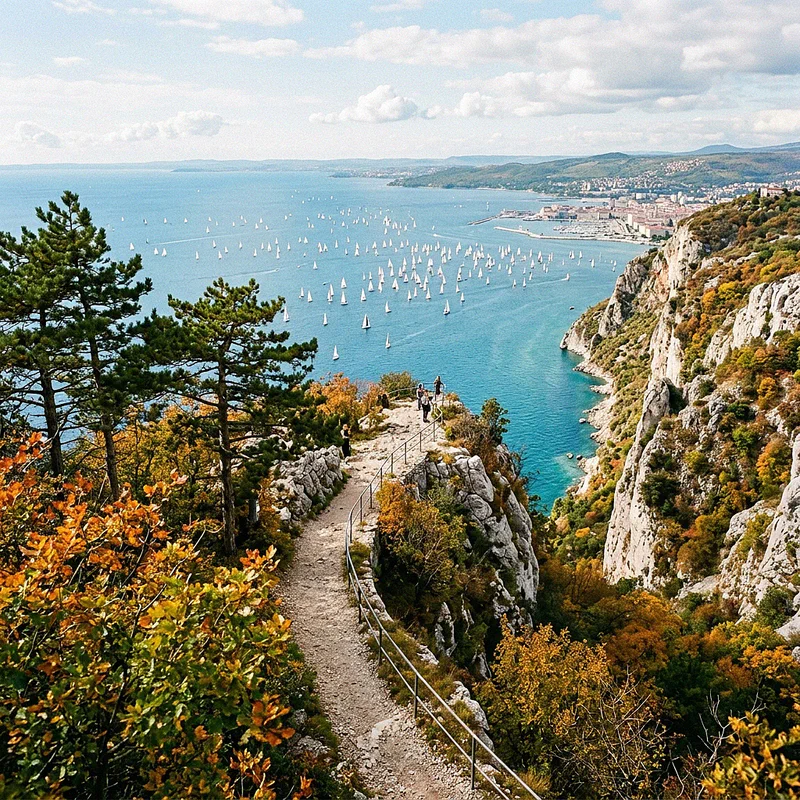
Skip the Rive’s Sunday morning crush. Instead, head up towards Prosecco and hit the Strada Napoleonica, a flat trail winding along the Carso’s edge. From here, the entire coastline unfolds into an incredible vista, with white sails looking like tiny confetti scattered across the blue water. You can walk in peace, surrounded by the scent of Scots pine and Carso rock warmed by the autumn sun. The silence up here is priceless.
The Rebechin Ritual at Historic Buffets#
This regatta works up an appetite for anyone. Head down into the city and duck into one of Trieste’s historic buffets for the traditional rebechin of hot meats. The sharp aroma of freshly grated kren (horseradish) mixes with thick steam rising from the pork boiler. Order a capo in b, the classic macchiato in a glass that locals sip at any hour. This is authentic Trieste.
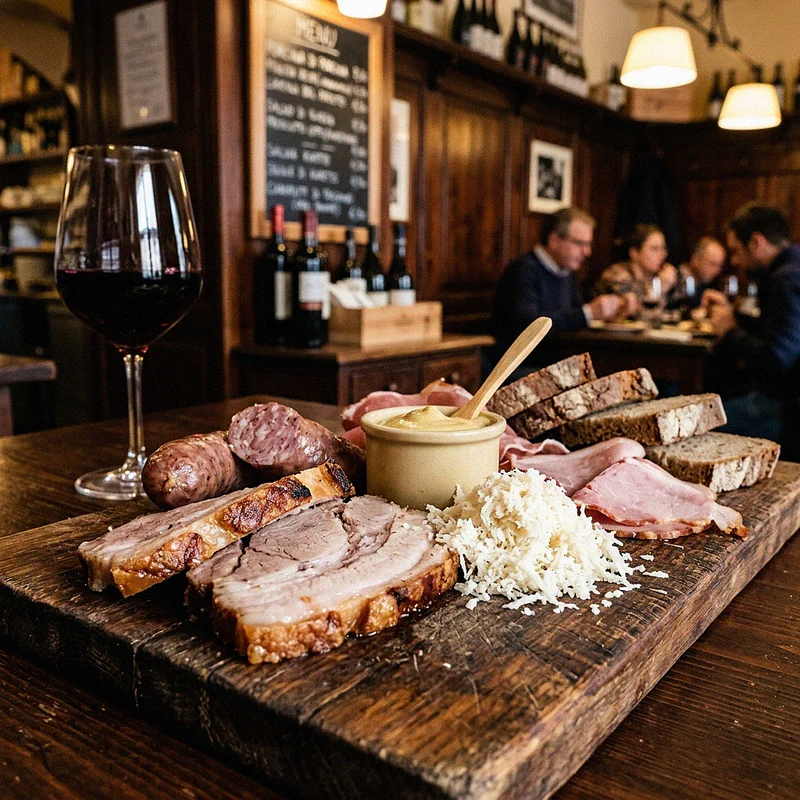
These dishes tell tales of Hapsburg roots. The counter displays hand-sliced hot hams, pickled tongues, Vienna sausages, and steaming bacon, all ready for the knife. Each bite comes with perfectly tart sauerkraut, a dollop of sweet mustard, and a shower of fresh horseradish that cleanses the palate. This isn’t Michelin-star fine dining; it’s pure soul food for the hungry explorer. Porcina here is sacred.
My First Barcolana: A Memory of Spray and Bora#
I still remember my first time on board. An old Triestine friend convinced me to hop on a small twelve-meter boat with no pretense of winning. I recall the tension building as we neared the starting line amidst a sea of sails that covered every horizon. The cannon’s roar was swallowed by crew shouts and waves slapping the hull. It was an unforgettable sea baptism.
Regattas aren’t just about technique and tactics. The real magic of Barcolana hits when you’re back on solid ground, soaked in salt and chilled by the rising Bora wind. In the alleyways behind Piazza Unità d’Italia, you’ll find impromptu osterias where everyone toasts together, no distinction between millionaire owners and simple enthusiasts. There, I shared a mug of Terrano wine with a Slovenian sailor who spoke only in gestures, yet we understood each other instantly. This festival breaks down every barrier.
Practical Survival Tips#
Driving here is pure madness. Ditch your car at the park-and-ride lots near the central station and move around solely on foot or by public transport. Remember, the Bora wind can kick up suddenly and fiercely, so always pack a sturdy windbreaker and protect your eyes. Molo Audace has no barriers, so be extra careful if you walk to the end during gusts. You can never be too cautious.
To completely escape the downtown crowds after the awards ceremony, seek out an open osmiza on the Carso. These temporary taverns, marked by an ivy branch along the road, offer hard-boiled eggs, homemade cured meats, and glasses of Terrano or Vitovska wine at local prices.
Beyond the Gulf’s Sails#
Trieste is just the start of the journey. If, after the gulf’s commotion, you crave historical calm, a short distance away lies a border transformed into a meeting point, as described in the Gorizia guide. The Friulian plain offers untouched rural landscapes and small villages preserving ancient cultural traditions. For those wanting to swap the sea horizon for forest trails and mountain gorges, exploring the region’s wilder valleys, illustrated in the Friuli valleys guide, is ideal. Let the road inspire you.
Hit the road and hoist your sails. Luca