
Forget seaside lounging; August in Apulia means red-stained hands and aching backs. I’m Giulia, and for me, summer isn’t a postcard sunset but the rhythmic, metallic clang of the tomato press echoing through every courtyard. The sun beats down on the white stone of the masserias, while the sharp scent of olive wood smoke clings to your clothes and won’t let go. If you’re looking for pure relaxation, stay far away from rural courts during this time. It’s brutal work, but without this ritual, winter would have no soul.
In Apulia, summer is measured in quintals of tomatoes piled in wooden crates that smell of earth and resin. It’s not a hobby for the faint of heart, but a general mobilization involving children, grandchildren, and neighbors. Watching those thousands of bright red fruits is almost hypnotic—a necessary sacrifice to fill the winter pantry. Call it a festival if you want, but here, we really sweat.
Update: Months after this fiery August, I wrote a guide for those who want to sleep right here, among the stunning Apulian masserias. If hunger strikes you now, I published an article in January 2026 on where to find the best orecchiette in Bari Vecchia.
More than just a preserve#
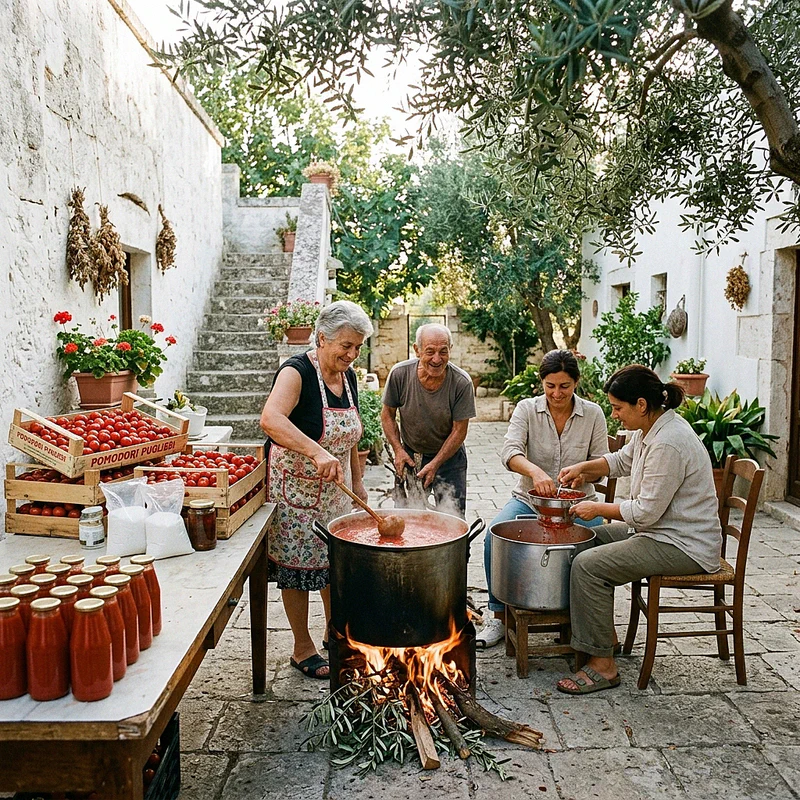
Making the bottles is an act of cultural resistance against supermarket mediocrity. When the thermometer hits forty degrees in the shade, the streets of our villages come alive with a frenzy that borders on madness. Vacations are planned around tomato ripening, not low-cost flights. Three generations gather under the same porch: children pluck green stems, and men feed the fires under the great cauldrons. In this apparent chaos, the only general who matters is Grandma.
Apulian grandmothers direct operations with a precision that would make a colonel blush. Don’t ask for exact doses, because “quanto basta” (as much as needed) is a secret they take to the grave. Each bottle is filled with quick movements, leaving the exact space for the vacuum to form. Miss a millimeter, and you’ll be banished from the kitchen forever.
The obsession with the right tomato#
The tomato waits for no one, and if it’s ready, you must be too. My grandmother repeated this like a mantra while checking the ripeness of the fiaschetto or San Marzano. We harvest them at dawn, when the dew is still fresh on the skin but the heart is already heavy with natural sugar. The quality of the Apulian soil is the only ingredient that truly matters at this stage. If the fruit is mediocre, the passata is an insult.
My real pet peeve is industrial passata that tastes like metal and chemical preservatives. We add nothing except a fresh basil leaf at the bottom of each bottle. If I see someone using sugar to “correct” the acidity, I literally lose my patience. The sun doesn’t need sugary corrections.
Sweat, smoke, and the tomato press#
Washing is a ritual of purification that admits no distractions. Every single tomato passes through your fingers to find even the smallest dark spot. A single spoiled fruit can ruin an entire cauldron, turning hours of work into an acidic disaster. Precision is our only defense against waste. A distracted check is an unforgivable mistake.
The aluminum “quadari” boil over fires fed by olive wood, spitting gray smoke into the still air. I still hear the hiss of boiling water mixed with the shouts of cousins unloading crates. Then comes the “spermitore”—that rhythmic noise that is the true soundtrack of our August. The passata comes out thick and velvety, a red that almost blinds you.
Sterilization is the final act, a moment of almost religious silence. We wrap the bottles in old burlap sacks to protect them from shocks during the final boil. They stay there cooling all night long, wrapped in woolen cloths like newborns. It’s here that time stops and summer is sealed away.
Update: Later on, I had the chance to explore another Apulian treasure that pairs divinely with this sauce: Altamura Bread.
Where to live the Red Gold experience#
If you want to see the real Apulia, follow the trail of tractors loaded with red. In Torre Guaceto, the fiaschetto is a sacred institution, and producers will show you the fields with a pride that is almost moving. The Capitanata, in the Foggia area, is an infinite expanse where red dominates the horizon as far as the eye can see. Among the trulli of the Itria Valley, the ritual takes place in stone courtyards that seem suspended in time. Everyone has their secret, but the passion is the same.
Grandma-approved tips (to avoid embarrassment)#
Always put the basil leaf at the bottom before pouring the tomato. Use only summer basil, washed with care and dried perfectly in the shade. Don’t even dare mention the powdered or dried kind from the supermarket. It is the aromatic soul of the bottle and deserves absolute respect. The wrong basil kills the poetry of the dish.
Be careful with the ZTL (Restricted Traffic Zone) if you decide to venture into the historic centers of Lecce or Bari to buy local products. Wild parking is a national sport here, but the fines are real and painful. Update: My colleague Marco later wrote an essential guide on how to avoid fines in Italy that you should read before you leave. A fine ruins even the best of dinners.
Making the bottles is exhausting work that leaves you dead tired and with marked hands. But when you open that glass in December to dress your orecchiette, you will feel all the heat of our land explode. In that first bite, you will finally understand why we are so stubborn in defending these labors. It’s the taste of real life, the kind that knows no shortcuts.
A presto e… buon appetito!
Giulia